
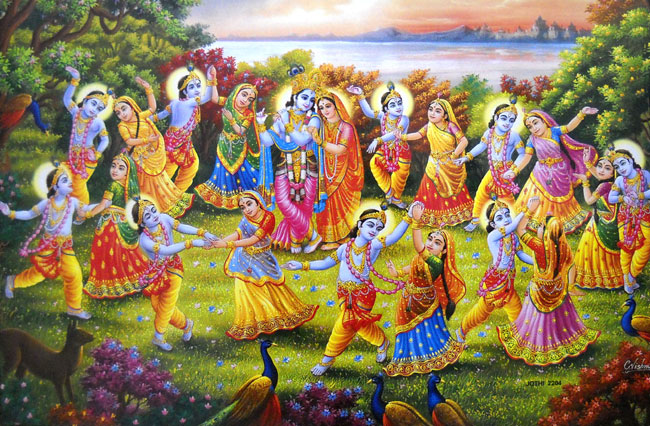
In the Srimad-Bhagavatam it is stated the rasa dance took place on the full moon night of the sarat season. From the statement of previous chapters, it appears that the festival of Govardhana Puja was performed just after the dark moon night of the month of Karttika, and thereafter the ceremony of Bhratrdvitiya was performed; then the wrath of Indra was exhibited in the shape of torrents of rain and hailstorm, and Lord Krsna held up Govardhana Hill for seven days, up until the ninth day of the moon. Thereafter, on the tenth day, the inhabitants of Vrndavana were talking amongst themselves about the wonderful activities of Krsna, and the next day, Ekadasi was observed by Nanda Maharaja. On the next day, Dvadasi, Nanda Maharaja went to take bath in the Ganges and was arrested by the men of Varuna; then he was released by Lord Krsna. Then Nanda Maharaja, along with the cowherd men, was shown the spiritual sky.
In this way, the full moon night of the sarat season came to an end. The full mmoon night of Asvina is called sarad-purnima. It appears from the statement of Srimad-Bhagavatam that Krsna had to wait another year for such a moon before enjoying the rasa dance with the gopis. At the age of seven years, He lifted Govardhana Hill. Therefore, the rasa dance took place during His eighth year.
From Vedic literature it appears that when a theatrical actor dances among many dancing girls, the group-dance is called a rasa dance. When Krsna saw the full moon night of the sarat season, He decorated Himself with various seasonal flowers, especially the mallika flowers, which are very fragrant, He remembered the gopis’ prayers to goddess Katyayani, wherein they prayed for Krsna to be their husband. He thought that the full night of the sarat season was just suitable for a nice dance. So their desire to have Krsna as their husband would then be fulfilled.
The words used in this connection in the Srimad-Bhagavatam arebhagavan api. This means that although Krsna is the Supreme Personality of Godhead, He has no desire that needs to be fulfilled because He is always full with six opulences yet He wanted to enjoy the company of the gopis. Bhagavan api signifies that this is not like the ordinary dancing of young boys and young girls. The specific word used in the Srimad-Bhagavatam is yogamayam upasritah, which means that this dancing with the gopis is on the platform of yogamaya, notmahamaya. The dancing of young boys and girls within this material world is in the kingdom of mahamaya, or the external energy. The rasadance of Krsna with the gopis is on the platform of yogamaya. The difference between the platform of yogamaya and mahamaya is compared in the Caitanya-caritamrta to the difference between gold and iron. From the viewpoint of metallurgy, gold and iron are both metals, but the quality is completely different. Similarly, although the rasa dance and Lord Krsna’s association with the gopis appear like the ordinary mixing of young boys and girls, the quality is completely different. The difference is appreciated by great Vaisnavas because they can understand the difference between love of Krsna and lust.
On the mahamaya platform, dances take place on the basis of sense gratification. But when Krsna called the gopis by sounding His flute, thegopis very hurriedly rushed towards the spot of rasa dance with the transcendental desire of satisfying Krsna. The author of Caitanya-caritamrta, Krsnadasa Kaviraja Gosvami, has explained that lust means sense gratification, and love also means sense gratification–but for Krsna. In other words, when activities are enacted on the platform of personal sense gratification, they are called material activities, but when they are enacted for the satisfaction of Krsna, then they are spiritual activities. On any platform of activities, the principle of sense gratification is there. But on the spiritual platform, sense gratification is for the Supreme Personality of Godhead, Krsna, whereas on the material platform it is for the performer. For example, on the material platform, when a servant serves a master, he is not trying to satisfy the senses of the master, but rather his own senses. The servant would not serve the master if the payment stopped. That means that the servant engages himself in the service of the master just to satisfy his senses. On the spiritual platform, the servitor of the Supreme Personality of Godhead serves Krsna without payment, and he continues his service in all conditions. That is the difference between Krsna consciousness and material consciousness.
It appears that Krsna enjoyed the rasa dance with the gopis when He was eight years old. At that time, many of the gopis were married, because in India, especially in those days, girls were married at a very early age. There are even many instances of a girl giving birth to a child at the age of twelve. Under the circumstances, all the gopis who wanted to have Krsna as their husband were already married. At the same time, they continued to hope that Krsna would be their husband. Their attitude toward Krsna was that of paramour love. Therefore, the loving affairs of Krsna with the gopis is called parakiya-rasa. A married man or a wife who desires another wife or husband is called parakiya-rasa.
Actually, Krsna is the husband of everyone because He is the supreme enjoyer. The gopis wanted Krsna to be their husband, but factually there was no possibility of His marrying all the gopis. But because they had that natural tendency to accept Krsna as their supreme husband, the relationship between the gopis and Krsna is called parakiya-rasa. Thisparakiya-rasa is ever-existent in Goloka Vrndavana in the spiritual sky where there is no possibility of the inebriety which characterizesparakiya-rasa in the material world. In the material world, parakiya-rasa is abominable, whereas in the spiritual world it is present in the superexcellent relationship of Krsna and the gopis. There are many other relationships with Krsna: master and servant, friends and friend, parent and son, and lover and beloved. Out of all these rasas, the parakiya-rasa is considered to be the topmost.
This material world is the perverted reflection of the spiritual world; it is just like the reflection of a tree on the bank of a reservoir of water: the topmost part of the tree is seen as the lowest part. Similarly, parakiya-rasa, when pervertedly reflected in this material world, is abominable. When people, therefore, imitate the rasa dance of Krsna with the gopis,they simply enjoy the perverted, abominable reflection of the transcendental parakiya-rasa. There is no possibility of enjoying this transcendental parakiya-rasa within the material world. It is stated inSrimad-Bhagavatam that one should not imitate this parakiya-rasaeven in dream or imagination. Those who do so drink the most deadly poison.
When Krsna, the supreme enjoyer, desired to enjoy the company of thegopis on that full moon night of the sarat season, exactly at that very moment, the moon, the lord of the stars, appeared in the sky, displaying its most beautiful features. The full moon night of the sarat season is the most beautiful night in the year. In Indian there is a great monument called Taj Mahal in Agra, a city in the Uttar Pradesh province, and the tomb is made of first-class marble stone. During the night of the full moon of thesarat season, many foreigners go to see the beautiful reflections of the moon on the tomb. Thus this full moon night is celebrated even today for its beauty.
When the full moon rose in the east, it tinged everything with a reddish color. With the rising of the moon, the whole sky appeared smeared by red kunkuma. When a husband long separated from his wife returns home, he decorates the face of his wife with red kunkuma. This long-expected moonrise of the sarat season was thus smearing the eastern sky.
The appearance of the moon increased Krsna’s desire to dance with thegopis. The forests were filled with fragrant flowers. The atmosphere was cooling and festive. When Lord Krsna began to blow His flute, the gopisall over Vrndavana became enchanted. Their attraction to the vibration of the flute increased a thousand times due to the rising full moon, the red horizon, the calm and cool atmosphere, and the blossoming flowers. All these gopis were by nature very much attracted to Krsna’s beauty, and when they heard the vibration of His flute, they became apparently lustful to satisfy the senses of Krsna.
Immediately upon hearing the vibration of the flute, they all left their respective engagements and proceeded to the spot where Krsna was standing. While they ran very swiftly, all their earrings swung back and forth. They all rushed toward the place known as Vamsivata. Some of them were engaged in milking cows, but they left their milking business half finished and immediately went to Krsna. One of them had just collected milk and put it in a milk pan on the oven to boil, but she did not care whether the milk overboiled and spilled–she immediately left to go see Krsna. Some of them were breast feeding their small babies, and some were engaged in distributing food to the members of their families, but they left all such engagements and immediately rushed towards the spot where Krsna was playing His flute. Some were engaged in serving their husbands, and some were themselves engaged in eating, but neither caring to serve their husbands nor eat, they immediately left. Some of them wanted to decorate their faces with cosmetic ointments and to dress themselves very nicely before going to Krsna, but unfortunately they could not finish their cosmetic decorations nor put on their dresses in the right way because of their anxiety to meet Krsna immediately. Their faces were decorated hurriedly and were haphazardly finished; some even put the lower part of their dresses on the upper part of their bodies and the upper part on the lower part.
While all the gopis were hurriedly leaving their respective places, their husbands, brothers and fathers were all struck with wonder to know where they were going. Being young girls, they were protected either by husbands, elderly brothers or fathers. All their guardians forbade them to go to Krsna, but they disregarded them. When a person becomes attracted by Krsna and is in full Krsna consciousness, he does not care for any worldly duties, even though very urgent. Krsna consciousness is so powerful that it gives everyone relief from all material activities. Srila Rupa Gosvami has written a very nice verse wherein one gopi advises another, “My dear friend, if you desire to enjoy the company of material society, friendship and love, then please do not go to see this smiling boy Govinda, who is standing on the bank of the Yamuna and playing His flute, His lips brightened by the beams of the full moonlight.” Srila Rupa Gosvami indirectly instructs that one who has been captivated by the beautiful smiling face of Krsna has lost all attraction for material enjoyments. This is the test of advancement in Krsna consciousness: a person advancing in Krsna consciousness must lose interest in material activities and personal sense gratification.
Some of the gopis were factually detained from going to Krsna by their husbands and were locked up by force within their rooms. Being unable to go to Krsna, they began to meditate upon His transcendental form by closing their eyes. They already had the form of Krsna within their minds. They proved to be the greatest yogis; as is stated in the Bhagavad-gita,a person who is constantly thinking of Krsna within his heart with faith and love is considered to be the topmost of all yogis. Actually, a yogiconcentrates his mind on the form of Lord Visnu. That is real yoga.Krsna is the original form of all Visnu tattvas. The gopis could not go to Krsna personally, so they began to meditate on Him as perfect yogis.
In the conditioned stage of the living entities, there are two kinds of results of fruitive activities: the conditioned living entity who is constantly engaged in sinful activities has suffering as his result, and he who is engaged in pious activities has material enjoyment as a result. In either case–material suffering or material enjoyment–the enjoyer or sufferer is conditioned by material nature.
The gopi associates of Krsna, who assembled in the place where Krsna is appearing, are from different groups. Most of the gopis are eternal companions of Krsna. As stated in the Brahma-samhita, ananda-cin-maya-rasa-pratibhavitabhih: in the spiritual world the associates of Krsna, especially the gopis, are the manifestation of the pleasure potency of Lord Krsna. They are expansions of Srimati Radharani. But when Krsna exhibits His transcendental pastimes within the material world in some of the universes, not only the eternal associates of Krsna come, but also those who are being promoted to that status from this material world. The gopis who joined Krsna’s pastimes within this material world were coming from the status of ordinary human beings. If they had been bound by fruitive action, they were fully freed from the reaction of karma by constant meditation on Krsna. Their severe painful yearnings caused by their not being able to see Krsna freed them from all sinful reactions, and their ecstasy of transcendental love for Krsna in His absence was transcendental to all their reactions of material pious activities. The conditioned soul is subjected to birth and death, either by pious or sinful activities, but the gopis who began to meditate on Krsna transcended both positions and became purified and thus elevated to the status of thegopis already expanded by His pleasure potency. All the gopis who concentrated their minds on Krsna in the spirit of paramour love became fully uncontaminated from all the fruitive reactions of material nature, and some of them immediately gave up their material bodies developed under the three modes of material nature.
Maharaja Pariksit heard Sukadeva Gosvami explain the situation of thegopis who assembled with Krsna in the rasa dance. When he heard that some of the gopis, simply by concentrating on Krsna as their paramour, became freed from all contamination of material birth and death, he said, “The gopis did not know that Krsna is the Supreme Personality of Godhead. They accepted Him as a beautiful boy and considered Him to be their paramour. So how was it possible for them to get freed from the material condition just by thinking of a paramour?” One should consider here that Krsna and ordinary living beings are qualitatively one. The ordinary living beings, being part and parcel of Krsna, are also Brahman, but Krsna is the Supreme–Parabrahman. The question is, If it is possible for the devotee to get free from the material, contaminated stage simply by thinking of Krsna, then why not others who are also thinking of someone? If one is thinking of a husband or son, or if anyone at all is thinking of another living entity, since all living entities are also Brahman, then why are they not all freed from the contaminated stage of material nature? This is a very intelligent question, because the atheists are always imitating Krsna. In these days of Kaliyuga, there are many rascals who think themselves to be as great as Krsna and who cheat people into believing that thinking of them is as good as thinking of Lord Krsna. Pariksit Maharaja, apprehending the dangerous condition of blind followers of demoniac imitators, therefore asked this question, and fortunately it is recorded in the Srimad-Bhagavatam to warn innocent people that thinking of an ordinary man and thinking of Krsna are not the same.
Actually, even thinking of the demigods cannot compare with thinking of Krsna. It is also warned in the Vaisnava Tantra that one who puts Visnu, Narayana, or Krsna on the same level of the demigods is called apasanda, or a rascal. On hearing this question of Maharaja Pariksit, Sukadeva Gosvami replied, “My dear King, your question is already answered, even before this incident.”
Because Pariksit Maharaja wanted to clear up the situation, his spiritual master answered him very intelligently, “Why are you again asking the same subject matter which has already been explained to you? Why are you so forgetful?” A spiritual master is always in the superior position, so he has the right to chastise his disciple in this way. Sukadeva Gosvami knew that Maharaja Pariksit asked the question not for his own understanding, but as a warning to the future innocent people who might think others to be equal to Krsna.
Sukadeva Gosvami then reminded Pariksit Maharaja about the salvation of Sisupala. Sisupala was always envious of Krsna, and because of his envy Krsna killed him. Since Krsna is the Supreme Personality of Godhead, Sisupala gained salvation simply by seeing Him. If an envious person can get salvation simply by concentrating his mind on Krsna, then what to speak of the gopis who are so dear to Krsna and always thinking of Him in love? There must be some difference between the enemies and the friends. If Krsna’s enemies could get freed from material contamination and become one with the Supreme, then certainly His dear friends like the gopis are freed and with Him.
Besides that, in the Bhagavad-gita Krsna is called Hrsikesa. Sukadeva Gosvami also said that Krsna is Hrsikesa, the Supersoul, whereas an ordinary man is a conditioned soul covered by the material body. Krsna and Krsna’s body are the same because He is Hrsikesa. Any person making a distinction between Krsna and Krsna’s body is fool number one. Krsna is Hrsikesa and Adhoksaja. These two particular words have been used by Pariksit Maharaja in this instance. Hrsikesa is the Supersoul, and Adhoksaja is the Supreme Personality of Godhead, transcendental to the material nature. Just to show favor to the ordinary living entities, out of His causeless mercy, He appears as He is. Unfortunately, foolish persons mistake Him to be another ordinary person, and so they become eligible to go to hell. Sukadeva Gosvami reconfirmed that Krsna is the Supreme Personality of Godhead, imperishable, immeasurable, and free from all material contamination.
Sukadeva Gosvami continued to inform Maharaja Pariksit that Krsna is not an ordinary person. He is the Supreme Personality of Godhead, full of all spiritual qualities. He appears in this material world out of His causeless mercy, and whenever He appears, He appears as He is without change. This is also confirmed in the Bhagavad-gita. There the Lord says that He appears in His spiritual potency. He does not appear under the control of this material potency. The material potency is under His control. In the Bhagavad-gita it is stated that the material potency is working under His superintendence. It is also confirmed in the Brahma-samhita that the material potency known as Durga is acting just as a shadow which moves with the movement of the substance. The conclusion is that if one somehow or other becomes attached to Krsna or attracted to Him, either because of His beauty, quality, opulence, fame, strength, renunciation or knowledge, or even through lust, anger or fear, or affection or friendship, then one’s salvation and freedom from material contamination is assured.
 Self Discovery