Vaikuntha Ekadasi Festival /Story of Vaikuntha Ekadashi

vaikuntha-ekadashi-vishnu

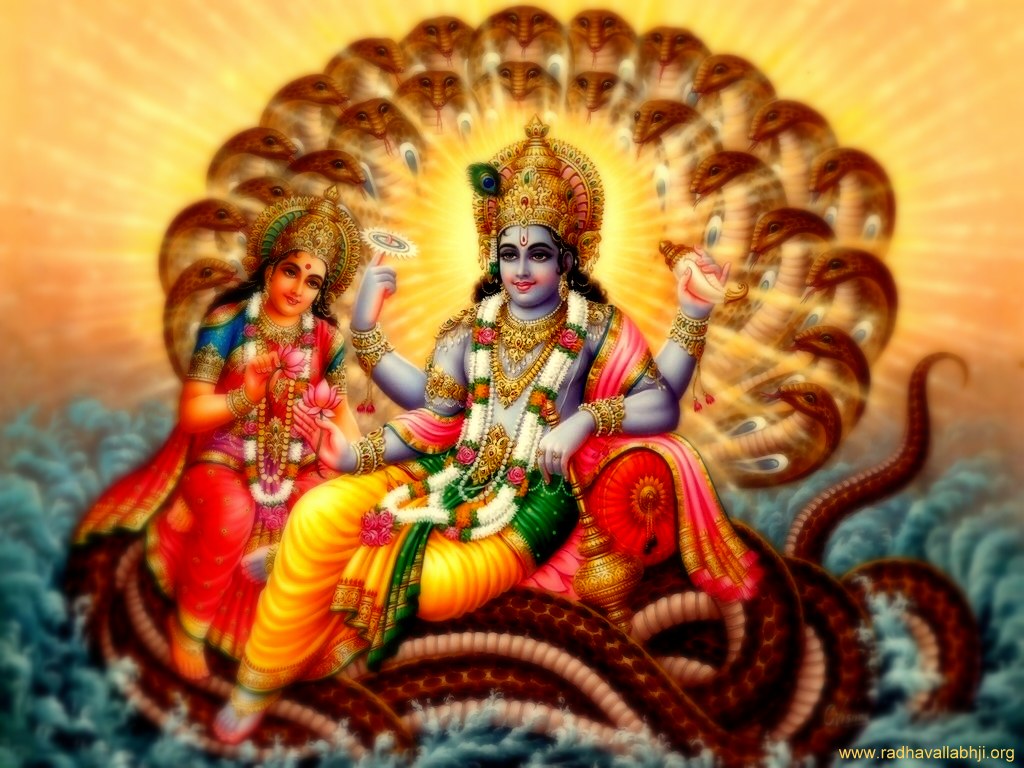
The month of Margashirsha (Dec-Jan) also known as Dhanur masa is of great importance to the devotees of Lord Krishna. Lord Krishna says in the Bhagavad-gita  masanam margasirso ham – of the months, I amMargashirsha. The Ekadashi, 11th day of the waxing moon of Margashirsha masa is popularly known asVaikuntha Ekadashi. This Ekadashi acquires significance because the great devotee Nammalwar, who comes in the disciplic succession of Sri Ramanuja, went back to Godhead on this day. Lord Vishnu, the Lord of Vaikuntha was at the door to receive His pure devotee. To commemorate this great event, generally all Vishnu temples create a Vaikuntha dwara – a special entrance – in the temple and the utsava Deities of the temple are installed near the dwara. It is said that anyone who passes through the Vaikuntha dwara is guaranteed to go back to Godhead.

Apart from this, Vaikuntha Ekadashi is the day on which the epic churning of the ocean of milk was completed by the demons and demigods and the proverbial nectar obtained. It was also on this day that Lord Krishna spoke the Bhagavad-gita to Arjuna on the battlefield of Kurukshetra.

Ekadashi and the killing of the demon Mura

The Padma Purana describes that once during the Krita (Satya) Yuga, a great demon, Mura attained immense powers by performing great austerities. The demigods were defeated by him and headed by Indra they took shelter of Lord Shiva, who guided them saying that Lord Vishnu alone could solve their tribulation. Accepting the prayers of the demigods, Lord Vishnu fought with Mura. During the long battle, which lasted one thousand celestial years, Vishnu needed to rest for a while. He also realized that Mura could not be destroyed by His conventional ayudhas, and needed a different ayudha, one against which Mura would be vulnerable. He entered a beautiful cave called Himavati in Badarikashrama to rest, and formed the new ayudha. Mura wanted to strike Vishnu while He was sleeping. However, Vishnu made Shakti (Vishnu’s female energy) emerge out of His body and assume the form of a beautiful damsel who fought Mura and reduced him to ashes with one look.

When Vishnu awoke He was very pleased and named this maiden as Ekadashi and granted her a boon. The maiden said, “O Lord, if You are pleased with me and wish to give me a boon, then give me the power to deliver people from the greatest sins if they fast on this day.” Vishnu granted her the boon and declared that people worshipping her would reach Vaikuntha. Thus, it is said, was born the first Ekadashi, which was aDhanur masa shukla paksha Ekadashi.

One earthly year corresponds to one day in deva loka. The earthly year is divided into two parts based on the transit of Sun. The northerly transit of the Sun is called Uttarayana. This corresponds to the calendar months from January to June and lunar months from Margashirsha masa to Ashada masa. The southern transit of the Sun is termed as Dakshinayana which corresponds to the calendar months from June to December. For the heavenly planets Uttarayana corresponds to the day and Dakshinayana to the night. Margashirsha masa,which generally falls in last month of Dakshinayana corresponds to the pre-dawn and during the 11th day of lunar month (Ekadashi), is the time when the dawn just about begins. Hence it is considered auspicious for the propitiation of the supreme Lord Vishnu, as He appears to the denizens of heaven and blesses them.

How is Vaikunta Ekadasi Celebrated?  (by: Surya Prakash Rao vadlamani Venkata)

It is believed that the gates of the heaven- the Gate of Vaikunta open on the Vaikunta Ekadasi day. Temples prepare what is called as ‘Vaikunta Dwaram’ or ‘the gate to the heaven‘ and This gate is opened on this day. In all Vaishnava temples, the northern doors remains open on this day and it is on this day, devotees visit the Lord through this northern entrance.

Fasting is an important aspect of Vaikunta ekadasi and is believed to help in redemption of sins and in attaining Moksha. devotees who observe fast on Vaikunta Ekadashi attain salvation by going to Heaven. people fast for the whole day and maintain vigil. Rice is not eaten on this day.it is believed that demon Muran dwells in the rice and eating of rice could get one feel heavy and hamper the vigil to be kept up. People visit temples offer prayers to Lord Vishnu.

Vaikunta Ekadasi festival is more elaborately celebrated by Vaishnavites. This festival is celebrated with lot of fervour at Vishnu temples in Tamil Nadu, Andhra Pradesh, Kerala and Karnataka. Vaikunta Ekadashi is very important day and celebrated with utmost fervour and devotion in Tirumala Venkateswara Temple at Tirupati, Sri Ranganathaswamy Temple at Srirangam and in Trivandrum Padmanabha Swamy temple.

Source:  Glories of Ekadashi by A. C. Bhaktivedanta Swami Prabhupada

“Jai Shri RadheKrishna”

Sri Radhika – Radharani

RadhaRani

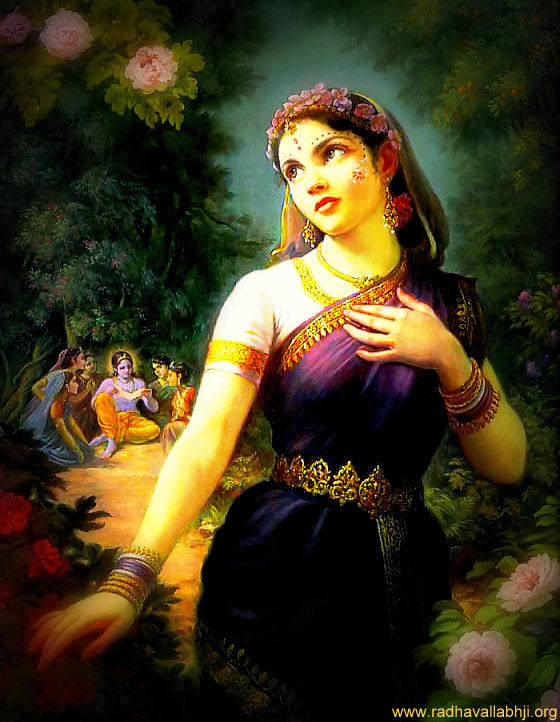
Among all the beautiful gopis Srimati Radharani is the best. Radharani is the queen of Vrndavana. She has many famous friends, headed by Lalita and Visakha.

Sri Krsna, the cowherd prince whose charming sweetness has no equal or superior, is very dear to Srimati Radharani. She considers Him millions and millions of times more dear than Her own life’s breath.

Now the beauty of Srimati Radharani’s trancendental form will be described. Srimati Radharani is expert in all the fine arts and Her transcendental form is like an ocean of nectar. Her splendid bodily luster is like the yellow pigment gorocana, molten gold, or stationary lightning. She wears wonderfully beautiful blue garments and She is decorated with various pearls and flowers.

She is very beautiful and She has long nicely braided hair. She is decorated with a garland of flowers and a beautiful pearl necklace. Her splendid forehead is decorated with the red pigment sindura and with beautiful locks of curling hair.

Decorated with blue bangles, Her arms have defeated Cupid’s staff with their beauty. Decorated with black mascara and reaching back almost to Her ears, Srimati Radharani’s lotus eyes are the most beautiful in all the three planetary systems. Her nose is as beautiful as a sesame flower and it is nicely decorated with a pearl. She is anointed with various perfumes. She is splendidly beautiful.

Her ears are decorated with wonderful earrings and Her nectarean lips defeat the red lotus flowers. Her teeth are like a row of pearls and Her tongue is very beautiful. Decorated with a nectarean smile of pure love for Krsna, Her beautiful face is a splendid as millions of moons.

The beauty of Her chin has defeated and bewildered the demigod Cupid. Decorated with a drop of musk, Her chin appears like a golden lotus flower with a bumblebee. Bearing all the marks of wonderful beauty, Her neck is decorated with a string of pearls. Her neck, back and sides are enchantingly beautiful.

Her beautiful breasts are like two splendid waterpots covered with a bodice and decorated with a necklace of pearls. Her beautiful enchanting arms are decorated with jeweled armlets. Her arms are also decorated with jeweled bracelets and other kinds of jeweled ornaments. Her hands are like two red lotus flowers illuminated by the series of moons that are Her fingernails

Srimati Radharani’s hands are decorated with many auspicious markings such as the signs of the bumblebee, lotus, crescent moon, earring, parasol, sacrificial post, conchshell, tree, flower, camara and svastika. These auspicious marks are manifest in various ways on Srimati Radharani’s lotus hands. Her splendidly beautiful fingers are also decorated with jeweled rings.

Charming, full of sweet nectar and decorated with a deep navel, Srimati Radharani’s beautiful waist enchants the three worlds. Her sloping hips lead to Her charmingly beautiful slender waist, which is bound by a creeper of three beautiful folds of skin and decorated with a sash of tinkling bells.

As beautiful as two exquisite plantain trees, Her thighs enchant the mind of Cupid. Her beautiful knees are like two reservoirs filled with the nectar of various transcendental pastimes. Her beautiful lotus feet are decorated with jeweled ankle-bells and Her toes with toe rings as beautiful as the treasure of Varuna. The auspicious markings on Srimati Radharani’s lotus feet include the signs of the conchshell, moon, elephant, barleycorn, rod for controlling elephants, chariot flag, small drum, svastika and fish.

Srimati Radharani is fifteen years old and full of the luster of youth.

Yasoda-devi, the queen of the cowherds, is more affectionate to Radharani than millions of mothers can be. Radharani’s father is King Vrsabhanu, who is as splendid as the sun.

Srimati Radharani’s mother is Kirtida-devi, who is also known in this world as Ratnagarbha-devi. Radharani’s paternal grandfather is Mahibhanu and Her maternal grandfather is Indu.

Her maternal grandmother is Mukhara-devi and Her paternal grandmother is Sukhada-devi. Her father’s brothers (Her uncles) are RatnabhanuSubhanu and Bhanu.

BhadrakirtiMahakirti and Kirticandra are Radharani’s materal uncles. Menaka-devi, Sasthi-devi, Gauri-devi, Dhatri-devi and Dhataki-devi are Radharani’s materal aunts.

Radharani’s mother’s sister is Kirtimati-devi, whose husband is Kasa. Radharani’s father’s sister is Bhanumudra-devi, whose husband is Kusa.

Radharani’s elder brother is Sridama and Her younger sister is Ananga-manjari. Radharani’s father-in-law isVrkagopa and Her brother-in-law is Durmada.

Jatila-devi is Radharani’s mother-in-law and Abhimanyu is Radharani’s so-called husband. Kutila-devi, who is always eager to find fault, is Radharani’s sister-in-law.

Lalita, Visakha, Sucitra, Campakalata, Ranga-devi, Sudevi, Tungavidya and Indulekha are the eight dearest friends of Srimati Radharani. These gopis are considered the leaders of all the others.

Kurangaksi, Mandali, Mankiundala, Matali, Candralalita, Madhavi, Madanalasa, Manjumedha, Sasikala, Sumadhya, Madhureksana, Kamala, Kamalatika, Gunacuda, Varangada, Madhuri, Candrika, Prema-manjari, Tanumadhyama, Kandarpa-sundari and Manjukesi are among the millions of dear friends (priya-sakhi) of Srimati Radharani.

Lasika, Kelikandali, Kadambari, Sasimukhi, Candrarekha, Priyamvada, Madonmada, Madhumati, Vasanti, Kalabhasini, Ratnavali, Manimati and Karpuralatika are among those friends (jivita-sakhi) for whom Srimati Radharani is as dear as life.

Kasturi, Manojna, Manimanjari, Sindura, Candanavati, Kaumudi and Madira are among Sriamti Radharani’s eternal friends (nitya-sakhi).

Ananga-manjari, Rupa-manjari, Rati-manjari, Lavanga-manjari, Raga-manjari, Rasa-manjari, Vilasa-manjari, Prema-manjari, Mani-manjari, Suvarna-manjari, Kama-manjari, Ratna-manjari, Kasturi-manjari, Gandha-manjari, Netra-manjari, Sripadma-manjari, Lila-manjari and Hema-manjari are among Srimati Radharani’s manjari friends. Prema-manjari and Rati-manjari are both also known by the name Bhanumati-devi.

Srimati Radharani’s worshipable deity is the sun-god, who enlivens the lotus flowers and acts as an eye for the entire world. Srimati Radharani’s maha-mantra is the name of Lord Krsna. Srimati Radharani’s benefactor, who brings Her all good fortune, is Bhagavati Paurnamasi.

In Radharani’s garden is a vine of golden jasmine flowers that She has named Tadidvalli (“the vine of lightning”). Her private lake bears Her own name (Radha-kunda) and on the shore of that lake is a kadamba tree that is the site of very confidential talks between Her and Lord Krsna.

Her favorite ragas are mallara and dhanasri and Her favorite dances are chalikya and rudravallaki.

Srimati Radharani’s glorious birth occured on the eighth day of the bright moon in the month of Bhadra. Although generally not full on that day, the moon appeared full to celebrate Radharani’s appearance in this world. (SSRKGD)

Sri Caitanya Mahaprabhu is Sri Krsna, the Supreme Personality of Godhead. It is therefore said, sri-krsna-caitanya, radha-krsna nahe anya: “Two personalities–Srimati Radharani and Sri Krsna–are combined in the incarnation of Sri Caitanya Mahaprabhu.” (CC Madhya 5.142-143p)

In Brhad-gautamiyatantra it is said: Sri Radha is known as Devi, Krsnamayi, Supreme Goddess in whom all Laksmis reside; Her beauty and charm defeat that of all others.

In a supplement to the Rg-veda it is said: Among all people, Radhika and Madhava together are the most beautiful. In the Matsya-purana: In Varanasi, She is known as Sri Visalaksi, and in Purusottama-ksetra, She is called Sri Vimala. In Dvaraka, She is Sri Rukmini, and as the queen of the Vrndavana forest, She is called Sri Radha.

In the Ujjvala-nilamani, a statement taken from the Padma-purana says: Just as Sri Radha is the most beloved of Sri Krsna, similarly Sri Radha-kunda is also very dear. Among all the gopis, Sri Radha is the dearest lover of Sri Krsna.

In the Radha-prakarana of Ujjvala-nilamani it is said: Sri Radhika’s body is composed of maha-bhava. The greatest of all saktis is the hladini-sakti. Therefore it is called maha-sakti. Of that, the essence is madana, which is the zenith of maha-bhava. Sri Radha is the embodiment of that highest maha-bhava. This conclusion is well established.

In the Gopalottara-tapani, She is glorified as Gandharva. This daughter of Vrsabhanu has a very beautiful form and wears 16 items of beautification (srngara) and 12 types of ornaments (abharana).

An example concerning Her beautiful form is given in Ujjvala-nîlamani, wherein Sri Krsna says, “O Radhe! The locks of Your hair curl beautifully, and You have a lotus-like face with elongated restless eyes. Your chest is adorned with lovely large and firm breasts. Your waist is attractively slender, Your head is bowed slightly in modesty, and Your fingernails are like rows of jewels. Your beautiful form is a festival of elegance and sweetness that crushes the vanity of the three worlds.”

Concerning Her sixteen items of beautification, Subala says to Sri Krsna, “After bathing, Sri Radhika decorates the tip of Her nose with an effulgent jewel. She dresses in blue clothing, with a sash (nivibandhana) around Her waist. Her hair is plaited and She wears ornaments on Her ears. Her limbs are smeared with camphor, musk and sandal paste. She wears flowers in Her hair and a garland around Her neck. In Her hand She playfully carries a lotus flower. In Her mouth She has tambula, and on Her chin a dot of musk. She wears kajjala around Her eyes and on Her cheeks are muskpaintings of dolphins, etc. The bottoms of Her lotus feet are painted red and She wears tilaka on Her forehead.”

Concerning Her twelve ornaments, Subala says, “Sri Radhika wears a diamond on Her head, golden earrings on Her ears, and tiny golden bells around Her hips. A golden locket hangs around Her neck. She wears a cakri-salaka (an elaborate ornament that encircles the entire ear and fastens at the top) over Her ears, bangles on Her hands, and a necklace around Her throat. There are rings on Her fingers and a group of star-like necklaces on Her bosom. She is adorned with jewelled armlets, jewelled ankle bells and radiant toe rings. She is very beautiful wearing these twelveornaments.”

Sri Radha’s age is in the middle of the kaisora period. Just as previously, Krsna’s age was increased by half again, so Radha’s age is increased to 14 years, 2 months and 15 days. She has a strong feeling that Krsna belongs to Her (madiyata-bhava), as well as madhu-sneha (a very sweet affectionate mood). Her love for Krsna is pure, powerful and lasting, and She has various kunjas for Her pastimes with Him. Her home is in Yavatagrama, Her mother’s name is Kirtida, and Her father’s Vrsabhanu. Her husband’s name is AbhimanyuDurmukha is Her brother-in-law,Jatila is Her mother-inlaw, and Kutila is Her sister-in-law. Just as Sri Krsna always exists as the nayaka (heroiclover), Sri Radhika is forever the principal nayika (heroine).

Sri Radha’s sakhis are of five types: sakhi, nitya-sakhi, prana-sakhi, priya-sakhi, and parama-prestha-sakhi.KusumikaVindhyaDhanistha and others are known as sakhis. KasturikaMani Manjari, etc., are known asnitya-sakhisSasimukhiVasantiLasika, etc., are known as prana-sakhis. These gopis usually have forms (or natures) similar to Sri Radha. KurangaksiSumadhyaMadanalasaKamalaMadhuriManjukesi,Kandarpasundari, MadhaviMalatiKamalata and Sasikala, etc., are priya-sakhis. LalitaVisakhaCitra,CampakalataTungavidyaIndulekhaRangadevi and Sudevi are the parama-prestha-sakhis. These eightgopis are chief amongst them all. They are worthy of being yuthesvaris (group leaders) themselves, but because they love Radha so much, they would rather be Her sakhis. 

Source: http://www.vrindavan.de/radha.htm

“Jai Shri RadheKrishna”

Meeting of Nanda & Vasudeva

vasudeva

Although Krsna was the real son of Vasudeva and Devaki, because of Kamsa’s atrocious activities Vasudeva could not enjoy the birth ceremony of his son. But Nanda Maharaja, the foster father, celebrated the birth ceremony of Krsna very joyfully. The next day, it was declared that a male child was born of Yasoda. According to Vedic custom, Nanda Maharaja called for learned astrologers andbrahmanas to perform the birth ceremony. After the birth of a child, the astrologers calculate the moment of the birth and make a horoscope of the child’s future life. Another ceremony takes place after the birth of the child: the family members take baths, cleanse themselves and decorate themselves with ornaments and garlands; then they come before the child and the astrologer to hear of the future life of the child. Nanda Maharaja and other members of the family dressed and sat down in front of the birthplace. All the brahmanas who were assembled there on this occasion chanted auspicious mantras,according to the rituals, while the astrologers performed the birth ceremony. All the demigods are also worshiped on this occasion, as well as the forefathers of the family. Nanda Maharaja distributed 200,000 well decorated, dressed and ornamented cows to the brahmanas. He not only gave cows in charity, but hills of grains, decorated with golden-bordered garments and many ornaments.

In the material world we possess riches and wealth in many ways, but sometimes not in very honest and pious ways, because that is the nature of accumulating wealth. According to Vedic injunction, therefore, such wealth should be purified by giving cows and gold in charity to thebrahmanas. A newborn child is also purified by giving grains in charity to the brahmanas. In this material world it is to be understood that we are always living in a contaminated state. We therefore have to purify the duration of our lives, our possession of wealth and ourselves. The duration of life is purified by taking daily bath and cleansing the body inside and outside and accepting the ten kinds of purificatory processes. By austerities, by worship of the Lord, and by distribution of charity, we can purify the possession of wealth. We can purify ourselves by studying the Vedas, by striving for self-realization and by understanding the Supreme Absolute Truth. It is therefore stated in the Vedic literature that by birth everyone is born a sudra, and by accepting the purificatory process one becomes twice-born. By studies of the Vedas one can become vipra, which is the preliminary qualification for becoming abrahmana. When one understands the Absolute Truth in perfection, he is called a brahmana. And when the brahmana reaches further perfection, he becomes a Vaisnava or a devotee.

In that ceremony, all the brahmanas assembled began to chant different kinds of Vedic mantras to invoke all good fortune for the child. There are different kinds of chanting known as suta, magadha, vandi andvirudavali. Along with this chanting of mantras and songs, bugles and kettledrums sounded outside the house. On this occasion, the joyous vibrations could be heard in all the pasturing grounds and all the houses. Within and outside of the houses there were varieties of artistic paintings, done with rice pulp, and scented water was sprinkled everywhere, even on the roads and streets. Ceilings and roofs were decorated with different kinds of flags, festoons and green leaves. The gates were made of green leaves and flowers. All the cows, bulls and calves were smeared with a mixture of oil and turmeric and painted with minerals like red oxide, yellow clay and manganese. They wore garlands of peacock feathers and were covered with nice colored dresses and gold necklaces.

When all the ecstatic cowherd men heard that Nanda Maharaja, father of Krsna, was celebrating the birth ceremony of his son, they became spontaneously joyful. They dressed themselves with very costly garments and ornamented their bodies with different kinds of earrings and necklaces and wore great turbans on their heads. After dressing themselves in this gorgeous way, they took various kinds of presentations and thus approached the house of Nanda Maharaja.

As soon as they heard that mother Yasoda had given birth to a child, all the cowherd women became overwhelmed with joy, and they also dressed themselves with various kinds of costly garments and ornaments and smeared scented cosmetics on their bodies.

As the dust on the lotus flower exhibits the exquisite beauty of the flower, all the gopis (cowherd girls) applied the dust of kunkuma on their lotus-like faces. These beautiful gopis took their different presentations and very soon reached the house of Maharaja Nanda. Overburdened with their heavy hips and swollen breasts, the gopis could not proceed very quickly towards the house of Nanda Maharaja, but out of ecstatic love for Krsna they began to proceeded as quickly as possible. Their ears were decorated with pearl rings, their necks were decorated with jewel padlocks, their lips and eyes were decorated with different kinds of lipstick and ointment, and their hands were decorated with nice golden bangles. As they were very hastily passing over the stone road, the flower garlands which were decorating their bodies fell to the ground, and it appeared that a shower of flowers was falling from the sky. From the movement of the different kinds of ornaments on their bodies, they were looking still more beautiful. In this way, they all reached the house of Nanda-Yasoda and blessed the child: “Dear child, You live long just to protect us.” While they were blessing child Krsna in this way, they offered a mixture of turmeric powder with oil, yogurt, milk and water. They not only sprinkled this mixture on the body of child Krsna but on all other persons who were present there. Also on that auspicious occasion, there were different bands of expert musicians playing.

When the cowherd men saw the pastimes of the cowherd women, they became very joyful, and in response they also began to throw yogurt, milk, clarified butter and water upon the bodies of the gopis. Then both parties began to throw butter on each other’s bodies. Nanda Maharaja was also very happy to see the pastimes of the cowherd men and women, and he became very liberal in giving charity to the different singers who were assembled there. Some singers were reciting great verses from theUpanisads and Puranas, some were glorifying the family ancestors, and some were singing very sweet songs. There were also many learnedbrahmanas present, and Nanda Maharaja, being very satisfied on this occasion, began to give them different kinds of garments, ornaments, and cows in charity.

It is very important to note in this connection how wealthy the inhabitants of Vrndavana were simply by raising cows. All the cowherd men belonged to the vaisya community, and their business was to protect the cows and cultivate crops. By their dress and ornaments and by their behavior, it appears that although they were in a small village, they still were rich in material possessions. They possessed such an abundance of various kinds of milk products that they were throwing butter lavishly on each other’s bodies without restriction. Their wealth was in milk, yogurt, clarified butter and many other milk products, and by trading their agricultural products, they were rich in various kinds of jewelry, ornaments and costly dresses. Not only did they possess all these things, but they could give them away in charity, as did Nanda Maharaja.

Thus Nanda Maharaja, the foster father of Lord Krsna, began to satisfy the desires of all the men assembled there. He respectfully received them and gave them in charity whatever they desired. The learned brahmanas,who had no other source of income, were completely dependent on thevaisya and ksatriya communities for their maintenance, and they received gifts on such festive occasions as birthdays, marriages, etc. While Nanda Maharaja was worshiping Lord Visnu on this occasion and was trying to satisfy all the people there, his only desire was that the newborn child Krsna would be happy. Nanda Maharaja had no knowledge that this child was the origin of Visnu, but he was praying to Lord Visnu to protect Him.

Rohinidevi, mother of Balarama, was the most fortunate wife of Vasudeva. She was away from her husband, yet just to congratulate Maharaja Nanda on the occasion of the birth ceremony of his son, Krsna, she dressed herself very nicely. Wearing a garland, a necklace and other bodily ornaments, she appeared on the scene and moved hither and thither. According to the Vedic system, a woman whose husband is not at home does not dress herself very nicely. But although Rohini’s husband was away, she still dressed herself on this occasion.

From the opulence of the birth ceremony of Krsna, it is very clear that at that time Vrndavana was rich in every respect. Because Lord Krsna took birth in the house of King Nanda and mother Yasoda, the goddess of fortune was obliged to manifest her opulences in Vrndavana. It appeared that Vrndavana had already become a site for the pastimes of the goddess of fortune.

After the birth ceremony, Nanda Maharaja decided to go to Mathura to pay the annual tax to the government of Kamsa. Before leaving, he called for the able cowherd men of the village and asked them to take care of Vrndavana in his absence. When Nanda Maharaja arrived in Mathura, Vasudeva got the news and was very eager to congratulate his friend. He immediately went to the place where Nanda Maharaja was staying. When Vasudeva saw Nanda, he felt that he had regained his life. Nanda, overwhelmed with joy, immediately stood up and embraced Vasudeva. Vasudeva was received very warmly and offered a nice place to sit. At that time Vasudeva was anxious about his two sons who had been put under the protection of Nanda without Nanda’s knowledge. With great anxiety, Vasudeva inquired about Them. Both Balarama and Krsna were the sons of Vasudeva. Balarama was transferred to the womb of Rohini, Vasudeva’s own wife, but Rohini was kept under the protection of Nanda Maharaja. Krsna was personally delivered to Yasoda and exchanged with her daughter. Nanda Maharaja knew that Balarama was the son of Vasudeva, although he did not know that Krsna was also Vasudeva’s son. But Vasudeva was aware of this fact and inquired very eagerly about Krsna and Balarama.

Vasudeva then addressed him, “My dear brother, you were old enough and very anxious to beget a son, and yet you had none. Now by the grace of the Lord you are fortunate to have a very nice son. I think that this incident is very auspicious for you. Dear friend, I was imprisoned by Kamsa, and now I am released; therefore this is another birth for me. I had no hope of seeing you again, but by God’s grace I can see you.” Vasudeva then expressed his anxiety about Krsna. Krsna was sent incognito to the bed of mother Yasoda, and after very pompously celebrating His birth ceremony, Nanda went to Mathura. So Vasudeva was very pleased and said, “This is a new birth for me.” He never expected that Krsna would live because all his other sons were killed by Kamsa.

Vasudeva continued, “My dear friend, it is very difficult for us to live together. Although we have our family and relatives, sons and daughters, by nature’s way we are generally separated from one another. The reason for this is that every living entity appears on this earth under different pressures of fruitive activities; although they assemble together, there is no certainty of their remaining together for a long time. According to one’s fruitive activities, one has to act differently and thereby be separated. For example, many plants and creepers are floating on the waves of the ocean. Sometimes they come together and sometimes they separate forever: one plant goes one way and another plant goes another. Similarly, our family assembly may be very nice while we are living together, but after some time, in the course of the waves of time, we are separated.”

The purport of this expression by Vasudeva is this: although he had eight sons born in the womb of Devaki, unfortunately they were all gone. He could not even keep his one son Krsna with him. Vasudeva was feeling His separation, but he could not express the real fact. “Please tell me about the welfare of Vrndavana,” he said. “You have many animals–are they happy? Are they getting sufficient grass and water? Please also let me know whether the place where you are now living is undisturbed and peaceful.” This inquiry was made by Vasudeva because he was very anxious about Krsna’s safety. He knew that Kamsa and his followers were trying to kill Krsna by sending various kinds of demons. They had already resolved that all children born within ten days of the birthday of Krsna should be killed. Because Vasudeva was so anxious about Krsna, he inquired about the safety of His residence. He also inquired about Balarama and His mother Rohini, who were entrusted to the care of Nanda Maharaja. Vasudeva also reminded Nanda Maharaja that Balarama did not know His real father. “He knows you as His father. And now you have another child, Krsna, and I think you are taking very nice care for both of Them.” It is also significant that Vasudeva inquired about the welfare of Nanda Maharaja’s animals. The animals, and especially the cows, were protected exactly in the manner of one’s children. Vasudeva was a ksatriya, and Nanda Maharaja was a vaisya. It is the duty of theksatriya to give protection to the citizens of mankind, and it is the duty of the vaisyas to give protection to the cows. The cows are as important as the citizens. Just as the human citizens should be given all kinds of protection, so the cows also should be given full protection.

Vasudeva continued to say that the maintenance of religious principles, economic development and the satisfactory execution of meeting the demands of the senses depend on cooperation among relatives, nations and all humanity. Therefore, it is everyone’s duty to see that his fellow citizens and the cows are not put into difficulty. One should see to the peace and comfort of his fellow man and the animals. The development of religious principles, economic development and sense gratification can then be achieved without difficulty. Vasudeva expressed his sorrow due to not being able to give protection to his own sons born of Devaki. He was thinking that religious principles, economic development and the satisfaction of his senses were therefore all lost.

On hearing this, Nanda Maharaja replied, “My dear Vasudeva, I know that you are very much aggrieved because the cruel king Kamsa has killed all your sons born of Devaki. Although the last child was a daughter, Kamsa could not kill her, and she has entered into the celestial planets. My dear friend, do not be aggrieved; we are all being controlled by our past unseen activities. Everyone is subjected to his past deeds, and one who is conversant with the philosophy of karma and its reaction is a man in knowledge. Such a person will not be aggrieved at any incident, happy or miserable.”

Vasudeva then replied, “My dear Nanda, if you have already paid the government taxes, then return soon to your place, because I think that there may be some disturbances in Gokula.”

After the friendly conversation between Nanda Maharaja and Vasudeva, Vasudeva returned to his home. The cowherd men headed by Nanda Maharaja, who had come to Mathura to pay their taxes, also returned.

Source:  Krsna by A. C. Bhaktivedanta Swami Prabhupada

“Jai Shri RadheKrishna”