
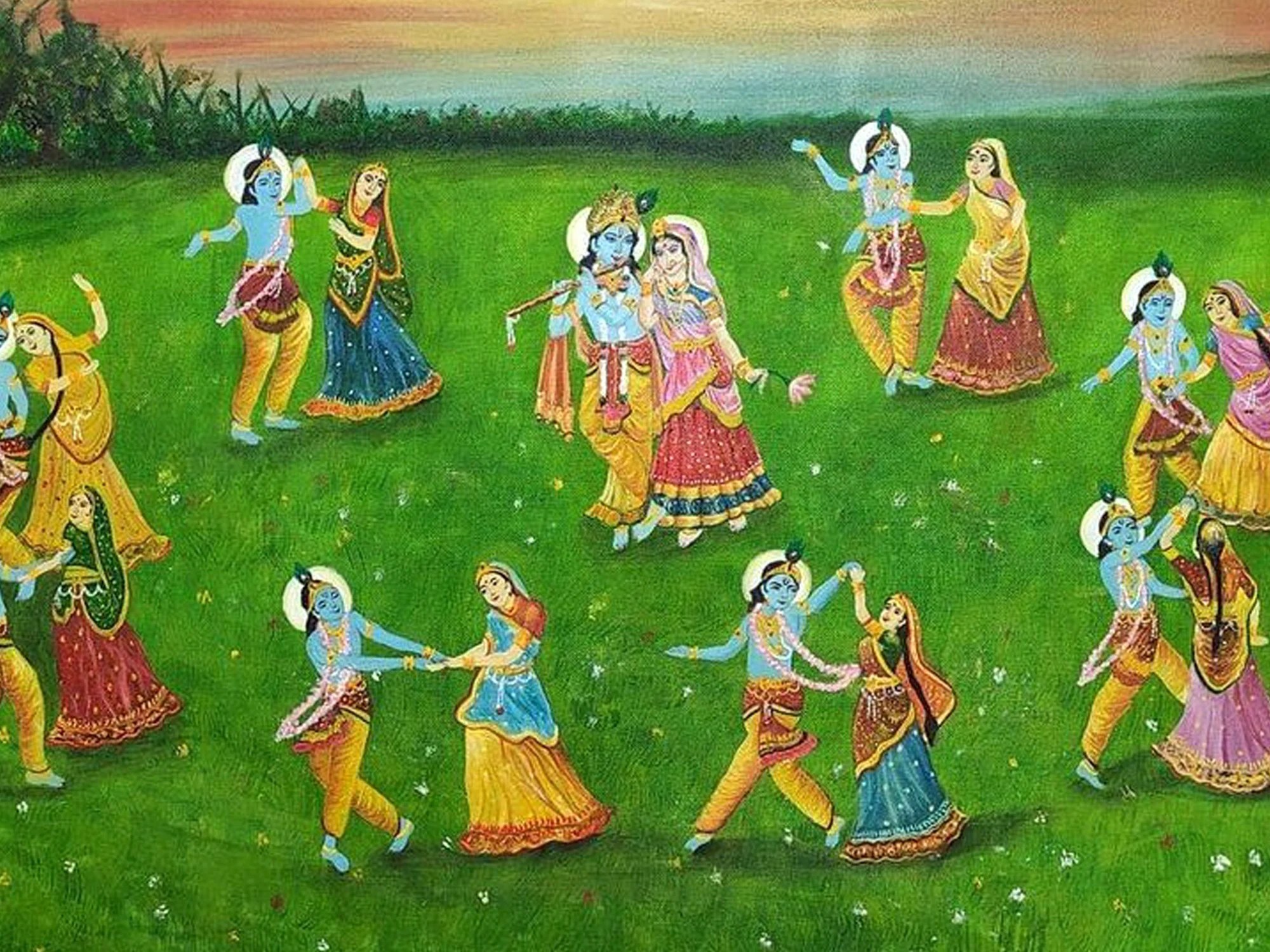
The “Rasleela” is a famous episode from Hindu mythology that is associated with Lord Krishna. It is a divine and highly symbolic dance that Krishna is believed to have performed with the Gopis (cowherd girls) in the forests of Vrindavan during his youth. The term “Ras” refers to the divine or transcendental essence, while “Leela” means play or pastime. So, Rasleela can be translated as the “divine play” or “divine dance.”
In the Rasleela, Lord Krishna would play his flute, and the melodious music would enchant the Gopis. They would be drawn to him irresistibly and would join him in a circle dance. The Rasleela is often depicted as a dance of pure, spiritual love and devotion, symbolizing the eternal love between the individual soul (Atma) and the divine (Paramatma).
There are several significant aspects of the Rasleela:
- Devotion and Surrender: The Gopis’ participation in the Rasleela represents the ideal of complete surrender and devotion to the divine. They abandon their worldly responsibilities to be with Krishna, symbolizing the idea that true devotion requires letting go of all attachments to material life.
- Universal Love: The Rasleela is often interpreted as a symbol of the universal love between God and all living beings. It transcends romantic love and represents the love that exists between the individual soul and the Supreme.
- The Dance of Divine Union: The Rasleela is seen as a metaphor for the union of the soul with the divine. In this dance, Krishna is the divine lover, and the Gopis are the devoted souls seeking union with God. It is a dance of the soul’s journey toward spiritual realization.
- Timelessness: In the Rasleela, it is said that time stands still. What seems like a single night to the Gopis actually spans the entirety of creation. This symbolizes the idea that divine love exists beyond the constraints of time and space.
The Rasleela is a deeply symbolic and spiritual aspect of Hindu mythology, emphasizing the importance of selfless devotion, surrender, and the eternal love between the individual soul and the divine. It is often celebrated and reenacted in various forms during Hindu festivals, especially during the festival of Holi in regions of India like Vrindavan and Mathura, where Krishna is believed to have performed these divine dances.
Image Credit: Exotic India Art
 Self Discovery
You must be logged in to post a comment.