
Why Lord Vishnu Assumed the Varaha Avatar?
In Hindu mythology, the Varaha Avatar of Lord Vishnu has a profound significance, and it revolves around the need to rescue the Earth. According to ancient legends, a demon named Hiranyaksha was responsible for a cataclysmic event – sinking the planet to the depths of the ocean.
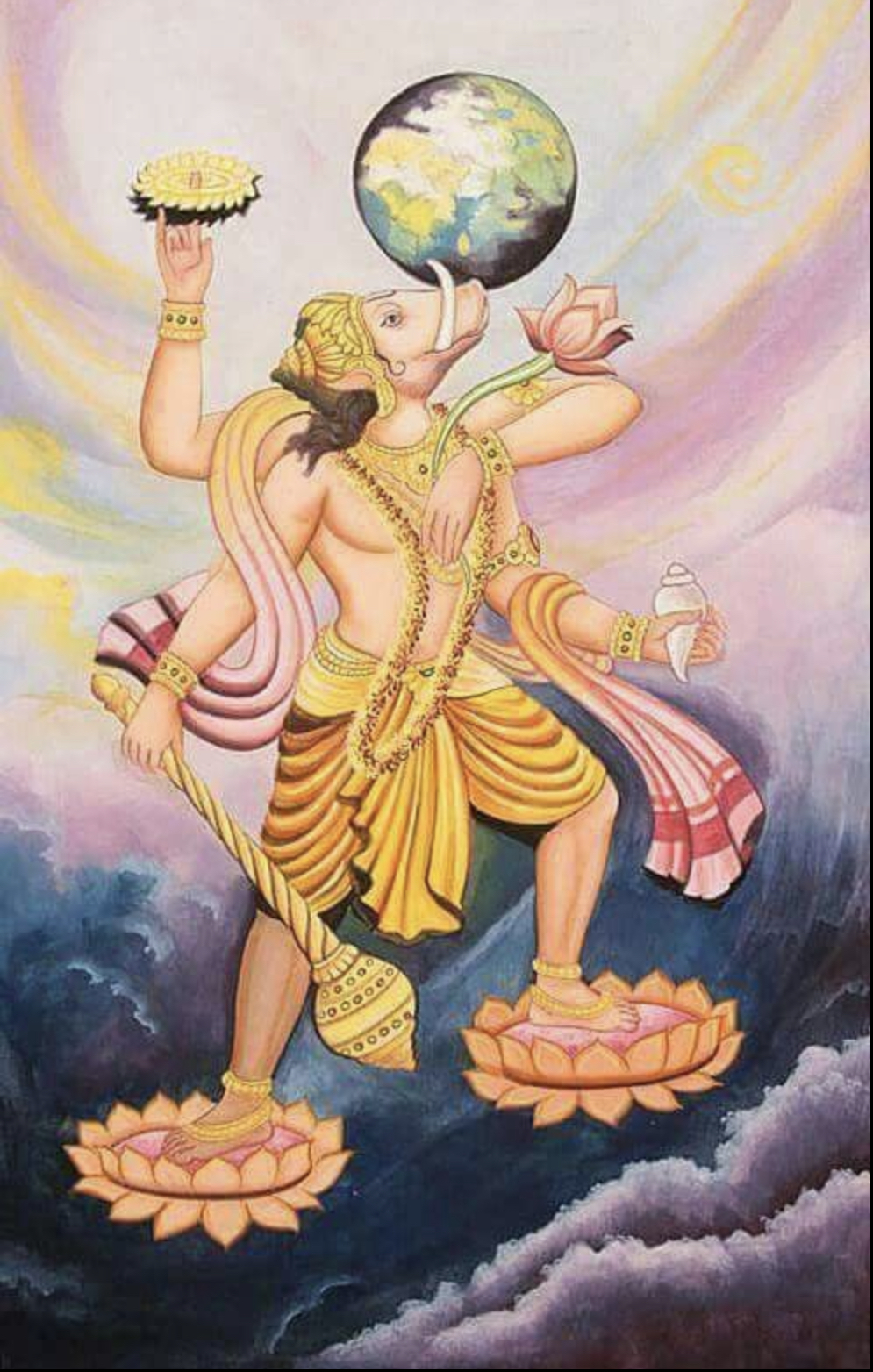
To save the Earth from this dire fate, Lord Vishnu transformed into the Varaha Avatar, taking on the appearance of a colossal wild boar. This divine battle between good and evil endured for a staggering millennium, spanning a thousand years.
The Varaha Avatar utilized his immense tusks to vanquish the demon and, through his incredible strength, raised the Earth from the abyss of the ocean. Depictions of the Varaha Avatar often showcase this divine being in two forms – either as a formidable boar or as a hybrid incarnation with the body of a man and the head of a boar. In the latter form, he is seen holding the Earth afloat with one of his tusks.
The hybrid half-human, half-animal representation of this avatar reveals him bearing the weight of Bhuma Devi on his leg.
During the Satya Yuga, the first of the four Yugas, Lord Vishnu adopted the Varaha form to safeguard the Earth from the clutches of the Asuras (demons) and to restore Dharma. In this context, Prithvi signifies the Earth itself.
The name “Varaha Avatar” is derived from the Sanskrit term for “boar” or “wild boar” (Devanagari: varaha). In the Rig-Veda, “Varaha” is translated as “wild boar.”
The Story of Varaha Avatar, the Third Incarnation of Lord Vishnu
The captivating narrative of the Varaha Avatar traces back to the doorkeepers of Lord Vishnu. Vaikuntha Loka, the divine dwelling place of Lord Vishnu, was guarded by two formidable gatekeepers, Jaya and Vijaya. Their profound affection for Lord Vishnu and unwavering loyalty were dedicated to the protection of their divine master.
The story takes a turn when Jaya and Vijaya, with the authority to grant access to the divine realm of Vaikunta Loka, refused entry to Lord Brahma’s four sons who sought to visit Lord Vishnu. Unfortunately, at that moment, Lord Vishnu was in repose, enjoying a well-deserved rest.
This refusal to grant access to Lord Vishnu deeply infuriated Lord Brahma’s sons, leaving them seething with anger. As a consequence, Jaya and Vijaya were cursed to take on human form and be reborn on Earth. Despite the heartfelt pleas of Jaya and Vijaya for forgiveness, Lord Brahma’s sons remained resolute in their decision, asserting that the curse could not be revoked.
In response to this predicament, Lord Vishnu himself graced the situation and expressed regret for the conduct of his guards. He clarified to the sons of Brahma that Jaya and Vijaya were acting in accordance with the rules given to them by Lord Vishnu. However, the sons of Lord Brahma remained steadfast in their decision, asserting that the curse was irrevocable.
To resolve this situation, Lord Vishnu informed Jaya and Vijaya that the only means to break the curse was for them to meet their demise at his hands. Remarkably, the guards did not appear daunted by this fate.
Fate had other plans for Jaya and Vijaya as they were reincarnated as two brothers named Hiranyakashipu and Hiranyaksha.
Hiranyaksha’s devotion to Lord Brahma was unparalleled. After years of unwavering worship, he received a potent boon from Lord Brahma himself. This boon assured him of his invincibility, decreeing that no being, divine or mortal, would ever be able to cause his demise.
Filled with an unwarranted sense of invulnerability, Hiranyaksha unleashed his malevolence upon unsuspecting victims on Earth. He wreaked havoc on the Devas (celestial beings) and even launched an attack on Indra’s celestial palace, compelling the Devas to flee for safety, seeking refuge in concealed caverns deep within the Earth.
Subsequently, Hiranyaksha seized control of the Earth, submerging it into the depths of Patal Loka. The colossal weight of the Earth overwhelmed the oceans, causing it to sink.
During these tumultuous events, the Earth was under the governance of the powerful Manu and Shatrupa. The distressed Manu and Shatrupa approached Lord Brahma to seek solace for their sorrow.
According to the legend, Lord Brahma advised that the only recourse was to seek Lord Vishnu’s intervention.
Lord Brahma then embarked on a deep meditation, and during this meditative state, a small piglet emerged from his nostrils.
This seemingly insignificant creature underwent a breathtaking transformation, growing in size until it reached a colossal magnitude, towering over the landscape like a colossal mountain. This was an avatar of Lord Vishnu, the Varaha Avatar. With unwavering determination, he announced his intention to plunge into the boundless ocean and rescue Mother Earth.
With a resounding roar, Lord Vishnu transformed into a mighty boar and soared into the sky, piercing through the clouds with his hooves.
With unyielding resolve, he dived into the depths of the ocean, embarking on a mission to find Mother Earth. After navigating the vast expanse of the ocean, he ultimately reached the other side and made a remarkable discovery. Deep within the enigmatic depths of the ocean lay Bhoomidevi, the revered Mother Earth herself.
As he traversed the boundless ocean, he encountered Varuna, the formidable Lord of the Seas. With immense determination, Lord Varaha dared to challenge Varuna Deva to a formidable battle. Varuna’s ingenious plan involved persuading Hiranyaksha that the only adversary worthy of his might was none other than Lord Vishnu himself. Consequently, Hiranyaksha was compelled to engage in a fierce battle with the divine being.
Abruptly, Narada, the celestial sage, materialized on the scene. Hiranyaksha inquired about the whereabouts of Lord Vishnu, to which Narada revealed that Lord Vishnu had embarked on a daring quest to rescue Mother Earth from the ocean’s depths.
Enraged, Hiranyaksha proceeded toward the ocean’s abyss with fury in his heart. In a display of unparalleled heroism, Lord Varaha plunged his mighty tusk into the ocean’s depths and raised Mother Earth upon it. With unwavering determination, he propelled himself toward the glistening surface above.
In a fierce confrontation, Hiranyaksha charged toward Lord Varaha, wielding his mighty mace. He challenged Lord Vishnu in his Varaha Avatar, asserting that he possessed the strength to contend with the divine being.
With formidable strength, the demon hurled his powerful mace toward the Lord, prepared to strike with his full demonic might. It is said that Lord Varaha took a step back, and the battle raged on.
As the sun began its descent, Lord Brahma issued a dire warning: the demon must be vanquished before nightfall, lest his malevolent sorcery be unleashed upon the world.
In the relentless battle between Varaha Avatar and Hiranyaksha, Lord Varaha delivered a powerful blow to his opponent’s face with a thunderous fist. With a swift motion, he raised him
high and sent him soaring through the air. Finally, Hiranyaksha met his demise as he fell and was instantly vanquished.
Symbolism and Teachings of Varaha Avatar
The third avatar of Lord Vishnu, known as Varaha, is often depicted as a half-human, half-animal being. This fierce incarnation is commonly seen supporting the world’s weight on his formidable tusk.
This avatar of Lord Vishnu symbolizes sacrifice and the restoration of peace amid chaos. It exemplifies the triumph of good over evil as Hiranyaksha is defeated.
In various temples in the northeastern regions of India, Lord Varaha is worshipped during Varaha Jayanti. This auspicious day falls on the third day of the Bhadrapada month in the Hindu calendar.
The story of the Varaha Avatar is a rich tapestry of myth, symbolism, and moral teachings, serving as a reminder of the eternal battle between good and evil and the divine’s enduring protection of the Earth.
Temples related to Varaha Avatar:
1. Adi Varaha Swamy Temple, Chittor district, Andhra Pradesh
2. Varaha Swamy temple, Karimnagar, Telangana
3. Varaha Lakshmi Narasimha Swamy temple, Simhachalam, Visakhapatnam, Andhra Pradesh
4. Adi Varaha swamy Temple, Kallidaikuruchi, Tirunelveli district, Tamil Nadu
5. Sri Varaha Swamy Temple, Paravur taluk, Ernakulam district, Kerala
6. Sri Varaha Venkateswara Swamy temple, Cherai, Ernakulam district, Kerala
7. Sri Varaha Swamy Temple, Yelandur, Chamarajnagar district, Karnatak
8. Koneru Varaha Swamy Temple, Secunderabad, Telangana
9. Sri Lakshmi Varaha Swamy temple, Alu, Orrissa
10. Yagna Varaha Swamy Temple, Jujpur, Orrissa
11. Varaha Swamy (Nityakalyana Perumal) Temple, Thiruvidandhai, Tamil Nadu
12. Sri Bhu Varaha Swamy Vishnu Temple, Srimushnum, Cuddalore, Tamil Nadu
13. Sri Vishnu Varah Temple, Majholi, Jabalpur, Madhya Pradesh
14. Varaha Tirth Temple, Barah, Jind, Haryana
15. Varaha Temple, Pushkar, Ajmer, Rajasthan
16. Sri Bhuvaraha Laxmi Narsimha Temple, Halasi, Belgaum, Karnataka
17. Vishnu Varaha Mandir, Bilhari, Katani, Madhya Pradesh
18. Bhuvaraha Swamy Temple, Kattahalli, Mandya, Karnataka
19. Varaha Temple, Khajuraho, Madhya Pradesh
20. Sri Aadhi Varaha Perumal Temple, Kanchipuram, Tamil Nadu
Image Credit: Unknown
 Self Discovery
You must be logged in to post a comment.