
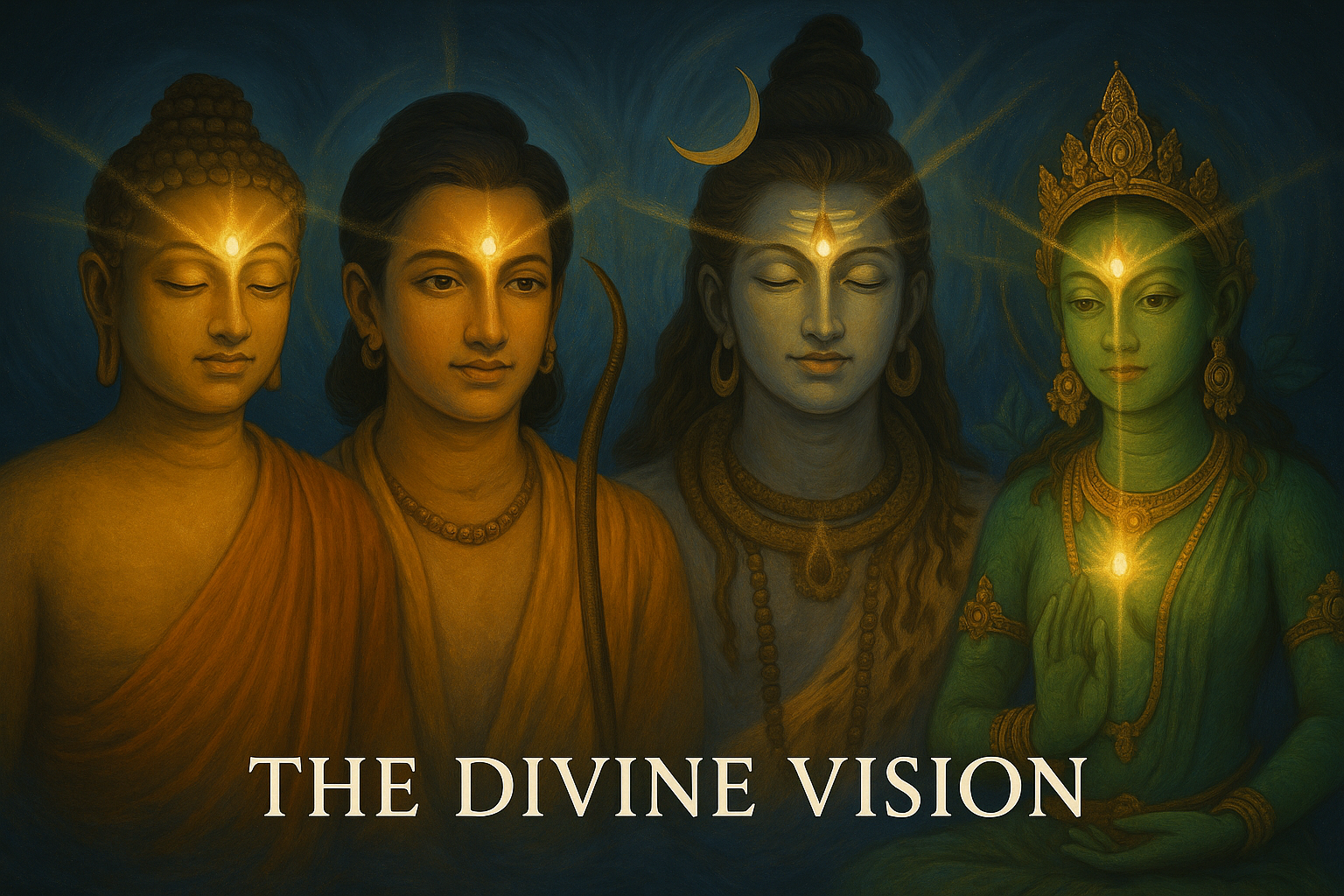
Awakening the Inner Eye of Self-Discovery
Across the world’s great spiritual traditions, the symbol of the Third Eye — or Ājñā Chakra — represents the gateway to higher consciousness. It is not merely an organ of mystical sight, but a state of inner knowing — where mind, soul, and truth merge into a single current of awareness.
In both Vedic and Buddhist traditions, divine beings embody this vision in unique ways. Lord Shiva’s blazing Trinetra, Lord Rama’s dharmic perception, Lord Buddha’s serene ūrṇā, and Green Tārā’s compassionate gaze — each reflect a different aspect of awakened consciousness.
Through their third eye, they do not “see” the world as we do — they perceive its essence. This article explores the deeper meaning behind each of these forms and how their wisdom guides us on the journey of self-discovery.
🕉️ Lord Shiva — The Fire of Awareness
Shiva’s Trinetra (Third Eye) is perhaps the most famous symbol of divine vision. Seated in deep meditation, Shiva’s two physical eyes represent the dualities of life — day and night, creation and destruction, joy and sorrow. The third, resting at the center of his forehead, is the eye of transcendence.
When this eye opens, it burns away illusion (Māyā) and ego. The momentary flash of Shiva’s third eye is said to dissolve universes — not in anger, but in liberating truth. It signifies that real seeing begins when the veil of ignorance falls away.
Shiva teaches us that awakening the third eye is not about mystical powers — it is about perceiving reality beyond likes and dislikes, beyond personal judgment.
Through meditation, silence, and self-discipline, we begin to access this inner fire — the Agni of awareness — that purifies and illumines the path.
Mantra: Om Namah Shivaya
“I bow to the inner Self that is pure consciousness.”
🪔 Lord Rama — The Vision of Dharma
Lord Rama, the embodiment of Dharma (righteousness), rarely depicted with a physical third eye, possesses instead a spiritual one — the unwavering inner vision of truth and justice.
Rama’s consciousness is anchored in clarity and compassion. His third eye is the light of discernment (viveka), which guides every action with purpose and integrity. In times of confusion or emotional turmoil, Rama’s example reminds us that the true third eye opens through moral clarity and surrender to divine order.
For modern seekers, Rama’s third eye is not a flame of destruction, but a lamp of discipline — one that steadies the mind and anchors the heart in devotion. When the intellect (buddhi) aligns with love, the Ājñā Chakra naturally awakens.
Mantra: Sri Ram Jai Ram Jai Jai Ram
“Victory to Rama, who dwells in the heart as divine light.”🌿 Lord Buddha — The Eye of Enlightenment
Between the serene brows of Lord Buddha lies the ūrṇā, a subtle mark symbolizing the Eye of Wisdom (Prajñā). Unlike the fiery intensity of Shiva, the Buddha’s eye opens in stillness — calm, luminous, and boundless in compassion.
Buddha’s third eye represents direct insight into the nature of reality: that all phenomena are impermanent, all attachments cause suffering, and liberation lies in awareness itself. This seeing is not intellectual but experiential — a perception beyond form and name.
Through meditation, mindfulness, and compassion, we begin to see the world as the Buddha did — not through illusion or attachment, but through clear seeing (vipassanā). His third eye invites us to dissolve the false sense of separateness and awaken to the unity of all life.
Mantra: Om Muni Muni Mahāmuniye Svāhā
“Homage to the Awakened One, the Great Sage.”
🌸 Green Tārā — The Third Eye of Compassion
From the heart of Buddhist Tantra emerges Green Tārā, the swift savioress and mother of all Buddhas. She is depicted with three eyes, one in each hand and foot, and one on her forehead — representing omniscient awareness that transcends time and space.
Her third eye is the eye of compassion in action — the ability to see the suffering of all beings instantly and respond with fearless love. Unlike the still fire of Shiva or the tranquil gaze of Buddha, Tārā’s third eye radiates movement, grace, and healing.
It is said that when we call upon her with pure intent, she perceives us instantly through this divine eye — removing obstacles and dissolving fear. Her vision teaches that true awakening must be balanced with compassion; wisdom without love is incomplete.
Mantra: Om Tāre Tuttāre Ture Svāhā
“Salutations to the Liberator, the Swift and Fearless Mother.”
🌼 The Universal Third Eye — Gateway to the Infinite
Though these deities appear in different forms and traditions, their essence converges at the same truth:
the Third Eye is the bridge between mind and soul, duality and oneness, ignorance and liberation.
| Deity | Aspect of the Third Eye | Inner Power | Path of Practice |
|---|---|---|---|
| Shiva | Fire of awareness | Dissolution of illusion | Meditation, renunciation |
| Rama | Vision of dharma | Clarity of mind and purpose | Devotion, righteous action |
| Buddha | Eye of wisdom | Insight into reality | Mindfulness, compassion |
| Green Tārā | Eye of compassion | Protection and swift healing | Mantra, selfless service |
Each path leads toward the same awakening — to see not with the eyes, but with consciousness itself.
🌺 The Third Eye Within You
The journey of self-discovery begins not by seeking outside, but by turning inward. The Ājñā Chakra, located between the eyebrows, governs intuition, clarity, and spiritual sight.
When awakened, it aligns thought with higher will — a union of Shiva’s awareness, Rama’s righteousness, Buddha’s wisdom, and Tārā’s compassion.
To activate this inner eye:
- Meditate daily on the space between the brows.
- Chant mantras that invoke clarity and calm.
- Serve selflessly, as compassion opens perception.
- Practice silence, for intuition speaks softly.
- Trust your inner guidance — it is your divine compass.
In time, the world begins to appear not as a battlefield or illusion, but as a mirror — reflecting your own consciousness.
🌞 Conclusion: Seeing with the Eye of the Heart
The third eye is not about supernatural power — it is about supernatural presence.
To see through it is to realize the Self (Ātman) as one with the Divine (Brahman).
When we awaken this inner sight, every act becomes sacred, every face divine, every challenge a teacher.
We begin to live as Shiva’s awareness, Rama’s righteousness, Buddha’s peace, and Tārā’s compassion — all at once.
And that, truly, is the essence of Self-Discovery.
“Open the eye that sees beyond form.
When you look through it, you will find —
there was never any distance between you and the Divine.”
 Self Discovery
You must be logged in to post a comment.