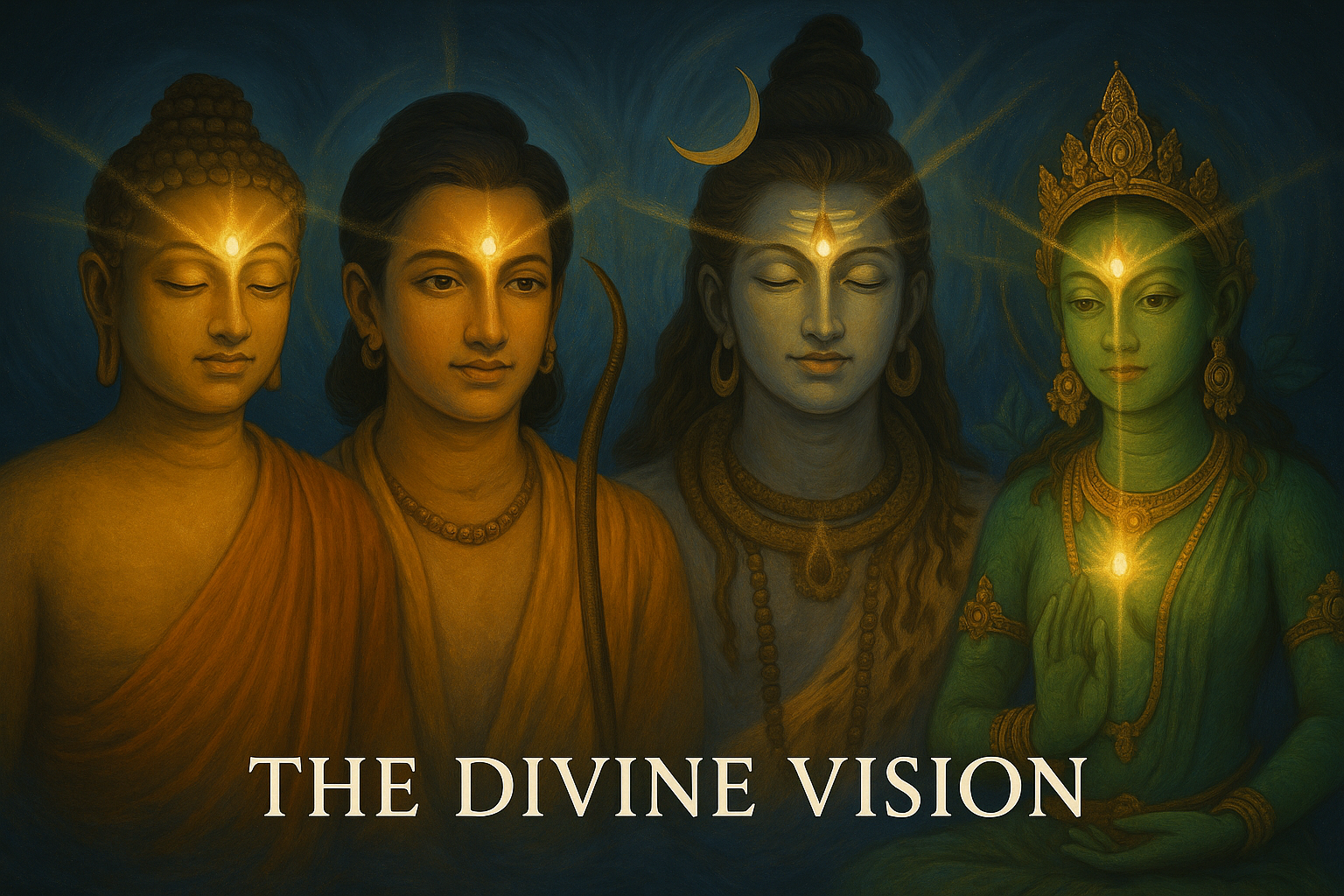
The Divine Vision: Exploring the Third Eye of Lord Shiva, Lord Rama, Lord Buddha, and Green Tārā

Awakening the Inner Eye of Self-Discovery

Across the world’s great spiritual traditions, the symbol of the Third Eye — or Ājñā Chakra — represents the gateway to higher consciousness. It is not merely an organ of mystical sight, but a state of inner knowing — where mind, soul, and truth merge into a single current of awareness.

In both Vedic and Buddhist traditions, divine beings embody this vision in unique ways. Lord Shiva’s blazing Trinetra, Lord Rama’s dharmic perception, Lord Buddha’s serene ūrṇā, and Green Tārā’s compassionate gaze — each reflect a different aspect of awakened consciousness.

Through their third eye, they do not “see” the world as we do — they perceive its essence. This article explores the deeper meaning behind each of these forms and how their wisdom guides us on the journey of self-discovery.

🕉️ Lord Shiva — The Fire of Awareness

Shiva’s Trinetra (Third Eye) is perhaps the most famous symbol of divine vision. Seated in deep meditation, Shiva’s two physical eyes represent the dualities of life — day and night, creation and destruction, joy and sorrow. The third, resting at the center of his forehead, is the eye of transcendence.

When this eye opens, it burns away illusion (Māyā) and ego. The momentary flash of Shiva’s third eye is said to dissolve universes — not in anger, but in liberating truth. It signifies that real seeing begins when the veil of ignorance falls away.

Shiva teaches us that awakening the third eye is not about mystical powers — it is about perceiving reality beyond likes and dislikes, beyond personal judgment.
Through meditation, silence, and self-discipline, we begin to access this inner fire — the Agni of awareness — that purifies and illumines the path.

Mantra: Om Namah Shivaya
“I bow to the inner Self that is pure consciousness.”

🪔 Lord Rama — The Vision of Dharma

Lord Rama, the embodiment of Dharma (righteousness), rarely depicted with a physical third eye, possesses instead a spiritual one — the unwavering inner vision of truth and justice.

Rama’s consciousness is anchored in clarity and compassion. His third eye is the light of discernment (viveka), which guides every action with purpose and integrity. In times of confusion or emotional turmoil, Rama’s example reminds us that the true third eye opens through moral clarity and surrender to divine order.

For modern seekers, Rama’s third eye is not a flame of destruction, but a lamp of discipline — one that steadies the mind and anchors the heart in devotion. When the intellect (buddhi) aligns with love, the Ājñā Chakra naturally awakens.

Mantra: Sri Ram Jai Ram Jai Jai Ram
“Victory to Rama, who dwells in the heart as divine light.”

🌿 Lord Buddha — The Eye of Enlightenment

Between the serene brows of Lord Buddha lies the ūrṇā, a subtle mark symbolizing the Eye of Wisdom (Prajñā). Unlike the fiery intensity of Shiva, the Buddha’s eye opens in stillness — calm, luminous, and boundless in compassion.

Buddha’s third eye represents direct insight into the nature of reality: that all phenomena are impermanent, all attachments cause suffering, and liberation lies in awareness itself. This seeing is not intellectual but experiential — a perception beyond form and name.

Through meditation, mindfulness, and compassion, we begin to see the world as the Buddha did — not through illusion or attachment, but through clear seeing (vipassanā). His third eye invites us to dissolve the false sense of separateness and awaken to the unity of all life.

Mantra: Om Muni Muni Mahāmuniye Svāhā
“Homage to the Awakened One, the Great Sage.”

🌸 Green Tārā — The Third Eye of Compassion

From the heart of Buddhist Tantra emerges Green Tārā, the swift savioress and mother of all Buddhas. She is depicted with three eyes, one in each hand and foot, and one on her forehead — representing omniscient awareness that transcends time and space.

Her third eye is the eye of compassion in action — the ability to see the suffering of all beings instantly and respond with fearless love. Unlike the still fire of Shiva or the tranquil gaze of Buddha, Tārā’s third eye radiates movement, grace, and healing.

It is said that when we call upon her with pure intent, she perceives us instantly through this divine eye — removing obstacles and dissolving fear. Her vision teaches that true awakening must be balanced with compassion; wisdom without love is incomplete.

Mantra: Om Tāre Tuttāre Ture Svāhā
“Salutations to the Liberator, the Swift and Fearless Mother.”

🌼 The Universal Third Eye — Gateway to the Infinite

Though these deities appear in different forms and traditions, their essence converges at the same truth:
the Third Eye is the bridge between mind and soulduality and onenessignorance and liberation.

DeityAspect of the Third EyeInner PowerPath of Practice
ShivaFire of awarenessDissolution of illusionMeditation, renunciation
RamaVision of dharmaClarity of mind and purposeDevotion, righteous action
BuddhaEye of wisdomInsight into realityMindfulness, compassion
Green TārāEye of compassionProtection and swift healingMantra, selfless service

Each path leads toward the same awakening — to see not with the eyes, but with consciousness itself.

🌺 The Third Eye Within You

The journey of self-discovery begins not by seeking outside, but by turning inward. The Ājñā Chakra, located between the eyebrows, governs intuition, clarity, and spiritual sight.
When awakened, it aligns thought with higher will — a union of Shiva’s awareness, Rama’s righteousness, Buddha’s wisdom, and Tārā’s compassion.

To activate this inner eye:

  1. Meditate daily on the space between the brows.
  2. Chant mantras that invoke clarity and calm.
  3. Serve selflessly, as compassion opens perception.
  4. Practice silence, for intuition speaks softly.
  5. Trust your inner guidance — it is your divine compass.

In time, the world begins to appear not as a battlefield or illusion, but as a mirror — reflecting your own consciousness.

🌞 Conclusion: Seeing with the Eye of the Heart

The third eye is not about supernatural power — it is about supernatural presence.
To see through it is to realize the Self (Ātman) as one with the Divine (Brahman).

When we awaken this inner sight, every act becomes sacred, every face divine, every challenge a teacher.
We begin to live as Shiva’s awareness, Rama’s righteousness, Buddha’s peace, and Tārā’s compassion — all at once.

And that, truly, is the essence of Self-Discovery.

“Open the eye that sees beyond form.
When you look through it, you will find —
there was never any distance between you and the Divine.”
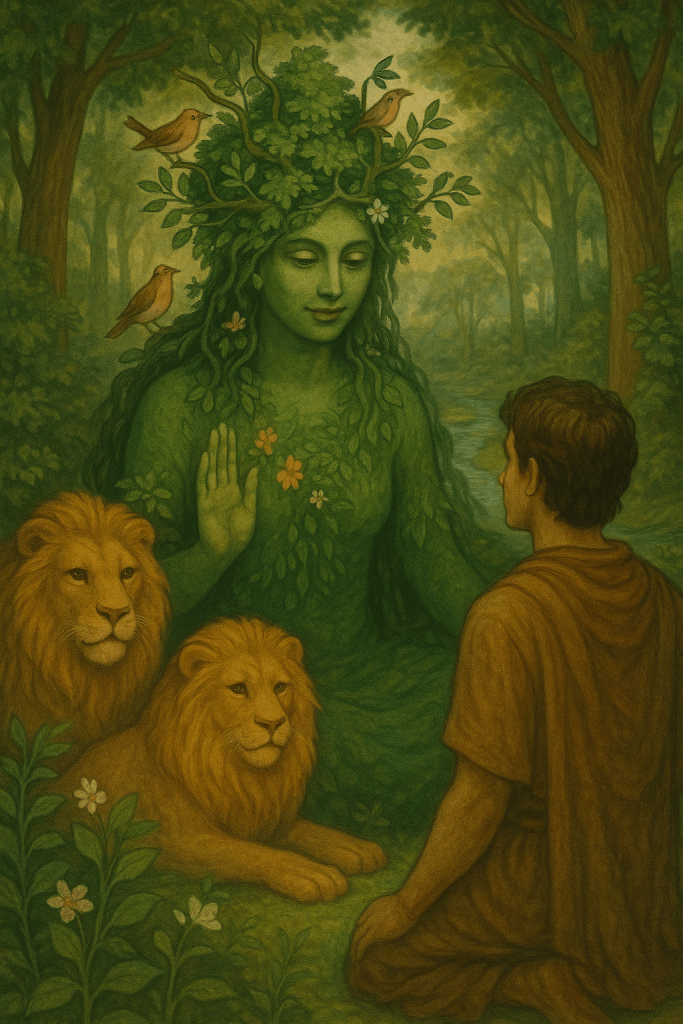
Return to the Mother Within

Long ago, a weary seeker left his village to find the meaning of life. He traveled through cities, temples, and libraries, asking sages, priests, and scholars:

“Who am I?”

Each gave him words, but none gave him peace.

One day, exhausted, he collapsed in a forest. He lay under a great banyan tree, too tired to think. Slowly, he began to notice the world around him.

The tree whispered:

“I am strong because I go deep into the Earth. My roots are unseen, but they hold me. Find your roots—your values, your truth.”

A river nearby laughed as it flowed:

“I never resist. When rocks block me, I flow around them. Self-discovery is not control—it is flowing with life.”

The wind brushed his face and said:

“You cannot see me, yet you feel me. Thoughts and dreams are the same. Do not fear them—let them move freely.”

Then the sun broke through the clouds and warmed his skin:

“I give light to all, not just a few. When you discover yourself, you too will shine without asking who deserves your light.”

At last, the seeker felt a gentle presence. A radiant woman emerged from the forest—clothed in vines, crowned with flowers, lions at her side, and birds circling her head. She smiled.

“I am Mother Nature,” she said. “And you are my child. You search outside for yourself, yet you are made of me. The earth is your body, the water your blood, the fire your spirit, the air your breath. Return to me, and you will know who you are.”

In that moment, the seeker understood: Self-discovery was not finding something new—it was remembering what he already was.

Green Tārā: The Goddess of Compassion, Protection, and Swift Action


In the vast expanse of Buddhist philosophy and practice, few deities embody the qualities of compassion and fearless action as beautifully as Green Tārā. She is known as the Mother of Liberation and is revered across Tibetan Buddhism, Vajrayana practice, and even by spiritual seekers around the world.

Green Tārā is not just a mythological figure—she is a symbol, a guide, and an energetic presence that offers immediate help to those who call upon her. Her practice continues to thrive because it speaks directly to the challenges of our times: fear, uncertainty, and the longing for protection and clarity.

Origins of Tārā: Born from Compassion

According to Buddhist legend, Tārā was born from the tears of Avalokiteśvara (Chenrezig), the bodhisattva of compassion. Distressed by the endless suffering of beings, Avalokiteśvara wept, and from one of his tears emerged Tārā—a female bodhisattva who vowed to liberate beings swiftly and fearlessly.

She made a profound promise:

“As long as there is suffering in the world, may I remain in female form to help beings overcome fear and obstacles.”

This makes Tārā unique, as she deliberately chose to remain as a divine feminine energy, representing active compassion in action.

The Many Forms of Tārā

Tārā manifests in 21 primary forms, each representing a different quality of compassionate energy. Among these, Green Tārā is the most beloved and widely practiced.

  • Green Tārā – Swift action, protection, and active compassion.
  • White Tārā – Healing, long life, and serenity.
  • Red Tārā – Power, magnetism, and passion.
  • Black Tārā – Fierce protection and destruction of negativity.

But Green Tārā is considered the “first responder,” always ready to act the moment a prayer is made.

Iconography and Symbolism of Green Tārā

Green Tārā’s image is filled with profound symbolism:

  • Color Green: Symbolizes vitality, renewal, and enlightened activity.
  • Posture: She sits with her left leg folded in meditation and her right leg extended—signifying readiness to rise instantly to help.
  • Right Hand: Held in the gesture of granting boons and protection (varada mudra).
  • Left Hand: Holds a blue lotus (utpala), representing purity and wisdom that flourish even in the muddiest waters.
  • Lotus Throne: Signifies her transcendence of worldly impurities, yet her willingness to engage with the world to aid beings.

This unique posture makes her different from many deities who remain in deep meditation. Green Tārā is ever-active—alert, compassionate, and engaged.

The Eight Great Fears Green Tārā Protects Us From

Buddhist texts describe Green Tārā as the protector from eight great fears, each symbolizing both outer dangers and inner struggles:

  1. Lions – Pride and arrogance.
  2. Elephants – Ignorance and delusion.
  3. Fires – Hatred and anger.
  4. Snakes – Jealousy and envy.
  5. Thieves – Greed and desire.
  6. Imprisonment – Clinging and attachment.
  7. Floods – Delusion and confusion.
  8. Demons – Doubt and spiritual distractions.

When invoked, she helps practitioners overcome not only physical challenges but also the inner poisons of the mind.

The Mantra of Green Tārā

Her mantra is one of the most widely recited in Buddhism:

Om Tāre Tuttāre Ture Svāhā

Each word carries deep meaning:

  • Om – The sacred vibration of the universe.
  • Tāre – She who liberates from mundane suffering.
  • Tuttāre – She who protects from fears and dangers.
  • Ture – She who brings swift assistance and ultimate liberation.
  • Svāhā – A closing blessing, affirming “may it be so.”

Chanting this mantra daily is believed to invite her protection, dissolve fear, and open the heart to compassion. Many practitioners report a sense of calm and courage when engaging with this practice.
Benefits of Green Tārā Practice

People across centuries have turned to Green Tārā for blessings in different aspects of life. Some of the key benefits include:

  • Protection from harm and accidents.
  • Overcoming fear, anxiety, and uncertainty.
  • Strength and courage in times of crisis.
  • Spiritual growth and clarity of mind.
  • Cultivation of compassion toward others.
  • Healing from emotional and physical challenges.

Her compassionate energy is said to act swiftly, making her practice especially powerful for modern-day seekers navigating stressful lives.

Relevance of Green Tārā in Modern Times

In today’s world—marked by uncertainty, stress, and rapid change—Green Tārā’s presence feels especially timely. She is not just a religious figure but a universal symbol of fearlessness, resilience, and loving action.

Her extended foot reminds us of a powerful lesson: spirituality is not about escaping the world—it is about engaging with it, fearlessly and compassionately.

For anyone seeking courage in the face of fear, clarity in times of confusion, or protection during uncertain times, Green Tārā’s practice offers timeless wisdom.

Closing Thoughts

Green Tārā is more than a Buddhist goddess—she is a living archetype of divine feminine energy, reminding us that compassion must be active, engaged, and fearless. By chanting her mantra, meditating on her image, or embodying her qualities in daily life, we awaken the Green Tārā within ourselves.

She teaches us that courage and compassion are not opposites—they are inseparable. In her presence, fear melts away, and what remains is the strength to serve, to love, and to uplift others.

May Green Tārā guide you with courage, protect you with compassion, and bless you with wisdom on your journey.