Meeting of Nanda & Vasudeva

vasudeva

Although Krsna was the real son of Vasudeva and Devaki, because of Kamsa’s atrocious activities Vasudeva could not enjoy the birth ceremony of his son. But Nanda Maharaja, the foster father, celebrated the birth ceremony of Krsna very joyfully. The next day, it was declared that a male child was born of Yasoda. According to Vedic custom, Nanda Maharaja called for learned astrologers andbrahmanas to perform the birth ceremony. After the birth of a child, the astrologers calculate the moment of the birth and make a horoscope of the child’s future life. Another ceremony takes place after the birth of the child: the family members take baths, cleanse themselves and decorate themselves with ornaments and garlands; then they come before the child and the astrologer to hear of the future life of the child. Nanda Maharaja and other members of the family dressed and sat down in front of the birthplace. All the brahmanas who were assembled there on this occasion chanted auspicious mantras,according to the rituals, while the astrologers performed the birth ceremony. All the demigods are also worshiped on this occasion, as well as the forefathers of the family. Nanda Maharaja distributed 200,000 well decorated, dressed and ornamented cows to the brahmanas. He not only gave cows in charity, but hills of grains, decorated with golden-bordered garments and many ornaments.

In the material world we possess riches and wealth in many ways, but sometimes not in very honest and pious ways, because that is the nature of accumulating wealth. According to Vedic injunction, therefore, such wealth should be purified by giving cows and gold in charity to thebrahmanas. A newborn child is also purified by giving grains in charity to the brahmanas. In this material world it is to be understood that we are always living in a contaminated state. We therefore have to purify the duration of our lives, our possession of wealth and ourselves. The duration of life is purified by taking daily bath and cleansing the body inside and outside and accepting the ten kinds of purificatory processes. By austerities, by worship of the Lord, and by distribution of charity, we can purify the possession of wealth. We can purify ourselves by studying the Vedas, by striving for self-realization and by understanding the Supreme Absolute Truth. It is therefore stated in the Vedic literature that by birth everyone is born a sudra, and by accepting the purificatory process one becomes twice-born. By studies of the Vedas one can become vipra, which is the preliminary qualification for becoming abrahmana. When one understands the Absolute Truth in perfection, he is called a brahmana. And when the brahmana reaches further perfection, he becomes a Vaisnava or a devotee.

In that ceremony, all the brahmanas assembled began to chant different kinds of Vedic mantras to invoke all good fortune for the child. There are different kinds of chanting known as suta, magadha, vandi andvirudavali. Along with this chanting of mantras and songs, bugles and kettledrums sounded outside the house. On this occasion, the joyous vibrations could be heard in all the pasturing grounds and all the houses. Within and outside of the houses there were varieties of artistic paintings, done with rice pulp, and scented water was sprinkled everywhere, even on the roads and streets. Ceilings and roofs were decorated with different kinds of flags, festoons and green leaves. The gates were made of green leaves and flowers. All the cows, bulls and calves were smeared with a mixture of oil and turmeric and painted with minerals like red oxide, yellow clay and manganese. They wore garlands of peacock feathers and were covered with nice colored dresses and gold necklaces.

When all the ecstatic cowherd men heard that Nanda Maharaja, father of Krsna, was celebrating the birth ceremony of his son, they became spontaneously joyful. They dressed themselves with very costly garments and ornamented their bodies with different kinds of earrings and necklaces and wore great turbans on their heads. After dressing themselves in this gorgeous way, they took various kinds of presentations and thus approached the house of Nanda Maharaja.

As soon as they heard that mother Yasoda had given birth to a child, all the cowherd women became overwhelmed with joy, and they also dressed themselves with various kinds of costly garments and ornaments and smeared scented cosmetics on their bodies.

As the dust on the lotus flower exhibits the exquisite beauty of the flower, all the gopis (cowherd girls) applied the dust of kunkuma on their lotus-like faces. These beautiful gopis took their different presentations and very soon reached the house of Maharaja Nanda. Overburdened with their heavy hips and swollen breasts, the gopis could not proceed very quickly towards the house of Nanda Maharaja, but out of ecstatic love for Krsna they began to proceeded as quickly as possible. Their ears were decorated with pearl rings, their necks were decorated with jewel padlocks, their lips and eyes were decorated with different kinds of lipstick and ointment, and their hands were decorated with nice golden bangles. As they were very hastily passing over the stone road, the flower garlands which were decorating their bodies fell to the ground, and it appeared that a shower of flowers was falling from the sky. From the movement of the different kinds of ornaments on their bodies, they were looking still more beautiful. In this way, they all reached the house of Nanda-Yasoda and blessed the child: “Dear child, You live long just to protect us.” While they were blessing child Krsna in this way, they offered a mixture of turmeric powder with oil, yogurt, milk and water. They not only sprinkled this mixture on the body of child Krsna but on all other persons who were present there. Also on that auspicious occasion, there were different bands of expert musicians playing.

When the cowherd men saw the pastimes of the cowherd women, they became very joyful, and in response they also began to throw yogurt, milk, clarified butter and water upon the bodies of the gopis. Then both parties began to throw butter on each other’s bodies. Nanda Maharaja was also very happy to see the pastimes of the cowherd men and women, and he became very liberal in giving charity to the different singers who were assembled there. Some singers were reciting great verses from theUpanisads and Puranas, some were glorifying the family ancestors, and some were singing very sweet songs. There were also many learnedbrahmanas present, and Nanda Maharaja, being very satisfied on this occasion, began to give them different kinds of garments, ornaments, and cows in charity.

It is very important to note in this connection how wealthy the inhabitants of Vrndavana were simply by raising cows. All the cowherd men belonged to the vaisya community, and their business was to protect the cows and cultivate crops. By their dress and ornaments and by their behavior, it appears that although they were in a small village, they still were rich in material possessions. They possessed such an abundance of various kinds of milk products that they were throwing butter lavishly on each other’s bodies without restriction. Their wealth was in milk, yogurt, clarified butter and many other milk products, and by trading their agricultural products, they were rich in various kinds of jewelry, ornaments and costly dresses. Not only did they possess all these things, but they could give them away in charity, as did Nanda Maharaja.

Thus Nanda Maharaja, the foster father of Lord Krsna, began to satisfy the desires of all the men assembled there. He respectfully received them and gave them in charity whatever they desired. The learned brahmanas,who had no other source of income, were completely dependent on thevaisya and ksatriya communities for their maintenance, and they received gifts on such festive occasions as birthdays, marriages, etc. While Nanda Maharaja was worshiping Lord Visnu on this occasion and was trying to satisfy all the people there, his only desire was that the newborn child Krsna would be happy. Nanda Maharaja had no knowledge that this child was the origin of Visnu, but he was praying to Lord Visnu to protect Him.

Rohinidevi, mother of Balarama, was the most fortunate wife of Vasudeva. She was away from her husband, yet just to congratulate Maharaja Nanda on the occasion of the birth ceremony of his son, Krsna, she dressed herself very nicely. Wearing a garland, a necklace and other bodily ornaments, she appeared on the scene and moved hither and thither. According to the Vedic system, a woman whose husband is not at home does not dress herself very nicely. But although Rohini’s husband was away, she still dressed herself on this occasion.

From the opulence of the birth ceremony of Krsna, it is very clear that at that time Vrndavana was rich in every respect. Because Lord Krsna took birth in the house of King Nanda and mother Yasoda, the goddess of fortune was obliged to manifest her opulences in Vrndavana. It appeared that Vrndavana had already become a site for the pastimes of the goddess of fortune.

After the birth ceremony, Nanda Maharaja decided to go to Mathura to pay the annual tax to the government of Kamsa. Before leaving, he called for the able cowherd men of the village and asked them to take care of Vrndavana in his absence. When Nanda Maharaja arrived in Mathura, Vasudeva got the news and was very eager to congratulate his friend. He immediately went to the place where Nanda Maharaja was staying. When Vasudeva saw Nanda, he felt that he had regained his life. Nanda, overwhelmed with joy, immediately stood up and embraced Vasudeva. Vasudeva was received very warmly and offered a nice place to sit. At that time Vasudeva was anxious about his two sons who had been put under the protection of Nanda without Nanda’s knowledge. With great anxiety, Vasudeva inquired about Them. Both Balarama and Krsna were the sons of Vasudeva. Balarama was transferred to the womb of Rohini, Vasudeva’s own wife, but Rohini was kept under the protection of Nanda Maharaja. Krsna was personally delivered to Yasoda and exchanged with her daughter. Nanda Maharaja knew that Balarama was the son of Vasudeva, although he did not know that Krsna was also Vasudeva’s son. But Vasudeva was aware of this fact and inquired very eagerly about Krsna and Balarama.

Vasudeva then addressed him, “My dear brother, you were old enough and very anxious to beget a son, and yet you had none. Now by the grace of the Lord you are fortunate to have a very nice son. I think that this incident is very auspicious for you. Dear friend, I was imprisoned by Kamsa, and now I am released; therefore this is another birth for me. I had no hope of seeing you again, but by God’s grace I can see you.” Vasudeva then expressed his anxiety about Krsna. Krsna was sent incognito to the bed of mother Yasoda, and after very pompously celebrating His birth ceremony, Nanda went to Mathura. So Vasudeva was very pleased and said, “This is a new birth for me.” He never expected that Krsna would live because all his other sons were killed by Kamsa.

Vasudeva continued, “My dear friend, it is very difficult for us to live together. Although we have our family and relatives, sons and daughters, by nature’s way we are generally separated from one another. The reason for this is that every living entity appears on this earth under different pressures of fruitive activities; although they assemble together, there is no certainty of their remaining together for a long time. According to one’s fruitive activities, one has to act differently and thereby be separated. For example, many plants and creepers are floating on the waves of the ocean. Sometimes they come together and sometimes they separate forever: one plant goes one way and another plant goes another. Similarly, our family assembly may be very nice while we are living together, but after some time, in the course of the waves of time, we are separated.”

The purport of this expression by Vasudeva is this: although he had eight sons born in the womb of Devaki, unfortunately they were all gone. He could not even keep his one son Krsna with him. Vasudeva was feeling His separation, but he could not express the real fact. “Please tell me about the welfare of Vrndavana,” he said. “You have many animals–are they happy? Are they getting sufficient grass and water? Please also let me know whether the place where you are now living is undisturbed and peaceful.” This inquiry was made by Vasudeva because he was very anxious about Krsna’s safety. He knew that Kamsa and his followers were trying to kill Krsna by sending various kinds of demons. They had already resolved that all children born within ten days of the birthday of Krsna should be killed. Because Vasudeva was so anxious about Krsna, he inquired about the safety of His residence. He also inquired about Balarama and His mother Rohini, who were entrusted to the care of Nanda Maharaja. Vasudeva also reminded Nanda Maharaja that Balarama did not know His real father. “He knows you as His father. And now you have another child, Krsna, and I think you are taking very nice care for both of Them.” It is also significant that Vasudeva inquired about the welfare of Nanda Maharaja’s animals. The animals, and especially the cows, were protected exactly in the manner of one’s children. Vasudeva was a ksatriya, and Nanda Maharaja was a vaisya. It is the duty of theksatriya to give protection to the citizens of mankind, and it is the duty of the vaisyas to give protection to the cows. The cows are as important as the citizens. Just as the human citizens should be given all kinds of protection, so the cows also should be given full protection.

Vasudeva continued to say that the maintenance of religious principles, economic development and the satisfactory execution of meeting the demands of the senses depend on cooperation among relatives, nations and all humanity. Therefore, it is everyone’s duty to see that his fellow citizens and the cows are not put into difficulty. One should see to the peace and comfort of his fellow man and the animals. The development of religious principles, economic development and sense gratification can then be achieved without difficulty. Vasudeva expressed his sorrow due to not being able to give protection to his own sons born of Devaki. He was thinking that religious principles, economic development and the satisfaction of his senses were therefore all lost.

On hearing this, Nanda Maharaja replied, “My dear Vasudeva, I know that you are very much aggrieved because the cruel king Kamsa has killed all your sons born of Devaki. Although the last child was a daughter, Kamsa could not kill her, and she has entered into the celestial planets. My dear friend, do not be aggrieved; we are all being controlled by our past unseen activities. Everyone is subjected to his past deeds, and one who is conversant with the philosophy of karma and its reaction is a man in knowledge. Such a person will not be aggrieved at any incident, happy or miserable.”

Vasudeva then replied, “My dear Nanda, if you have already paid the government taxes, then return soon to your place, because I think that there may be some disturbances in Gokula.”

After the friendly conversation between Nanda Maharaja and Vasudeva, Vasudeva returned to his home. The cowherd men headed by Nanda Maharaja, who had come to Mathura to pay their taxes, also returned.

Source:  Krsna by A. C. Bhaktivedanta Swami Prabhupada

“Jai Shri RadheKrishna”

The Great Sage Narada Visits the Different Homes of Lord Krishna

The great sage Narada heard that Lord Krsna had married sixteen thousand wives after He had killed the demon Narakasura, sometimes called Bhaumasura. Narada became astonished that Lord Krsna had expanded Himself into sixteen thousand forms and married these wives simultaneously in different palaces. Being inquisitive as to how Krsna was managing His household affairs with so many wives, Narada desired to see these pastimes and so set out to visit Krsna’s different homes. When Narada arrived in Dvaraka, he saw that the gardens and parks were full of various flowers of different colors and orchards that were overloaded with a variety of fruits. Beautiful birds were chirping, and peacocks were delightfully crowing. There were tanks and ponds full of blue and red lotus flowers, and some of these sites were filled with varieties of lilies. The lakes were full of nice swans and cranes whose voices resounded everywhere. In the city there were as many as 900,000 great palaces built of first-class marble with gates and doors made of silver. The posts of the houses and palaces were bedecked with jewels such as touchstone, sapphires and emeralds, and the floors gave off a beautiful luster. The highways, lanes, streets, crossings and marketplaces were all beautifully decorated. The whole city was full of residential homes, assembly houses, and temples, all of different architectural beauty. All of this made Dvaraka a glowing city. The big avenues, crossings, lanes, streets, and also the thresholds of every residential house, were very clean. On both sides of every path there were bushes, and at regular intervals there were large trees that shaded the avenues so that the sunshine would not bother the passersby.

In this greatly beautiful city of Dvaraka, Lord Krsna, the Supreme Personality of Godhead, had many residential quarters. The great kings and princes of the world used to visit these palaces just to worship Him. The architectural plans were made personally by Visvakarma, the engineer of the demigods, and in the construction of the palaces he exhibited all of his talents and ingenuity. These residential quarters numbered more than sixteen thousand, and a different queen of Lord Krsna resided in each of them. The great sage Narada entered one of these houses and saw that the pillars were made of coral and the ceilings were bedecked with jewels. The walls as well as the arches between the pillars glowed from the decorations of different kinds of sapphires. Throughout the palace there were many canopies made by Visvakarma that were decorated with strings of pearls. The chairs and other furniture were made of ivory, bedecked with gold and diamonds, and jeweled lamps dissipated the darkness within the palace. There was so much incense and fragrant gum burning that the scented fumes were coming out of the windows. The peacocks sitting on the steps became illusioned by the fumes, mistaking them for clouds, and began dancing jubilantly. There were many maidservants, all of whom were decorated with gold necklaces, bangles and beautiful saris. There were also many male servants, who were nicely dressed in cloaks and turbans and jeweled earrings. Beautiful as they were, the servants were all engaged in different household duties.

Narada saw that Lord Krsna was sitting with Rukminidevi, the mistress of that particular palace, who was bearing the rod of a camara whisk. Even though there were many thousands of maidservants who were equally beautiful and qualified, and who were of the same age, Rukminidevi personally was engaged in fanning Lord Krsna. Krsna is the Supreme Personality of Godhead, worshiped even by Narada, but still, as soon as He saw Narada enter the palace, Krsna got down immediately from Rukmini’s bedstead and stood up to honor him. Lord Krsna is the teacher of the whole world, and in order to instruct everyone how to respect a saintly person like Narada Muni, Krsna bowed down, touching His helmet to the ground. Not only did Krsna bow down, but He also touched the feet of Narada and with folded hands requested him to sit on His chair. Lord Krsna is the Supreme Personality worshiped by all devotees. He is the most worshiped spiritual master of everyone. The Ganges water which emanates from His feet sanctifies the three worlds. All qualified brahmanas worship Him, and therefore He is calledbrahmanya-deva.

Brahmanya means one who fully possesses the brahminical qualifications, which are said to be as follows: truthfulness, self-control, purity, mastery of the senses, simplicity, full knowledge by practical application, and engagement in devotional service. Lord Krsna personally possesses all these qualities, and He is worshiped by persons who themselves possess such qualities. There are thousands and millions of names of Lord Krsna–Visnu-sahasra-nama–and all of them are given to Him because of His transcendental qualities.

Lord Krsna in Dvaraka enjoyed the pastimes of a perfect human being. When, therefore, He washed the feet of the sage Narada and took the water on His head, Narada did not object, knowing well that the Lord did so to teach everyone how to respect saintly persons. The Supreme Personality of Godhead, Krsna, who is the original Narayana and eternal friend of all living entities, thus worshiped the sage Narada according to Vedic regulative principles. Welcoming him with sweet nectarean words, He addressed Narada as bhagavan, or one who is self-sufficient, possessing all kinds of knowledge, renunciation, strength, fame, beauty, and similar other opulences. He particularly asked Narada, “What can I do in your service?”

Narada replied, “My dear Lord, this kind of behavior by Your Lordship is not at all astonishing because You are the Supreme Personality of Godhead and master of all species of living entities. You are the supreme friend of all living entities, but at the same time You are the supreme chastiser of the miscreants and the envious. I know that Your Lordship has descended on this earth for the proper maintenance of the whole universe. Your appearance, therefore, is not forced by any other agency. By Your sweet will only, You agree to appear and disappear. It is my great fortune that I have been able to see Your lotus feet today. Anyone who becomes attached to Your lotus feet is elevated to the supreme position of neutrality and is uncontaminated by the material modes of nature. My Lord, You are unlimited; there is no limit to Your opulences. Great demigods like Lord Brahma and Lord Siva are always busy placing You within their hearts and meditating upon You. The conditioned souls who have now been put into the blind well of material existence can get out of this eternal captivity only by accepting Your lotus feet. Thus, You are the only shelter of all conditioned souls. My dear Lord, You have very kindly asked what You can do for me. In answer to this I simply request that I may not forget Your lotus feet at any time. I do not care where I may be, but I pray that I may be allowed to constantly remember Your lotus feet.”

The benediction which the sage Narada asked from the Lord is the ideal prayer of all pure devotees. A pure devotee never asks for any kind of material or spiritual benediction from the Lord, but his only prayer is that he may not forget the lotus feet of the Lord in any condition of life. A pure devotee does not care whether he is put in heaven or hell; he is satisfied anywhere, provided he can constantly remember the lotus feet of the Lord. Lord Caitanya also taught this same process of prayer in HisSiksastaka, in which He clearly stated that all He wanted was devotional service, birth after birth. A pure devotee does not even want to stop the repetition of birth and death. To a pure devotee, it does not matter whether he has to take birth again in the various species of life. His only ambition is that he may not forget the lotus feet of the Lord in any condition of life.

After departing from the palace of Rukmini, Naradaji wanted to see the activities of Lord Krsna’s internal potency, yogamaya; thus he entered the palace of another queen. There he saw Lord Krsna engaged in playing chess, along with His dear wife and Uddhava. The Lord immediately got up from His seat and invited Narada Muni to sit on His personal seat. The Lord again worshiped him with as much paraphernalia for reception as He had in the palace of Rukmini. After worshiping him properly, Lord Krsna acted as if He did not know what had happened in the palace of Rukmini. He therefore told Narada, “My dear sage, when Your Holiness comes here, you are full in yourself. Although We are householders and are always in need, you don’t require anyone’s help because you are self-satisfied. Under the circumstances, what reception can We offer you, and what can We possibly give you? Yet, since Your Holiness is a brahmana, it is Our duty to offer you something as far as possible. Therefore, I beg your pleasure to order Me. What can I do for you?”

Naradaji knew everything about the pastimes of the Lord, so without any further discussion, he simply left the palace silently, in great astonishment over the Lord’s activities. He then entered another palace. This time Naradaji saw that Lord Krsna was engaged as an affectionate father petting His small children. From there he entered another palace and saw Lord Krsna preparing to take His bath. In this way, Saint Narada entered each and every one of the sixteen thousand residential palaces of the queens of Lord Krsna, and in each of them he found Krsna engaged in different ways.

In one place he found Krsna engaged in offering oblations to the sacrificial fire and performing the ritualistic ceremonies of the Vedas as enjoined for householders. In another palace, Krsna was found performing the panca-yajna sacrifice, which is compulsory for a householder. This yajna is also known as panca-suna. Knowingly or unknowingly, everyone, specifically the householder, is committing five kinds of sinful activities. When we receive water from a water pitcher, we kill many germs that are in it. Similarly, when we use a grinding machine or take foodstuff, we kill many germs. When sweeping a floor or igniting a fire we kill many germs, and when we walk on the street we kill many ants and other insects. Consciously or unconsciously, in all our different activities, we are killing. Therefore, it is incumbent upon every householder to perform the panca-suna sacrifice to rid himself of the reactions to such sinful activities.

In one palace Lord Krsna was found engaged in feeding brahmanasafter performing ritualistic yajnas. In another palace, Narada found Krsna engaged in silently chanting the Gayatri mantra, and in a third he found Him practicing fighting with a sword and shield. In some palaces Lord Krsna was found riding on horses or elephants or chariots and wandering hither and thither. Elsewhere He was found lying down on His bedstead taking rest, and somewhere else He was found sitting in His chair, being praised by the prayers of His different devotees. In some of the palaces He was found consulting with ministers like Uddhava and others on important matters of business. In one palace He was found surrounded by many young society girls, enjoying in a swimming pool. In another palace He was found engaged in giving well-decorated cows in charity to thebrahmanas, and in another palace He was found hearing the narrations of the Puranas or histories, such as the Mahabharata, which are supplementary literatures for disseminating Vedic knowledge to common people by narrating important instances in the history of the universe. Somewhere Lord Krsna was found enjoying the company of a particular wife by exchanging joking words with her. Somewhere else He was found engaged along with His wife in religious ritualistic functions. Since it is necessary for householders to increase their financial assets for various expenditures, Krsna was found somewhere engaged in matters of economic development. Somewhere else He was found enjoying family life according to the regulative principles of the sastras.

In one palace He was found sitting in meditation as if He were concentrating His mind on the Supreme Personality of Godhead, who is beyond these material universes. Meditation, as recommended in authorized scripture, is meant for concentrating one’s mind on the Supreme Personality of Godhead, Visnu. Lord Krsna is Himself the original Visnu, but because He played the part of a human being, He taught us definitely by His personal behavior what is meant by meditation. Somewhere Lord Krsna was found satisfying elderly superiors by supplying them things which they needed. Somewhere else Naradaji found that Lord Krsna was engaged in discussing topics of fighting, and somewhere else in making peace with enemies. Somewhere Lord Krsna was found discussing the ultimate auspicious activity for the entire human society with His elder brother Lord Balarama. Narada saw Lord Krsna engaged in getting His sons and daughters married with suitable brides and bridegrooms in due course of time, and the marriage ceremonies were being performed with great pomp. In one palace He was found bidding farewell to His daughters, and in another He was found receiving a daughter-in-law. People throughout the whole city were astonished to see such pomp and ceremonies.

Somewhere the Lord was seen engaged in performing different types of sacrifices to satisfy the demigods, who are only His qualitative expansions. Somewhere He was seen engaged in public welfare activities, establishing deep wells for water supply, rest houses and gardens for unknown guests, and great monasteries and temples for saintly persons. These are some of the duties enjoined in the Vedas for householders for fulfillment of their material desires. Somewhere Krsna was found as aksatriya king engaged in hunting animals in the forest and riding on very beautiful sindhi horses. According to Vedic regulations, the ksatriyaswere allowed to kill prescribed animals on certain occasions, either to maintain peace in the forests or to offer the animals in the sacrificial fire.Ksatriyas are allowed to practice this killing art because they have to kill their enemies mercilessly to maintain peace in society. In one situation the great sage Narada saw Lord Krsna, the Supreme Personality of Godhead and master of mystic powers, acting as a spy by changing His usual dress in order to understand the motives of different citizens in the city and within the palaces.

Saint Narada saw all these activities of the Lord, who is the Supersoul of all living entities but who played the role of an ordinary human being in order to manifest the activities of His internal potency. He was smiling within himself and he began to address the Lord as follows: “My dear Lord of all mystic powers, object of the meditation of great mystics, the extent of Your mystic power is certainly inconceivable, even to mystics like Lord Brahma and Lord Siva. But by Your mercy, because of my being always engaged in the transcendental loving service of Your lotus feet, Your Lordship has very kindly revealed to me the actions of Your internal potency. My dear Lord, You are worshipable by all, and demigods and predominating deities of all fourteen planetary systems are completely aware of Your transcendental fame. Now please give me Your blessings so that I may be able to travel all over the universes singing the glories of Your transcendental activities.”

The Supreme Personality of Godhead, Lord Krsna, replied to Narada as follows: “My dear Narada, O sage among the demigods, you know that I am the supreme instructor and perfect follower of all religious principles, as well as the supreme enforcer of such principles. I am therefore personally executing such religious principles in order to teach the whole world how to act. My dear son, it is My desire that you not be bewildered by such demonstrations of My internal energy.”

The Supreme Personality of Godhead was engaged in His so-called household affairs in order to teach people how one can sanctify one’s household life although one may be attached to the imprisonment of material existence. Actually, one is obliged to continue the term of material existence because of household life. But the Lord, being very kind upon householders, demonstrated the path of sanctifying ordinary household life. Because Krsna is the center of all activities, a Krsna conscious householder’s life is transcendental to Vedic injunctions and is automatically sanctified.

Thus Narada saw one single Krsna living in sixteen thousand palaces by His plenary expansions. Due to His inconceivable energy, He was visible in each and every individual queen’s palace. Lord Krsna has unlimited power, and Narada’s astonishment was boundless upon observing again and again the demonstration of Lord Krsna’s internal energy. Lord Krsna behaved by His personal example as if He were very much attached to the four principles of civilized life, namely religiousness, economic development, sense gratification and salvation. These four principles of material existence are necessary for the spiritual advancement of human society, and although Lord Krsna had no need to do so, He exhibited His household activities so that people might follow in His footsteps for their own interest. Lord Krsna satisfied the sage Narada in every way. Narada was very much pleased by seeing the Lord’s activities in Dvaraka, and thus he departed.

In narrating the activities of Lord Krsna in Dvaraka, Sukadeva Gosvami explained to King Pariksit how Lord Krsna, the Supreme Personality of Godhead, descends on this material universe by the agency of His internal potency and personally exhibits the principles which, if followed, can lead one to achieve the ultimate goal of life. All the queens in Dvaraka, more than sixteen thousand in number, engaged their feminine attractive features in the transcendental service of the Lord by smiling and serving, and the Lord was pleased to behave with them exactly as a perfect husband enjoying household life. One should know definitely that such pastimes cannot be performed by anyone but Lord Sri Krsna. Lord Sri Krsna is the original cause of the creation, maintenance and dissolution of the whole cosmic manifestation. Anyone who attentively hears the narrations of the Lord’s pastimes in Dvaraka or supports a preacher of the Krsna consciousness movement will certainly find it very easy to traverse the path of liberation and taste the nectar of the lotus feet of Lord Krsna. And thus he will be engaged in His devotional service.

Source:  Krsna by A. C. Bhaktivedanta Swami Prabhupada

“Jai Shri RadheKrishna”
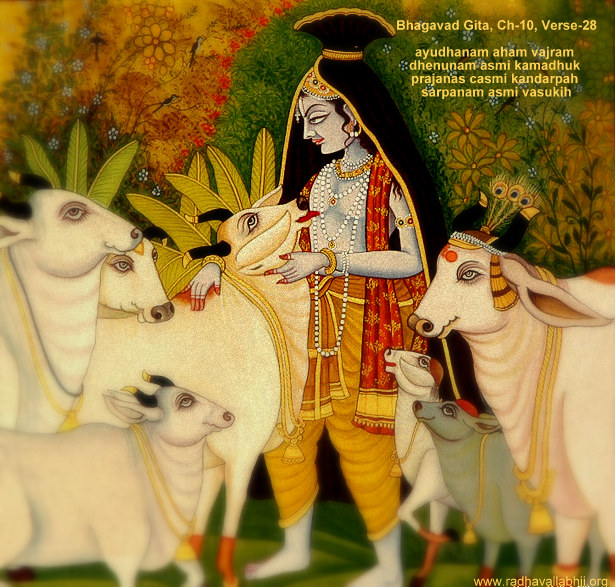
The Sacredness of the Holy Cow – Bhagavad Gita – Ch-10, Verse- 28

gopala_krishna

In this verse Lord Krishna reveals that among cows He is manifested as the kamadhuk meaning kamadhenu the original wish fulfilling cows known as the surabhi cows. Just who and what are the surabhi cows and how the surabhi cows attained such an elevated and exalted position that they are able to represent a portion of the energy of the supreme Lord Krishna will be revealed in the following information given in the Anusasana Parva of the Mahabharata by Krishna Dvaipayana Vyasa.

The surabhi cow descended from the spiritual worlds and manifested herself in the heavenly spheres from the aroma of celestial nectar for the benefit of all created beings. The direct descendants of the surabhi cows are the sacred cows from the continent India which are uniquely distinguished the same as the surabhi by the beautiful hump on their backs and the wonderfully soft folds of skin under their necks. Since all cows in existence in the world today are factual descendants of the sacred cows of India they are all holy as well and should always be lovingly cared for and protected with the highest esteem and greatest respect. One should never cause harm to cows in any way even in a dream and one should never ever even think of eating the flesh of cows as there is no action more sinful in all of creation then cow killing.

Cows are the mothers of all creatures. Cows are verily the mothers of the 33 crores of demigods that administrate creation in the material existence throughout all the universes. Cows are the goddesses of the gods and the refuge of all auspiciousness. Cows bestow every kind of happiness and for these reason they always are worshippable. Cows are the support of all the worlds for by their milk they nourish terrestrials beings and by their ghee offered in sacrifice they nourish the denziens of the celestial realms. Nothing superior to cows.

A cow should not be owned by one who is a killer of cows or a seller to killers of cows, by one who is unrighteous, by one who is sinful, by one who is untruthful in speech, and by one who is outside of the Vedic culture nor should cows ever be given to one such as these. Gifts of cows should be made after ascertaining and determining the qualification of the receiver. Cows should never be given unto those whose residence they are likely to suffer from fire or sun. Cows should always be given away accompanied by their calves. Those cows who have been rescued from situations of distress or have been received from humble farmers unable to continue to take care of them properly are considered to be most auspicious.

One should never show disrepect for cows in any way nor should one feel any repugnance towards the urine and dung of a cow because these things are also pure. When cows are grazing or laying down relaxing one should never disturb or annoy them in any way. Cows should never be killed in any type of sacrifice or slaughtered in any way for food as the killing of cows constitutes the most heinous of all sins in existence.

Cows are the foremost of all creatures in all the worlds. It is from cows that the means for sustaining the worlds has established. Cows are auspicious and sacred and the bequeathers of every blessing. Cows benefit humans with milk, yoghurt, cheese, butter and ghee. The Vedas have stated that the milk of a cow is equivalent to ambrosial nectar and that ghee derived from cows milk is the best of all libations poured onto the sacred fires of brahmins.

Cows of various kinds and diverse colors are always worshippable. They are the foremost of all creatures existing in all of creation. Morning and evening one should bow ones head in reverence to cows. One should never show any disregard to cows in any way but should always show them respect. When one awakes in the morning one should always remember cows. Before falling to sleep at night one should always remember cows. Cows are always auspicious. Cows are also fragrant. The wonderful scent of the amytis agallochum emantes from out of their sacred bodies.

Cows are the great refuge of all creatures. Cows constitute the greatest source of blessings for all creatures. Cows are the past. Cows are the future. Cows are the source of evolution and eternal growth. Cows are the root of prosperity. Whatever is given to cows always produces good fortune and is never in vain. It is solely and exclusively from the ghee of cows that the sacred rituals prescribed and authorised in the Vedas are empowered and able to be performed. Without the presence of cows ghee there is no possibiity of performing sacred rituals that will gratify the 33 million demigods who are responsible for universal management. Neither will the Supreme Personality of Godhead, Lord Krishna be pleased and satisfied. Ghee comes exclusively only from cows from whom flow offerings of milk and milk products. Thus cows verily establish the purity of all sacred rituals and constitute the very essence of performing all sacred activities being the very source of sacred activities.

Cows represent sacred acts themselves and without cows there can be no performance of any sacred act. This is the pure, sublime and supremely exalted position and pre-eminence of cows above all creatures in all the worlds. One who knows the pre-eminence of cows and the selfless service cows render to all creatures and does not protect them affectionately is a sinner and offender and their destination is certainly hell. Cows are equal to the rays of the sun that travel through the universe giving light, warmth and nourishment.

In previous yugas the Vedic injunction was given jiyaite pare yadi tabe mare prani veda-purane ache hena ajna vane that means in the Vedic scriptures known as Puranas there are injunctions declaring that one can take the life of a living being only if they are able to revive it back to life again by chanting Vedic mantras. But we find that this injunction has been terminated in todays age of kali yuga by the Brahma-Vaivarta Purana where it is stated that in the present age of kali yuga it is forbidden to kill cows under any circumstances.

Cows are equivalent to our mothers for when the mothers milk has dried up the cow gives her milk unselfishly to noursih and strengthen us. How can one who has ever drunk cows milk justify the killing and eating of such a mother as the sacred cow. One should never even in one’s mind do injury to a cow or ever think of harming cows as well as bulls. One should show all respect and compassion for cows and sincere reverence should be offered unto them all without reservation.

Those who fail to give cows reverence and protection and choose to foolishly oppose and whimsically ignore the injunctions of the Vedic scriptures by selling a cow for slaughter, by killing a cow, by eating cows flesh and by permittings the slaughter of cows will all rot in the darkest regions of hell for as many thousands of years as there are hairs on the body of each cow slain. There is no atonement for the killing of a cow.

“Jai Shri RadheKrishna”