
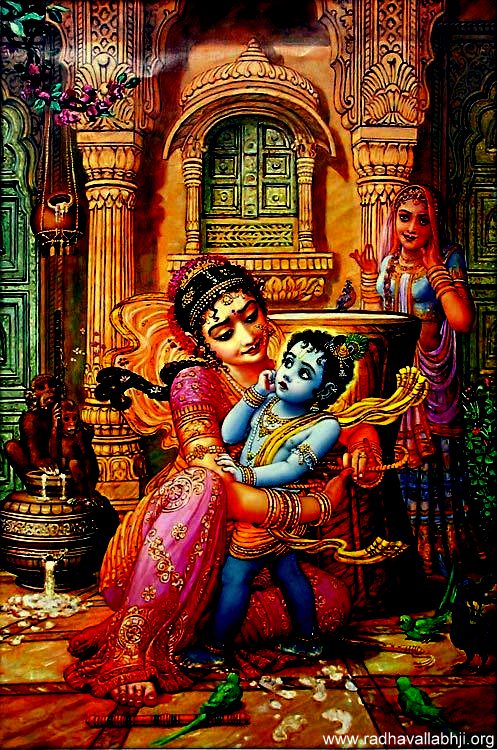
Once upon a time, seeing that her maidservant was engaged in different household duties, mother Yasoda personally took charge of churning butter. And while she churned butter, she sang the childhood pastimes of Krsna and enjoyed thinking of her son.
The end of her sari was tightly wrapped while she churned, and on account of her intense love for her son, milk automatically dripped from her breasts which moved as she labored very hard, churning with two hands. The bangles and bracelets on her hands tinkled as they touched each other, and her earrings and breasts shook. There were drops of perspiration on her face, and the flower garland which was on her head scattered here and there. Before this picturesque sight, Lord Krsna appeared as a child. He felt hungry, and out of love for His mother, He wanted her to stop churning. He indicated that her first business was to let Him suck her breast and then churn butter later.
Mother Yasoda took her son on her lap and pushed the nipples of her breasts into His mouth. And while Krsna was sucking the milk, she was smiling, enjoying the beauty of her child’s face. Suddenly, the milk which was on the oven began to boil over. Just to stop the milk from spilling, mother Yasoda at once put Krsna aside and went to the oven. Left in that state by His mother, Krsna became very angry, and His lips and eyes became red in rage. He pressed His teeth and lips, and taking up a piece of stone, He immediately broke the butter pot. He took butter out of it, and with false tears in His eyes, He began to eat the butter in a secluded place.
In the meantime, mother Yasoda returned to the churning place after setting the overflowing milk pan in order. She saw the broken pot in which the churning yogurt was kept. Since she could not find her boy, she concluded that the broken pot was His work. She began to smile as she thought, “The child is very clever. After breaking the pot He has left this place, fearing punishment.” After she sought all over, she found a big wooden grinding mortar which was kept upside down, and she found her son sitting on it. He was taking butter which was hanging from the ceiling on a swing, and He was feeding it to the monkeys. She saw Krsna looking this way and that way in fear of her because He was conscious of His naughty behavior. After seeing her son so engaged, she very silently approached Him from behind. Krsna, however, quikly saw her coming at Him with a stick in her hand, and immediately He got down from the grinding mortar and began to flee in fear.
Mother Yasoda chased Him to all corners, trying to capture the Supreme Personality of Godhead who is never approached even by the meditations of great yogis. In other words, the Supreme Personality of Godhead, Krsna, who is never caught by the yogis and speculators, was playing just like a little child for a great devotee like mother Yasoda. Mother Yasoda, however, could not easily catch the fast-running child because of her thin waist and heavy body. Still she tried to follow Him as fast as possible. Her hair loosened, and the flower in her hair fell to the ground. Although she was tired, she somehow reached her naughty child and captured Him. When He was caught, Krsna was almost on the point of crying. He smeared His hands over His eyes, which were anointed with black eye cosmetics. The child saw His mother’s face while she stood over Him, and His eyes became restless from fear. Mother Yasoda could understand that Krsna was unnecessarily afraid, and for His benefit she wanted to allay His fears.
Being the topmost well-wisher of her child, mother Yasoda began to think, “If the child is too fearful of me, I don’t know what will happen to Him.” Mother Yasoda then threw away her stick. In order to punish Him, she thought to bind His hands with some ropes. She did not know it, but it was actually impossible for her to bind the Supreme Personality of Godhead. Mother Yasoda was thinking that Krsna was her tiny child; she did not know that the child had no limitation. There is no inside or outside of Him, nor beginning or end. He is unlimited and all-pervading. Indeed, He is Himself the whole cosmic manifestation. Still, mother Yasoda was thinking of Krsna as her child. Although He is beyond the reach of all senses, she endeavored to bind Him up to a wooden grinding mortar. But when she tried to bind Him, she found that the rope she was using was too short–by two inches. She gathered more ropes from the house and added to it, but at the end she found the same shortage. In this way, she connected all the ropes available at home, but when the final knot was added, she saw that it was still two inches too short. Mother Yasoda was smiling, but she was astonished. How was it happening?
In attempting to bind her son, she became tired. She was perspiring, and the garland on her head fell down. Then Lord Krsna appreciated the hard labor of His mother, and being compassionate upon her, He agreed to be bound up by the ropes. Krsna, playing as a human child in the house of mother Yasoda, was performing His own selected pastimes. Of course, no one can control the Supreme Personality of Godhead. The pure devotee surrenders himself unto the lotus feet of the Lord, who may either protect or vanquish the devotee. But for his part, the devotee never forgets his own position of surrender. Similarly, the Lord also feels transcendental pleasure by submitting Himself to the protection of the devotee. This was exemplified by Krsna’s surrender unto His mother, Yasoda.
Krsna is the supreme bestower of all kinds of liberation to His devotees, but the benediction which was bestowed upon mother Yasoda was never experienced even by Lord Brahma or Lord Siva or the goddess of fortune.
The Supreme Personality of Godhead, who is known as the son of Yasoda and Nanda Maharaja, is never so completely known to the yogisand speculators. But He is easily available to His devotees. Nor is He appreciated as the supreme reservoir of all pleasure by the yogis and speculators.
After binding her son, mother Yasoda engaged herself in household affairs. At that time, bound up to the wooden mortar, Krsna could see a pair of trees before Him which were known as arjuna trees. The great reservoir of pleasure, Lord Sri Krsna, thus thought to Himself, “Mother Yasoda first of all left without feeding Me sufficient milk, and therefore I broke the pot of yogurt and distributed the stock butter in charity to the monkeys. Now she has bound Me up to a wooden mortar. So I shall do something more mischievous than before.” And thus He thought of pulling down the two very tall arjuna trees.
There is a history behind the pair of arjuna trees. In their previous lives, the trees were born as the human sons of Kuvera, and their names were Nalakuvara and Manigriva. Fortunately, they came within the vision of the Lord. In their previous lives they were cursed by the great sage Narada in order to receive the highest benediction of seeing Lord Krsna. This benediction-curse was bestowed upon them because of their forgetfulness due to intoxication.
Source: Krsna by A. C. Bhaktivedanta Swami Prabhupada
“Jai Shri RadheKrishna”
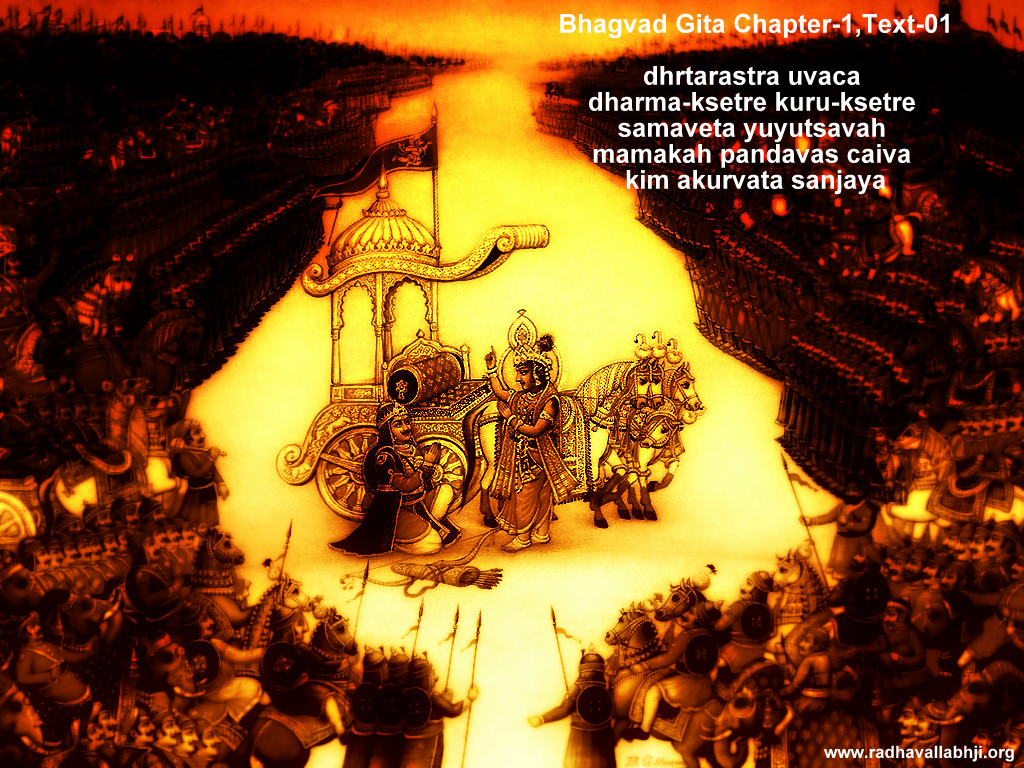
 The topics discussed by Dhrtarastra and Sanjaya, as described in theMahabharata, form the basic principle for this great philosophy. It is understood that this philosophy evolved on the Battlefield of Kuruksetra, which is a sacred place of pilgrimage from the immemorial time of the Vedic age. It was spoken by the Lord when He was present personally on this planet for the guidance of mankind.
 Self Discovery
You must be logged in to post a comment.