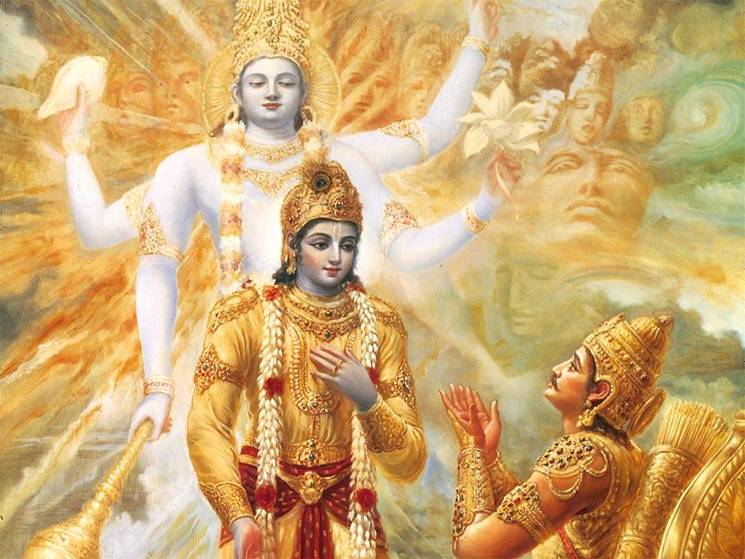
 Krishna is Everything.
Krishna: But now I will tell you the most intimate secrets, which only my friends can truly understand. Learn this, and you will be liberated from all misfortune. It is the supreme science, the monarch of mysteries, the purest purifier. It is very enjoyable, self-evident and everlasting.
Arjuna: If it is so enjoyable and tangibly beneficial, why is it so secret?
Krishna: Because common men have little interest in it. They are not interested in attaining me. Instead they want some temporary paradisiac from which they soon return to the cycle of mortality.
Arjuna: Please tell me these most confidential secrets.
Krishna: I am spread throughout this entire universe, in an imperceptible form. Everything is in me, but I am not contained within anything. And so, everything is not me.
Arjuna: This is almost incomprehensible.
Krishna: That is the nature of my mystic power.
Arjuna: Can you explain it more clearly?
Krishna: I am the original entity from which everything comes into being. Thus, I support everyone and everything, but I am not contained within anyone or anything.
Arjuna: It is still very difficult to understand. Can you give an analogy?
Krishna: The atmosphere is contained within space, and space is within the atmosphere. But the atmosphere does not contain space.
Arjuna: Ah! Like everything is within space, so everything exists within you. And you are within everything, just like everything has space within it. But just as nothing contains the whole of space, similarly nothing is completely you, except you yourself. I am beginning to understand.
I have a different question. You said everything that exists is within you. What about things that no longer exist, things that have been destroyed?
Krishna: When a thousand ages end, Arjuna, everything is destroyed and becomes energy, my energy. When a new cycle of a thousand ages begins again, I recreate everything.
Arjuna: How do you recreate everything from energy?
Krishna: Again and again, I create by placing living beings into my energy, which then automatically takes different forms in conformity to their will.
Arjuna: So you are not directly responsible for the things that arise in the universe?
Krishna: Right. I am a neutral party in all this, never implicated in the causality of their selfish deeds.
Arjuna: What role does a “neutral party” play in the universe?
Krishna: I keep my glance upon it and thereby grant it the power to reproduce all its mobile and immobile forms.
Arjuna: But here you are standing in front of me. How can you be the source of everything in the universe?
Krishna: Fools think that I am limited within the shelter of a human body. You are not such a fool, Arjuna.
Arjuna: How do you know I am not?
Krishna: Because you are not like them.
Arjuna: What are they like?
Krishna: Those fools take shelter of the material world. Intoxicated by it they become ungodly, wild and mindless. They develop useless ambitions, useless endeavors and useless understandings.
Arjuna: I’m not like that?
Krishna: No, you are like the great souls.
Arjuna: What are they like?
Krishna: Great souls take shelter of the spiritual world, and adore me without ulterior motive, because they understand that I am the inexhaustible origin of everything.
Arjuna: You’ve described their heart, what about their deeds?
Krishna: Great souls always strive with determined commitment to constantly perform kirtana: glorifying me and constantly offering me affectionate respect and worship.
Arjuna: Are there other ways to worship you?
Krishna: Yes. The not-so-great souls worship me indirectly in many different ways. They worship me as the effort to gain knowledge, as the oneness uniting plurality and as the personification of the universe itself.
Arjuna: Why are these less wonderful than kirtana?
Krishna: Because these people downplay the essence and focus on other things.
Arjuna: What is the essence?
Krishna: I am.
I am the ritual. I am the sacrifice. I am the ancestor’s offering. I am the sacred herb. I am the mantra. I am the oil, the fire and the offering. I am father, mother, provider and grandfather. I am the objective of “OM” which purifies the Rig, Sama and Yajur Vedas. I am the goal, the husband, the lord, the witness, the home, the shelter and the sweetheart. I am creation, destruction and existence. I am the original seed. I am warmth. I withhold and send forth the rains. I am immortality and death. I am the real and unreal.
Arjuna: What becomes of those who worship you in these distracted ways?
Krishna: Knowing the ways of rituals, they perform sacrifice as a prayer to me, expressing the desire to enter paradise. Drinking the ritual soma, they become purified and enter the pure realm of the king of gods, where there they enjoy the gods’ delights.
Arjuna: That sounds good.
Krishna: Yes, but by enjoying the vast heavenly realm they exhaust their piety and must return to the world of mortals. So, birth and death is the end result of worship done for selfish rewards.
Arjuna: What becomes of those who worship you with pure selfless love, not distracted by selfish ulterior motives?
Krishna: Those who have no selfish ulterior motives really perform true worship. I personally take care of them.
Arjuna: How?
Krishna: I protect them from whatever mistakes they make. And I uphold whatever they do correctly.
Arjuna: You just said that you are everything. So if I worship anything, I worship you?
Krishna: Yes, but that is generally unbeknownst to those who worship many gods. Although they have faith and devotion in such gods, and although the truth is that they are actually worshipping me, this is not the recommended path.
Arjuna: What is the recommended path?
Krishna: To be aware that I am every sacrifice, every god, every master and therefore to directly worship me without distraction. People who are not truly aware of this reality become distracted by gods and rituals. They remain in the mortal realm.
Arjuna: What if one worships the gods knowing that they are actually you?
Krishna: Worshippers of the gods attain the gods. Worshippers of ancestors attain the ancestors. Worshippers of spirits attain those spirits. But only those who directly worship me can attain me.
Arjuna: How should I directly worship you?
Krishna: It is simple, easy and joyful: with love.
Arjuna: How should I express that love?
Krishna: Out of love, offer me a leaf, a flower, a fruit or some water. When these are offered to me lovingly by a devoted soul, I hungrily accept them.
Arjuna: What if I cannot be so simple and pure?
Krishna: My friend, whatever you do, whatever you eat, whatever sacrifices you make, whatever gifts you give, whatever difficulties you undertake, do them for my sake, not your own. This discipline of renunciation will purify you completely from the positive and negative partiality of selfish deeds. Then you will be able to simply love me.
Arjuna: Why are you so partial towards your devotee and indifferent towards those who are distracted from loving you?
Krishna: I am not partial to anyone. I am equal to everyone. I neither favor nor disfavor anyone. But anyone who shows me true devotion is in my heart, just as I am in theirs.
I am open to everyone and anyone. Even if someone has been a very foul person, if they somehow develop love for me without ulterior motive I consider them a saint, and very righteous.
Arjuna: How can a very foul person have pure love for you?
Krishna: This love immediately makes them pure and righteous, and grants them spiritual peace. My dear cousin, you should declare that one who loves me can never fail to be righteous.
Arjuna: So anyone and everyone can become your devotee?
Krishna: Yes, even those born into foul circumstances, or those who are not educated in spiritual matters. Everyone can attain this supreme destination by pure love for me.
Arjuna: What about those born into good circumstances?
Krishna: Of course. It is even easier for philosophical intellectuals and the devoted, philosopher-kings like yourself. However you may have come into this temporary and unhappy situation, you can always take up my pure devotional service.
Arjuna: What is the essence of “pure devotional service”?
Krishna: Become devoted to me by keeping me in your mind, working for my sake and being respectful to me. With your soul thus dedicated to me, certainly you will attain me.
“Jai Jai Shri Radhe”

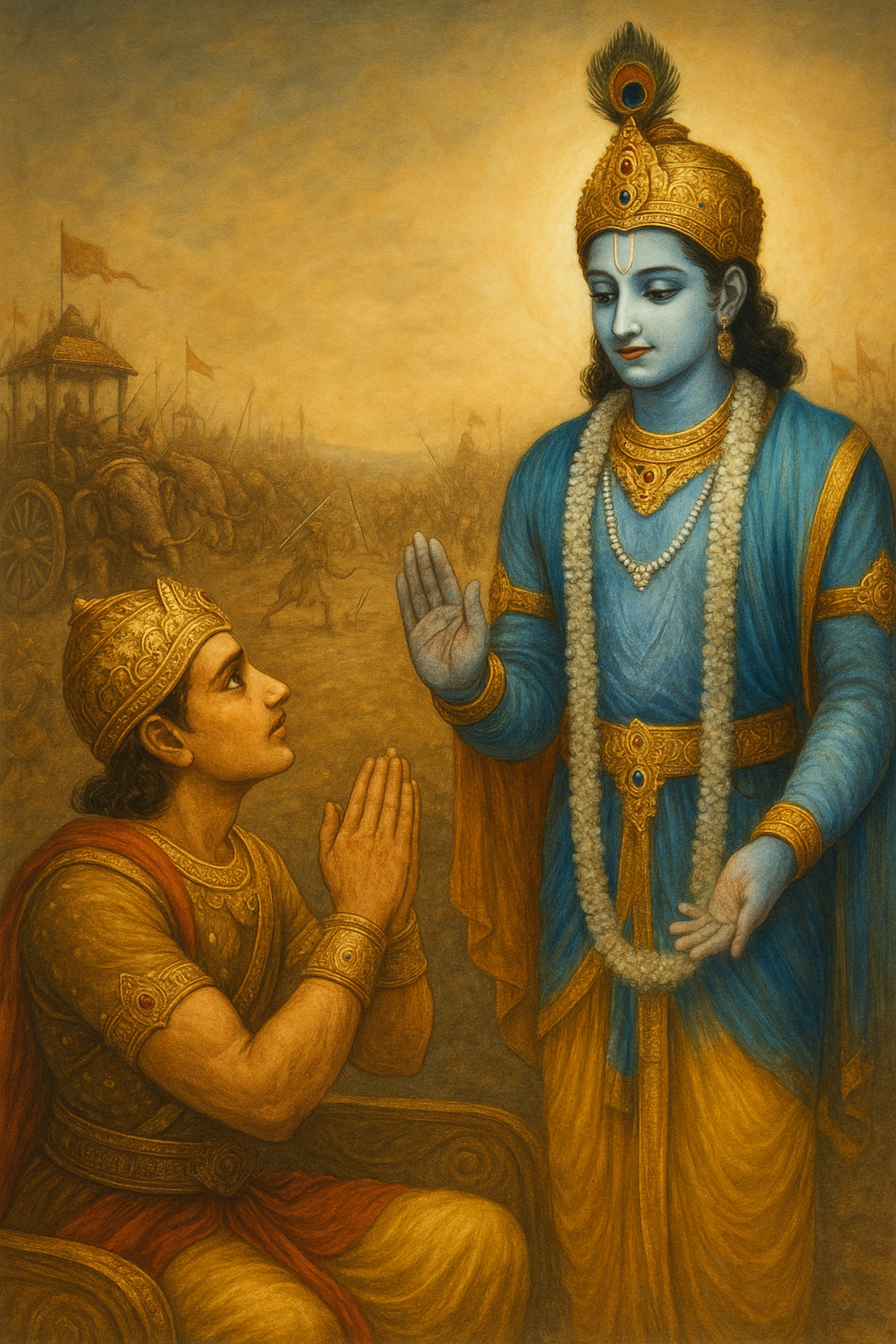
 Tilaka refers to the markings which Vaisnava devotees apply to their bodies, to remind themselves and others that we are all eternal servants of Lord Krsna. The U-shaped mark represents the heel of Lord Visnu, and the oval part represents the Tulasi leaf. Tilaka is applied to twelve parts of the body, and the twelve names of the Lord are recited with each application. To apply tilaka, start with a little Ganges or Yamuna water (if you don’t have any, get some water, and stirring it with your right middle finger, chant:
 Self Discovery
You must be logged in to post a comment.