Pavitropana Ekadashi in Shukla Paksha

krishnas Cow

Shri Yudhisthira Maharaja said, “Oh Madhusudana, please describe to me the Ekadashi that occurs during the light fortnight of the month of Shravana (July-August).” The Supreme Lord, Sri Krishna, replied, “Yes, I shall happily narrate its glories to you, for just by hearing about this sacred Ekadashi one attains the merit of performing a horse sacrifice.

At the dawn of Dvarpara-yuga there lived a king by the name of Mahijita, who ruled the kingdom of Mahismati-puri. As he had no son, his kingdom seemed cheerless to him.

The Sanskrit word for ‘son’ is putra. Pu is the name of a particular hell, and tra means ‘to deliver.’ Thus the word putra means ‘a person who delivers one from the hell named Pu.’ Therefore every married man should produce at least one son and train him properly; then the father will be delivered from a hellish condition of life. But this injunction does not apply to the serious devotees of Lord Vishnu or Krishna, for the Lord becomes their son, father, and mother.

For a long time this king tried very hard to obtain an heir, but to no avail. The king’s advisers visited various great sages. At last they came upon a sage who was austere, pure, and self-satisfied, and who was strictly observing a vow of fasting. He was expert in all the conclusions of the Vedas, and he had extended his life span to that of Lord Brahma himself. His name was Lomasa Rishi, and he knew the past, present, and future.

King Mahijita’s advisers offered obeisances to him and said, ‘Only because of our great good fortune, have we been allowed to see you.’  Lomasa Rishi saw them bowing down to him and replied, ‘Kindly let me know why you have come here. I shall do all I can to solve your problems.’

The king’s representatives said, ‘Our king, Mahijita, is without a son, though he has sustained and protected us as if we were his sons. We request you to tell us how our king can obtain a son.’

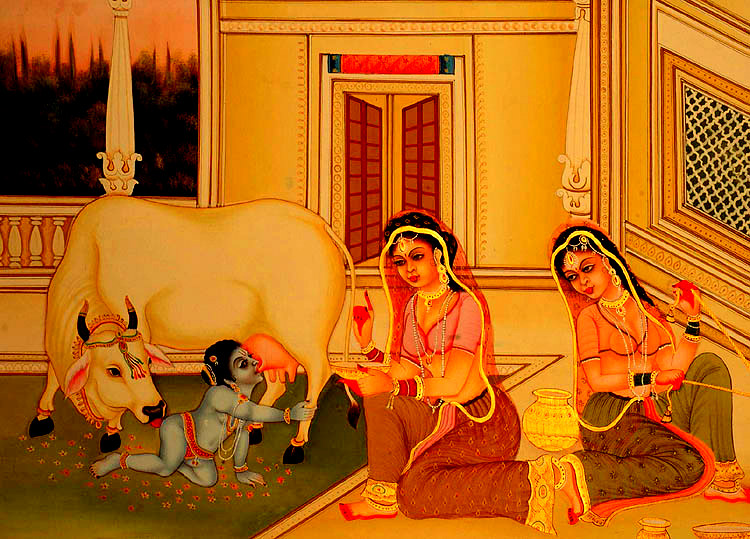
Lomasa Rishi absorbed himself in deep meditation for a moment and at once understood the king’s previous life. Then he said, ‘Your ruler was a merchant in his past life, and feeling his wealth insufficient, he committed sinful deeds. He traveled to many villages to trade his goods. Once, at noon he became thirsty while traveling from place to place. He came upon a pond and just as he was about to drink, a cow arrived there with her new-born calf. When the cow and calf started to drink, the merchant rudely shoved them aside and selfishly slaked his own thirst. This offense against a cow and her calf has resulted in your king’s being without a son now. But the good deeds he performed in his previous life have given him rulership over an undisturbed kingdom.’

Hearing this, the king’s advisers replied, ‘Oh renowned rishi, please give us some instruction by which our king’s sins can be destroyed; so that a prince will take birth in his family.’

Lomasa Rishi said, ‘There is an Ekadashi called Putrada, which comes during the light fortnight of the month of Shravana. On this day all of you, including your king, should fast and stay awake all night, strictly following the rules and regulations. Then you should give the king whatever merit you gain by this fast, he will surely be blessed with a fine son.’

When the month of Shravana arrived, all the citizens of Mahismati-puri, as well as the king, fasted on Ekadashi. And on the next day, Dwadashi, the citizens dutifully offered their accrued merit to him. By the strength of all this merit, the queen became pregnant and eventually gave birth to a beautiful son.

“O Yudhisthira,” Lord Krishna concluded, “the Ekadashi that comes during the light fortnight of the month of Shravana has thus rightfully become famous as Putrada [“bestower of a son”]. Whoever desires happiness in this world and the next should certainly fast from all grains and legumes on this holy day. Indeed, whoever simply hears the glories of Putrada Ekadashi becomes completely free of all sins, is blessed with a good son, and surely ascends to heaven after death.

Thus ends the narration of the glories of Shravana-shukla Ekadashi, or Putrada Ekadashi, from the Bhavishya Purana.

“Jai Shri RadheKrishna”
Kamika Ekadashi in Krishna Paksha

BrahmaKrishnaNarada

Yudhisthira Maharaj said, “Oh Sri Krishna, I would like to hear from You the glories of the Ekadashi that occurs during the dark fortnight (Krishna paksha) of the month of Shravana (July–August). Please be merciful to me and explain its glories.”

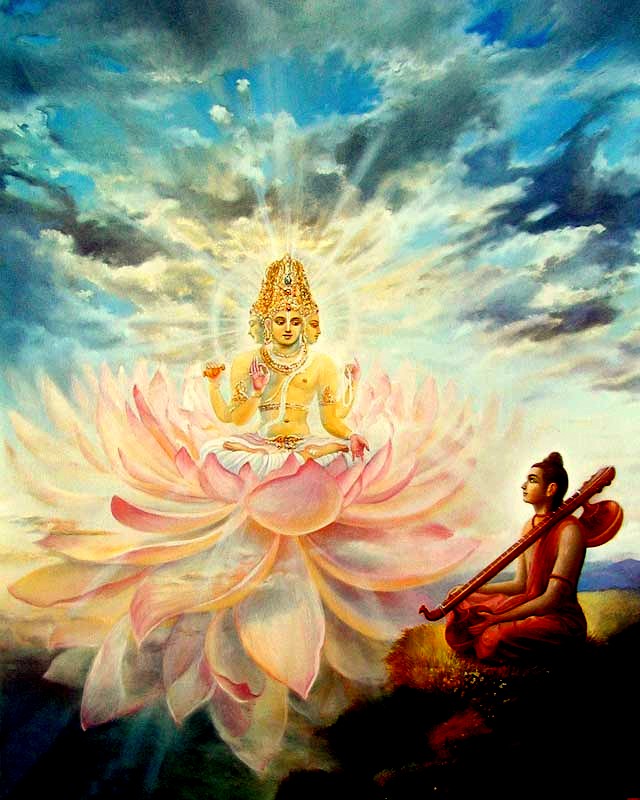
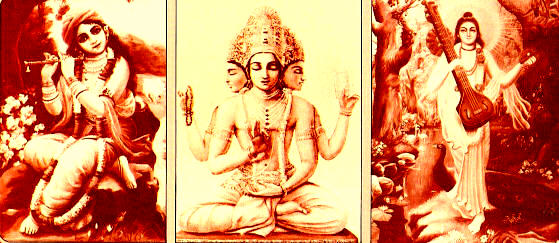
Sri Krishna, replied, “Oh King, please listen attentively as I describe the auspicious influence of this day, which removes all sins. Narada Muni once asked Lord Brahma about this same topic.

Lord Brahma replied, ‘My dear son Narada, for the benefit of all humanity I shall happily tell you everything you wish to know; for just hearing the glories of the Kamika Ekadashi bestows merit equal to that obtained by one who performs a horse sacrifice. Certainly, great merit is attained by one who worships, and who also meditates on the lotus feet of the four-armed Lord Gadadhara, who holds a conch shell, disc, club and lotus in His hands and who is also known as Sridhara, Hari, Vishnu, Madhava, and Madhusudana.

Observing Kamika Ekadashi bestows the same merit as donating a milch cow and her auspicious calf, along with their feed. On this all auspicious day, whosoever worships Lord Sri Sridhara-deva, Vishnu, is glorified by all the devas, Gandharvas, Pannagas, and Nagas.

Those who are afraid of their past sins and completely immersed in sinful materialistic life should at least observe this best of Ekadashis according to their ability and thus attain liberation. Oh Narada, Lord Shri Hari Himself once said about this Ekadashi, “One who fasts on Kamika Ekadashi attains much more merit than one who studies all the spiritual literatures.”

Anyone who fasts on this particular day and remains awake throughout the night will never experience the anger of Yamaraja, the king of death personified. 

Whosoever worships Lord Shri Hari with Tulasi leaves is freed from all implication of sin. Indeed, he lives untouched by sin, as the lotus leaf, although in the water, is untouched by it.

The Supreme Personality of Godhead is more pleased by one who offers Him a single Tulasi leaf than by one who worships Him with pearls, rubies, diamonds, etc. One who offers Lord Keshava newly grown manjari buds from the tulasi plant gets rid of all the sins he has committed during this or any other lifetime. Indeed, mere darshana of Tulasi on Kamika Ekadashi removes all sins, and merely touching her and praying to her removes all kinds of disease. One who waters Tulasi devi need never fear the Lord of death, Yamaraja. One who plants or transplants Tulasi on this day will eventually reside with Lord Shri Krishna in His own abode. To Srimati Tulasi devi, who awards liberation in devotional service, one should therefore daily offer one’s full obeisances.

Even Chitragupta, Yamaraja’s secretary, cannot calculate the merit obtained by one who offers Srimati Tulasi-devi a perpetually burning ghee lamp. So dear is this sacred Ekadashi to the Supreme Personality of Godhead that all the forefathers of one who offers a bright ghee lamp to Lord Shri Krishna on this day ascend to the heavenly planets and drink the celestial nectar there. Whoever offers a ghee or sesame oil lamp to Shri Krishna on this day is freed from all his sins and enters the abode of Surya, the Sun-god, with a body as bright as ten million lamps. This Ekadashi is so powerful that if one who is unable to fast simply follows the practices as mentioned herein, he / she is elevated to the heavenly planets, along with all their forefathers.

Oh Maharaj Yudhisthira, Lord Shri Krishna concluded, “…these were the words of Prajapati Brahma to his son Narada Muni concerning the incalculable glories of this Kamika Ekadashi, which removes all sins. This sacred day nullifies even the sin of killing a brahmana or the sin of killing an unborn child in the womb, and it promotes one to the spiritual world by making one supremely meritorious.”

Whosoever hears these glories of the Kamika Ekadashi with faith becomes free of all sins and returns home, back to Godhead.

“Jai Shri RadheKrishna”

Shayana Ekadashi in Shukla Paksha

Shayana

Yudhisthira Maharaj said, “Oh Keshava, what is the name of the Ekadashi that occurs during the light fortnight of the month of Ashadha (June – July) and what is the process for observing this event?”

Lord Sri Krishna replied, “I shall tell you a wonderful historical event that Lord Brahma once narrated to his son Narada Muni. One day Narada Muni asked his father, ‘What is the name of the Ekadashi that comes during the light part of the month of Ashadha? Kindly tell me how I should observe this Ekadashi and thus please the Supreme Lord, Sri Vishnu.’

Lord Brahma replied, ‘Your question is as usual excellent for all mankind. For this reason I shall tell you about this Ashadha-shukla Ekadashi.Fasting on this Ekadashi purifies one of all sins and fulfills all desires.Ashadha-shukla Ekadashi is also known as Padma Ekadashi. Just to please the Supreme Lord Hrishikesha, the master of the senses, one should fast on this day. Listen carefully, Oh Narada, as I relate to you a wonderful historical event that was recorded in the scriptures regarding this Ekadashi. Just hearing this account destroys all kinds of sins.

There was once a saintly king in the Surya Vamsha (Sun dynasty) whose name was Mandhata. Because he always stood up for the truth, he was appointed emperor. All his subjects were very wealthy. The king’s own treasury was free of any ill-gotten money, and thus he ruled happily for many years.

Once, however, because of some sin in his kingdom, there was a drought for three years. The lack of food grains made it impossible for the people to perform the prescribed Vedic sacrifices, etc. Finally, they all came before their beloved king and said, ‘Oh king, we humbly beg your assistance now. Everyone and everything in this world needs water. The Vedas call water Nara, and because the Supreme Personality of Godhead sleeps upon water, His another name is Narayana. In His form as the clouds, the Supreme Lord is present throughout the sky and pours forth rains, from which grow the grains that maintain every living entity. The severe drought has caused a great lack of valuable grains; thus we are all miserable, please find some solutions to this problem.’

The king replied, ‘Grains are like Brahman, the Absolute Truth, who lives within grains and thereby sustains all beings. If a king (or head of the country) is irreligious, both he and his subjects suffer. After searching my past and present character I can honestly say that I find no sin. Still, I shall try to remedy the situation.”

King Mandhata assembled his army and entourage, paid his obeisances to me, and then entered the forest. He wandered here and there, seeking great sages in their Ashrams and inquiring about how to resolve the crisis in his kingdom. At last he came upon the ashram of one of my other sons, Angira Muni, whose effulgence lit up all directions. King Mandhata was very pleased to see that exalted sage, whose senses were completely under control.

The king immediately dismounted his horse and offered his respectful obeisances at the lotus feet of Angira Muni. Then Angira Muni asked the king why he had undertaken such a difficult journey into the forest, and the king told him of the affliction his kingdom was suffering. The king said, ‘Oh great sage, to solve this mystery, I have approached you for help.’

Angira Rishi said to the king, ‘The present age, Satya yuga, is the best of all ages, for in this age Dharma stands on all four legs (Truthfulness, Austerity, Mercy, and Cleanliness). In this age everyone respects Brahmins as the topmost members of society. Also, everyone fulfills his occupational duties, and only twice-born Brahmins are allowed to perform Vedic austerities and penances. Although this is a standard, there is one shudra (uninitiated, untrained person) who is thus unlawfully performing the rites of austerity and penance in your kingdom. This is why there is no rain in your land. You should therefore punish this labourer with death, for by so doing you will remove the contamination inflicted by his actions and restore peace to your subjects.’

The king then replied, ‘How can I kill an offenseless performer of austerity and sacrifice? Please give me some spiritual solution.’

Angira Muni then said, ‘Oh king, you should observe a fast on the Ekadashi that occurs during the light fortnight of the month of Ashadha. This auspicious day is named Padma Ekadashi, and by its influence plentiful rains and thus grains and other foodstuffs will surely return to your kingdom. This Ekadashi bestows perfection upon its faithful observers, removes all kinds of bad elements, and destroys all obstacles on the path to perfection.

The king offered his obeisances and then returned to his palace. When the Padma Ekadashi arrived, King Mandhata and all his subjects strictly observed it, the rains fell, just as the sage had predicted, and in due course of time there were abundant crops and a rich harvest of grain. By the mercy of the Supreme Lord Hrishikesha, the master of the senses, all the subjects of King Mandhata became extremely happy and prosperous.

Therefore, Oh Narada, everyone should observe this Ekadashi fast very strictly, for it bestows all kinds of happiness, as well as ultimate liberation, upon the faithful devotee.’

Lord Sri Krishna concluded, “My dear Yudhishthira, Padma Ekadashi is so powerful that one who simply reads or hears its glories becomes completely sinless. Oh Pandava, one who wishes to please Me should strictly observe this Ekadashi, which is also known as Deva Shayani Ekadashi.

“Jai Shri RadheKrishna”