Yogini Ekadashi in Krishna Paksha

Krishna and Brahma

Yudhishthira Maharaj said, “Oh Supreme Lord, I have heard the glories of the Nirjala Ekadashi, which occurs during the light fortnight of the month of Jyeshtha (May – June). Now I wish to hear from You about the Shuddha Ekadashi that occurs during the dark fortnight of the month of Ashadha (June – July). Kindly describe to me all about it in detail.”

Sri Krishna, then replied, “Oh king, I shall indeed tell you about the best of all fasting days, the Ekadashi that comes during the dark part of the month of Ashadha. Famous as Yogini Ekadashi, it removes all kinds of sinful reactions and awards liberation.

This Ekadashi delivers people who are drowning in the vast ocean of material existence and transports them to the shore of the spiritual world. In all the three worlds, it is the chief of all sacred fasting days. I shall now reveal this truth to you by narrating a history recounted in the Puranas.

The king of Alakapuri – Kuvera, the treasurer of the demigods – was a steadfast devotee of Lord Shiva. He had a servant named Hemamali who was his gardener. Hemamali, a Yaksha like Kuvera, was lustfully attracted to his wife, Swarupavati, who had enchanting eyes.

Hemamali’s daily duty was to visit Manasarovara lake and bring flowers for his master, Kuvera, which he would use in the puja offerings to Lord Shiva. One day, after picking the flowers, Hemamali went to his wife instead of returning directly to his master. Absorbed in loving affairs with his wife, he forgot to return to the abode of Kuvera.

While Hemamali was enjoying with his wife, Kuvera had begun the worship of Lord Shiva and soon discovered that there were no flowers ready to be offered. The lack of such an important item angered Kuvera, and he asked a Yaksha messenger, ‘Why has dirty-hearted Hemamali not come with the daily offering of flowers? Go find out the exact reason.’ The Yaksha returned and told Kuvera, ‘Oh lord, Hemamali has become lost in the company of his wife.’

Kuvera became extremely angry and at once summoned Hemamali before him. Hemamali approached his master in great fear. Enraged, Kuvera cried out to Hemamali, ‘Oh you sinful rascal! I curse you to suffer from leprosy and to become separated from your beloved wife! Leave this place immediately and betake yourself to the lower planets to suffer!’

And so Hemamali fell at once from grace in Alakapuri and became ill with the terrible affliction of leprosy. He awoke in a dense and fearful forest, where there was nothing to eat or drink. Thus he passed his days in misery, unable to sleep at night due to pain. He continued to worship Lord Shiva with faith, his consciousness remained purely fixed and steady. Although implicated by great sin and its attendant reactions, he remembered his past life because of his piety.

After wandering for some time Hemamali eventually came upon the vast expanse of the Himalayan mountain ranges. There he had the good fortune to come in contact with the great saintly soul Markandeya Rishi, whose duration of life it is said, extends to seven of the days of Brahma.

Markandeya Rishi was seated peacefully at his ashrama. Hemamali, feeling very sinful, stood at a distance and offered his humble obeisances. Markandeya Rishi saw the leper and called him near, ‘What sort of sinful deeds have you done to earn this dreadful affliction?’ Hearing this, Hemamali painfully replied, ‘I am a Yaksha servant of lord Kuvera, and my name is Hemamali. It was my daily service to pick the flowers from the Manasarovara lake for my master’s worship of lord Shiva, but one day I was negligent and was late in returning with the offering because I had become overwhelmed with passion for my wife. When my master discovered this, he cursed me in great anger to be as I am before you. But fortunately I have come upon you, and now I hope to receive from you an auspicious benediction, for I know that devotees such as you are as merciful as the Supreme Lord. Oh best of sages, please help me!’

Softhearted Markandeya Rishi replied, ‘Because you have told me the truth, I shall tell you about a fast day that will benefit you greatly. If you fast on the Ekadashi that comes during the dark fortnight of the month of Ashadha, you will surely be freed of this terrible curse.’

Hemamali fell to the ground in complete gratitude and offered him his humble obeisances. As the sage had instructed him, Hemamali dutifully observed the Ekadashi fast, and by its influence he again became a handsome Yaksha. Then he returned home, where he lived happily with his wife.”

Lord Sri Krishna concluded, “So, you can readily see, Oh Yudhishthira that fasting on Yogini Ekadashi is very powerful and auspicious. Whatever merit one obtains by feeding eighty-eight thousand brahmanas is also obtained simply by observing a strict fast on Yogini Ekadashi. For one who fasts on this sacred Ekadashi, she (Ekadashi Devi), destroys heaps of past sinful reactions and makes him most pious.”

Thus ends the narration of the glories of Ashadha-krishna Ekadashi, or Yogini Ekadashi, from the Brahma-vaivarta Purana.

“Jai Shri RadheKrishna”
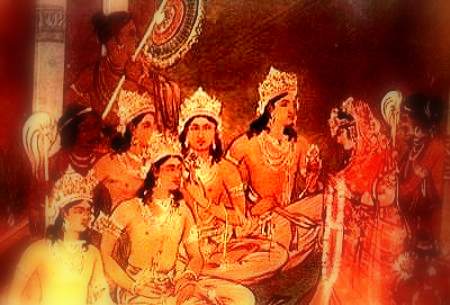
Pandava Ekadashi in Shukla Paksha. Also known as Nirjala Ekadasi

pandavas

Once Bhimasena asked the great sage Srila Vyasadeva, the grandfather of the Pandavas, whether it was possible to return to the spiritual world without having observed all the rules and regulations of the Ekadashi fasts. He said that he couldn’t live without eating, because hunger was unbearable to him. He asked him for a solution to obtain the same merits without fasting.

Vyasadeva replied, “Without drinking even water, you should fast on the Ekadashi that occurs during the light fortnight of the month of Jyeshtha (May-June) when the sun travels in the sign of Taurus (Vrishabh) and Gemini (Mithun).” According to learned personalities, on this day one may bathe and perform achamana for pratiprokshana purification. But while performing achamana one may drink only that amount of water equal to a drop of gold, or that amount it takes to immerse a single mustard seed. Only this amount of water should be placed in the right palm for sipping. If one drinks more water than this, he might as well have drunk wine.

One must certainly not eat anything, for if he does so he breaks his fast. This rigid fast is in effect from sunrise on the Ekadashi day to sunrise on the Dvadashi day. If a person endeavours to observe this great fast very strictly, he easily achieves the result of observing all twenty-four other Ekadashi fasts throughout the entire year.

On Dvadashi one should bathe early in the morning. Then, according to the prescribed rules and depending on his ability, he should give some gold and water to worthy brahmanas. Finally, he should cheerfully honour prasadam with a brahmana.

Oh Bhimasena, one who can fast on this special Ekadashi in this manner reaps the benefit of having fasted on every Ekadashi during the year. There is no doubt of this. Oh Bhima, now hear the specific merit one gets by fasting on this Ekadashi. The Supreme Lord Keshava, who holds a conch, discus, club and lotus, personally told me, ‘Everyone should take shelter of Me and follow My instructions.’ Then He told me that one who fasts on this Ekadashi, without even drinking water or eating, becomes free of all sinful reactions, and that one who observes the difficult nirjala fast on Jyeshtha-shukla Ekadashi truly reaps the benefit of all other Ekadashi fasts.

Oh Bhimasena, in the Kali-yuga, the age of quarrel and hypocrisy, when all the principles of the Vedas will have been destroyed or greatly minimised, and when there will be no proper charity or observance of the ancient Vedic principles and ceremonies, how will there be any means of purifying the self? But there is the opportunity to fast on Ekadashi and become free of all one’s past sins.”

When the other Pandavas heard about the benefits to be gained by following Jyeshtha-shukla Ekadashi, they resolved to observe it exactly as their grandfather Srila Vyasadeva had explained it to their brother, Bhimasena. All the Pandavas observed it by refraining from eating or drinking anything, and thus this day is also known as Pandava Nirjala Dvadashi (technically it is a Maha-Dvadashi).

Srila Vyasadeva continued, “One who on this day gives a brahmana a water pot, an umbrella, or shoes surely goes to the heavenly planets. Indeed, he who simply hears these glories also attains to the transcendental abode of the Supreme Lord, Sri Vishnu. Whoever performs the shraddha ceremony to the forefathers on the dark-moon day called amavasya, particularly if it occurs at the time of a solar eclipse undoubtedly achieves great merit, but this same merit is achieved by him who simply hears this sacred narration – so powerful and so dear to the Lord is this Ekadashi.

Oh Bhimasena, after this Ekadashi fast and donating the recommended items according to his ability, the devotee should feed brahmanas and thereafter honour prasadam silently.”

Thus ends the narration of the glories of Jyeshtha-shukla Ekadashi, or Bhimaseni-nirjala Ekadashi, from the Brahma-vaivarta Purana.

“Jai Shri RadheKrishna”
Apara Ekadashi in Krishna Paksha

yudhiSri Yudhishthira Maharaj said, “Oh Janardana, what is the name of the Ekadashi that occurs during the dark fortnight (Krishna paksha) of the month of Jyeshtha (May-June) I wish to hear from You the glories of this sacred day of Hari.” 

Lord Sri Krishna said, “Oh king, your inquiry is wonderful because the answer will benefit the whole human society. This Ekadashi is so sublime and meritorious that even the greatest sins can be erased by its purity. 

The name of this unlimitedly meritorious Ekadashi is Apara Ekadashi. Whoever fasts on this holy day becomes famous all over the universe. Even such sins as killing a brahmana, a cow, or an embryo; blasphemy; or having sex with another man’s wife are completely eradicated by observing Apara Ekadashi. 

Oh king, people who bear false witness are most sinful. A person who falsely or sarcastically glorifies another; one who cheats while weighing something on a scale; one who fails to execute the duties of his varna or ashrama (an unqualified man posing as a brahmin, for example, or a person reciting the Vedas wrongly); one who invents his own scriptures; one who cheats others; one who is a charlatan astrologer, a cheating accountant, or a false Ayurvedic doctor – are all destined for hellish punishments. But simply by observing Apara Ekadashi, all such sinners become completely free of their sinful reactions.

Warriors who fall from their Kshatriya-dharma and flee the battlefield go to a ferocious hell. But, Oh Yudhishthira, even such a fallen Kshatriya, if he observes fasting on Apara Ekadashi, he is freed of that great sinful reaction and goes to heaven.

That disciple is the greatest sinner who, after receiving a proper spiritual education from his spiritual master, turns around and blasphemes him. Such a so-called disciple suffers unlimitedly. But if he simply observes Apara Ekadashi, he can attain to the spiritual world.

The merit attained by one who performs all of the following acts of piety is equal to the merit achieved by one who observes Apara Ekadashi: bathing three times daily in Pushkara-kshetra during Kartika (October-November); bathing at Prayag in the month of Magh (January-February) when the sun is in the zodiac of Capricorn; rendering service to Lord Shiva at Varanasi (Benares) during Shiva-ratri; offering oblations to one’s forefathers at Gaya; bathing in the sacred Gautami River when Jupiter transits Leo (Simha); having darshan of Lord Shiva at Kedarnatha; seeing Lord Badrinath when the Sun transits the sign of Aquarius (Kumbha); and bathing at the time of a solar eclipse at Kurukshetra and giving cows, elephants, and gold there in charity. All the merit one gets from performing these pious acts is gained by a person who observes the Apara Ekadashi fast. Also, the merit attained by one who donates a pregnant cow, along with gold and fertile land, is attained by one who fasts on this day.

In other words, Apara Ekadashi is an axe that cuts down the fully matured forest full of trees of sinful deeds. Therefore, Oh Yudhisthira, whoever truly fears his past and present sins must observe Apara Ekadashi very strictly. One who does not observe this fast must be born again in the material world, like one bubble among millions in a huge body of water, or like a small ant among all other species.

Therefore one must faithfully observe the sacred Apara Ekadashi and worship the Supreme Personality of Godhead, Sri Trivikrama. One who does so is freed of all his sins and promoted to the abode of Lord Vishnu.

Anyone who hears or reads this description is certainly freed from all kinds of sins, oh best of saintly kings, Yudhishthira.” 

“Jai Shri RadheKrishna”