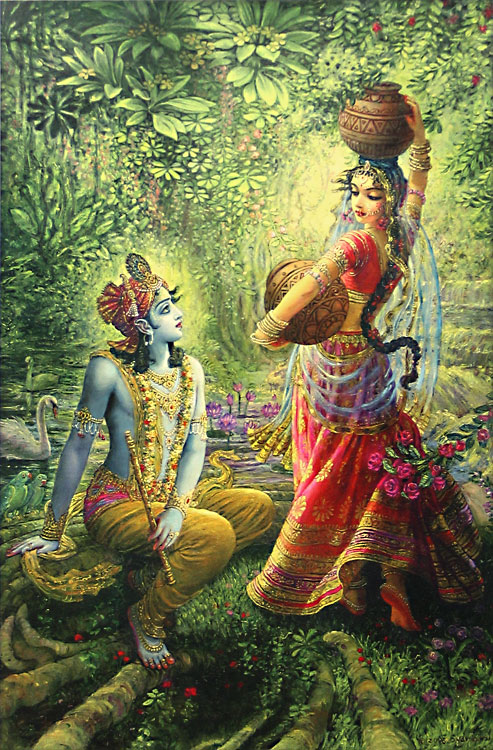
Radha Rani

Radharani

   Radhe Radhe Kahat hee, sab Biyadha mitjay
koti janm kee aapada, shri Radhe kahe se kat jay

  Srimati Radharani is the direct counterpart of Lordi Krishna. She is the central figure for all the goddesses of fortune. She possesses all the
attractiveness to attract the all-attractive Personality of Godhead. She is the primeval internal potency of the Lord . She is the chief associate and
devotee of Lord Krishna, and topmost of all goddesses Srimati Radharani is the Supreme Goddess. She is most always seen with Krishna. She is
the most excellent worshiper of Lord Krishna. However, She is also an expansion of the Lord’s energy. Since She is also an extension of Krishna,
She is the feminine aspect of God


Radharani has many names according to Her qualities and characteristics :

  GKrishnamayi
Govinda-mohini
Govinda-sarvasa
Govinda-anandini
Shiromani Sarva-kanta

Radha Rani is also known as Sarva-kanti , which indicates that all beauty and luster rest in Her body, and all the Lakshmis derive their beauty from Her. Sarva-kanti also means that all the desires of Lord Krishna rest in Srimati Radharani. As Lord Krishna enchants the world with His beauty and charm, Sri Radha enchants Him. Therefore She is the Supreme Goddess. Sri Radha is the full power, and Lord Krishna is the possessor of full power. Thus, the two are non-different, as the sunshine is nondifferent from the sun, or as the energy is non-different from the energetic or source of energy.

Radhe tu bad bhagini, Kyon tapsya keen
tenn lok taran tarad ,tere hee Adheen

Without Radha Rani there is no meaning to loard Krishna and without Krishna there is no meaning to Radha Rani. Because of this, in the Vaishnava tradition we always pay respects first to the Lord’s internal energy in the form of Radha Rani, and then to the Lord Krishna. Thus They are referred to as Radha-Krishna, or in other names as Sita-Rama, Lakshmi-Narayana, and so on. In this way, Radha and Krishna are one, but when Lord Krishna wants to enjoy, He manifests Himself as Radharani. Otherwise, there is no energy in which Krishna can attain pleasure outside Himself.

Among the gopis of Vrindavana, Srimati Radharani and another gopi are considered chief. However, when we compare the gopis , it appears that Srimati Radharani is most important because Her real feature expresses the highest ecstasy of love. The ecstasy of love experienced by the other gopis cannot be compared to that of Srimati Radharani.”

Vrindawan ke vrikh ko, Maram na jane koie
Jaha dal dal or pat pat pe ,Shri Radhe Radhe hoia

It is also described that the potency of love of God is called hladini , the Lord’s pleasure potency. Whenever the Lord wants to enjoy pleasure, He exhibits His own spiritual potency known as hladini . And the essence of that love is in the emotion called bhava . The ultimate development of that emotion is mahabhava , or great bhava . Mahabhava is full of the pleasure potency, and it is an exhibition of the highest love for Lord Krishna. Sri Radharani is the embodiment of that transcendental consciousness found in mahabhava . Her mind, senses and body are steeped in that highest sort of love for Krishna. She is as spiritual as the Lord Himself. In fact, being the personification of the hladini-shakti , the pleasure giving energy of the Lord, She is the only source of enjoyment for the Lord. This pleasure potency manifests spiritually as Radharani in a way that attracts even Lord Krishna. He takes no pleasure in anything material. The Lord could never enjoy anything that is less spiritual than Himself.

Therefore Radha and Krishna are identical. Then She expands Herself into different forms, known as Lalita, Visakha, and Her other confidential associates that increase the mood of divine love. However, being the Lord’s hladini feature, She is also the ultimate source of all happiness for all the living beings. In other words, everything that gives pleasure and happiness within the spiritual or the material worlds is because of Her and the energy that emanates from Her. That same pleasure potency expands and spreads throughout the spiritual worlds, and then descends into the material creation into the many forms of happiness that is experienced by the conditioned soul, though it may be called by different names and perceived in assorted ways. Since we are all parts and parcels of the Lord, we also have that pleasure potency within us to a minute degree. But we are trying to enjoy it in the material world. Therefore we are like sparks that are dying out because we have left our place which is in the blazing fire of Lord Krishna’s association.

In describing Srimati Radharani, it is also said in the Vidagdha-madhava by Rupa Gosvami, “The beauty of Srimati Radharani’s eyes forcibly devours the beauty of newly grown blue lotus flowers, and the beauty of Her face surpasses that of an entire forest of fully blossomed lotuses. Her bodily luster seems to place even gold in a painful situation. Thus the wonderful, unprecedented beauty of Srimati Radharani is awakening Vrindavana.”

“Although the effulgence of the moon is brilliant initially at night, in the daytime it fades away. Similarly, although the lotus is beautiful during the daytime, at night it closes. But, O My friend, the face of My most dear Srimati Radharani is always bright and beautiful, both day and night. Therefore, to what can Her face be compared?”

“When Srimati Radharani smiles, waves of joy overtake Her cheeks, and Her arched eyebrows dance like the bow of Cupid. Her glance is so enchanting that it is like a dancing bumblebee, moving unsteadily due to intoxication. That bee has bitten the whorl of My heart.”

Some unlimited transcendental qualities, of Radha Rani:

She is shy.
She is cunning.
She is very sweet.
She smiles brightly.
She is always calm.
She is always grave.
She is the chief gopi.
Her eyes are restless
Her speech is charming.
She is expert in enjoying life.
She is very expert in singing.
She is very humble and meek.
She has beautiful, auspicious lines
She is the reservoir of loving affairs in Gokula.
She makes Krishna happy with Her bodily aroma.
She is very submissive to the love of Her friends.
She is the most famous of submissive devotees
She is very expert in joking and speaking pleasantly.
She is situated in the topmost level of ecstatic love.
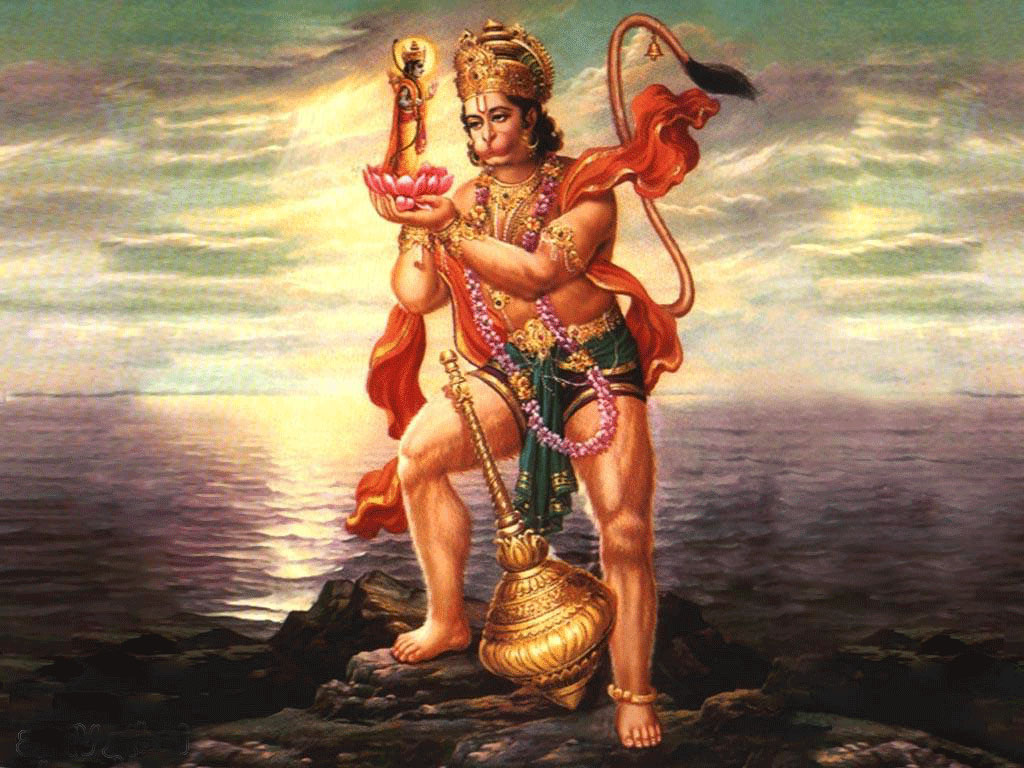
Lord Hanuman

Jai Bajrangbali

Hanuman, the mighty ape that aided Lord Rama in his expedition against evil forces, is one of the most popular idols in the Hindu pantheon. Believed to be an avatar of Lord Shiva, Hanuman is worshiped as a symbol of physical strength, perseverance and devotion. Hanuman’s tale in the epic Ramayana – where he is assigned the responsibility to locate Rama’s wife Sita abducted by Ravana, the demon king of Lanka — is known for its astounding ability to inspire and equip a reader with all the ingredients needed to face ordeals and conquer obstructions in the way of the world.

The Necessity of a Simian Symbol

Hindus believe in ten avatars of Lord Vishnu among a multitude of gods and goddesses. One of Vishnu’s avatars is Rama, who was created to destroy Ravana, the evil ruler of Lanka. In order to aid Rama, Lord Brahma commanded some gods and goddesses to take the avatar of ‘Vanaras’ or monkeys. Indra, the god of war and weather, was reincarnated as Bali; Surya, the sun god as Sugriva; Vrihaspati, the preceptor of the gods, as Tara, and Pavana, the god of wind, was reborn as Hanuman, the wisest, swiftest and strongest of all apes.

The Birth of Hanuman

The story of the birth of Hanuman goes thus: Vrihaspati had an attendant called Punjikasthala, who was cursed to assume the form of a female monkey — a curse that could only be nullified if she would give birth to an incarnation of Lord Shiva. Reborn as Anjana, she performed intense austerities to please Shiva, who finally granted her the boon that would cure her of the curse.

When Agni, the god of fire, gave Dasharath, the king of Ayodhya, a bowl of sacred dessert to share among his wives so they may have divine children, an eagle snatched a part of the pudding and dropped it where Anjana was meditating, and Pavana, the god of wind delivered the drop to her outstretched hands. After she took the divine dessert, she gave birth to Hanuman. Thus Lord Shiva incarnated as a monkey, and was born as Hanuman to Anjana, by the blessings of Pavana, who thus became Hanuman’s godfather.

Hanuman’s Childhood

The birth of Hanuman released Anjana from the curse. Before she returned to heaven, Hanuman asked his mother about his life ahead. She assured him that he would never die, and said that fruits as ripe as the rising sun would be his food. Mistaking the glowing sun as his food, the divine baby leapt for it. Indra struck him with his thunderbolt and hurled him down to earth. But Hanuman’s godfather, Pavana carried him to the nether world or ‘Patala’. As he departed from the earth, all life panted for air, and Brahma had to beg him to return. In order to appease him they conferred a lot of boons and blessings on his foster child that made Hanuman invincible, immortal and super powerful.

Hanuman’s Education


Hanuman selected Surya, the sun god as his preceptor, and approached him with the request to teach the scriptures. Surya agreed and Hanuman became his disciple, but had to face his constantly moving guru by traversing the sky backwards at equal pace, while taking his lessons. Hanuman’s phenomenal concentration took him only 60 hours to master the scriptures. Surya considered the manner in which Hanuman accomplished his studies as his tuition fees, but when Hanuman requested him to accept something more than that, the sun god asked Hanuman to assist his son Sugriva, by being his minister and compatriot.

The Power of Devotion

The character of Hanuman teaches us of the unlimited power that lies unused within each one of us. Hanuman directed all his energies towards the worship of Lord Rama, and his undying devotion made him such that he became free from all physical fatigue. And Hanuman’s only desire was to go on serving Rama. Hanuman perfectly exemplifies ‘Dasyabhava’ devotion — one of the nine types of devotions — that bonds the master and the servant. His greatness lies in his complete merger with his Lord, which also formed the base of his genial qualities.

In Service of Rama

Hanuman’s initial words highly impressed Rama, and made him comment: “None can talk this way without mastering the Vedas. He has such a flawless countenance, a wonderful accent, and a captivating way of speaking. He has the ability to move even an enemy…” After he revealed his identity as the prince of Ayodhya, Hanuman fell prostrate before him in respect of the Lord. Rama picked him up and embraced him. There began the story of Hanuman, which is inextricably interwoven with Rama, and dealt with in detail in Valmiki’s Ramayana and the Tulsidas’ Ramacharitamanas.

Ram Navami

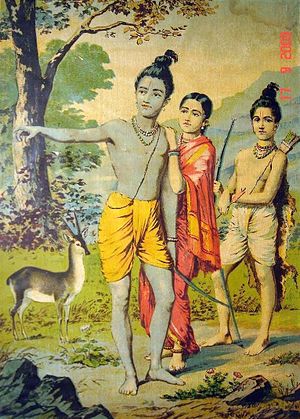
RamaRam Navami (Devanāgarī: राम नवमी) also known as Sri Rama Navami (IAST SriRām-navamī) is a Hindu festival, celebrating the birth of Lord Rama to King Dasharatha and Queen Kausalya of Ayodhya. Ram is the 7th incarnation of the Dashavatara of Vishnu.Years later Lord Rama was married to Sita on the Vivaha Panchami. The sacred marriage of Devi Sita with Lord Rama was held on Margashirsha Shukla Panchami as per Valmiki Ramayana (This occasion is known as Seetha kalyanam). The Rama Navami festival falls in the Shukla Paksha on the Navami, the ninth day of the month of Chaitra in the Hindu calendar. Thus it is also known as Chaitra Masa Suklapaksha Navami, and marks the end of the nine-day Chaitra-Navratri celebrations.

At some places the festival lasts the whole nine days of the Navratras, thus the period is called ‘Sri Rama Navratra’. It is marked by continuous recitals, Akhand Paath, mostly of the Ramacharitamanas, organized several days in advance to culminate on this day, with elaborate bhajan, kirtan and distribution of prasad after the puja and aarti. Images of infant form of Sri Rama are placed on cradles and rocked by devotees. Since Rama is the 7th incarnation of Vishnu having born at noon, temples and family shrines are elaborately decorated and traditional prayers are chanted together by the family in the morning. Also, at temples special havans are organized, along with Vedic chanting of Vedic mantras and offerings of fruits and flowers. Many followers mark this day by Vrata (fasting) through the day followed by feasting in the evening, or at the culmination of celebrations. In South India,in Bhadrachalam the day is also celebrated as the wedding anniversary of Sri Rama and his consort Sita. Sitarama Kalyanam, the ceremonial wedding ceremony of the celestial couple is held at temples throughout the south region, with great fanfare and accompanied by group chanting of name of Rama, (Rama nama smaranam). Whereas the marriage is celebrated in Mithila and Ayodhya during another day on Vivaha Panchami as per Valmiki Ramayana.

The important celebrations on this day take place at Ayodhya (Uttar Pradesh) Sita Samahit Sthal (Sitamarhi) (Bihar), Bhadrachalam (Andhra Pradesh) and Rameswaram (Tamil Nadu), thronged by thousands of devotees. Rathayatras, the chariot processions, also known as Shobha yatras of Rama, Sita, Lakshmana and Hanuman, are taken out at several places, including Ayodhya where thousands of people take a dip in the sacred river Sarayu.