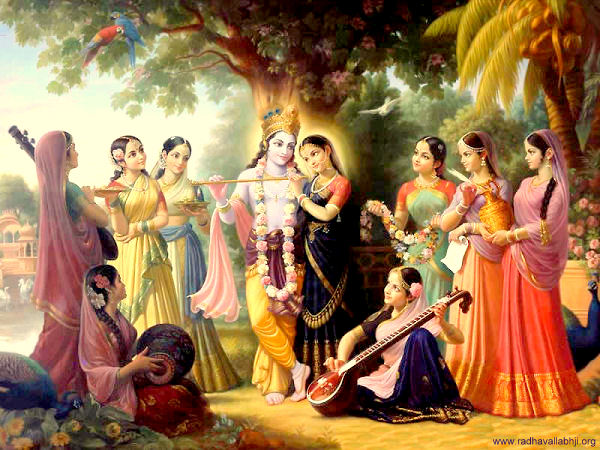
The Eight Topmost Varistha Gopis

varistha

Lalita-devi

Of the varistha gopis, Lalita is the most important, being the leader and controller. She and the other eight principal gopis, the other gopis and the manjari have forms that are for the most part like the transcendental form of Srimati Radharani, the queen of Vrndavana.

Lalita is famous as Srimati Radharani’s constant companion. Her complexion is like the yellow pigment gorocana and her garments are like peacock feathers. Her mother is Saradi-devi and her father is Visoka. Her husband is named Bhairava. He is a close friend of Govardhana-gopa. Her age is 14 years, 8 months and 27 days. Her home is in Yavata and her nature is vama-prakhara. In gaura-lila, she has assumed the form of Sri Svarupa Damodara Gosvami.

The beauty of all the other gopis appears to be conserved in the form of Lalita-devi. She is contrary and hot-tempered by nature. In an argument, her mouth becomes bent with ferocious anger and she expertly speaks the most outrageous and arrogant replies. When the arrogant gopis pick a quarrel with Krsna, she is at the forefront of the conflict. When Radha and Krsna meet, she audaciously remains standing a little away from them.

Lalita-devi is full of ecstatic love for the Divine Couple. She is expert at arranging both Their meetings and Their conjugal struggles. Sometimes, for Radha’s sake, she offends Lord Madhava. With the help of Purnamasi-devi and the other gopis Lalita arranges for the meetings of Radha and Krsna. She carries the parasol for the Divine Couple, she decorates Them with flowers, and she decorates the cottage where They rest at night and rise in the morning.

On the northern petal of Ananga-sukhada Kunja, there is a beautiful kunja covered with various kinds of flowers and trees. This place is known as Lalitanandada Kunja and it is the color of lightning. The lovely Lalita Sakhi always lives here. She has a beautiful bright yellow (gorocana) complexion and wears a dress the color of peacock feathers. She is adorned with celestial ornaments and personifies the type of bhava known as khandita. She and Sri Krsna are very, very dear to each other and her seva is to bring camphor and tambula to Him.

The chief sakhis in Lalita’s group are Ratnarekha (Ratnaprabha), Ratikala, Subhadra, Candrarekhika (Bhadrarekhika), Sumukhi, Dhanistha, Kalahamsi and Kalapini.


Visakha-devi

Visakha is the second most important of the eight varistha-gopis. Her attributes, activities and resolve are all much like those of her friend Lalita. Visakha was born at the exact same moment as her dear friend, Srimati Radharani, appeared in this world. Visakha’s garments are decorated with stars and her complexion is like lightning, being cream-colored with a tinge of red (gaurangi). She is 14 years, 2 months and 15 days in age. Her father is Pavana, the son of the sister of Mukhara-gopi, and her mother is Daksina-devi, the daughter of the sister of Jatila. Her husband is Bahuka (Vahika-gopa). Her residence is cloudlike in color. She appears in gaura-lila as Sri Ramananda Raya.

Visakha-devi is the intimate friend of the Divine Couple. Although she is more exalted than the younger gopis (the gopi messengers lead by Vrnda devi), she also takes up the work of carrying messages between Radha and Krsna and she is the most intelligent and expert of all the gopi messengers. Loquacious Visakha is expert at joking with Lord Govinda, and she is the perfect counsellor of the Divine Couple. Being expert at all aspects of amorous diplomacy, she knows all the arts of how to conciliate an angered lover, how to bribe him, and how to quarrel with him.

Visakha is very dear to Sri Krsna and has the bhava known as svadhina-bhartrka. Her seva is dressing and decorating. In Sri Visakha’s yutha the chief sakhis are Malati, Madhavi, Candrarekha, Subhanana, Kunjari, Harini, Surabhi and Capala.


Campakalata (Campakamallika)

Campakalata is the third of the varistha-gopis. Her complexion is the color of a blossoming yellow campaka flower and her garments are the color of a blue-jay’s. She is one day younger than Srimati Radharani, and her age is 14 years, 2 months and 13 1/2 days. Her father is Arama, her mother is Vatika-devi and her husband is Candaksa. Her qualities are much like those of Visakha. In gaura-lila she appears as Sri Sivananda.

Campakalata veils her activities in great secrecy. She is expert at the art of logical persuasion, and she is a skilled diplomat who knows how to thwart Srimati Radharani’s rivals.

Campakalata is expert at collecting fruits, flowers, and roots from the forest. Of all the gopis who are appointed as protectoresses of the trees, creepers, and bushes of Vrndavana, the leader is Campakalata-devi. She is an expert cook who knows all the literatures describing the six flavors of gourmet cooking. She is so expert at making various kinds of candy that she has become famous by the name Mistahasta (sweet hands). Using only the skill of her hands, she can artistically fashion things from clay.

On the southern petal of Madana-sukhada Kunja lies Kamalata Kunja, the home of Sri Krsna’s beloved Sri Campakalata. This extremely blissful kunja is the color of molten gold. Campakalata, who loves Krsna very much, personifies the stage of a nayika known as vasaka-sajja. Her nature is vama-madhya, and her seva is to offer jewelled necklaces and to fan with a camara. The chief gopis in Campakalata’s yutha are Kurangaksi, Suracita, Mandali, Manimandana, Candika, Candralatika, Kandukaksi and Sumandira.


Citra-devi

Citra is the fourth of the varistha gopis. Her beautiful saffron complexion resembles the color of kunkuma, and her garments are the color of crystal. She is 26 days younger than Srimati Radharani, being 14 years, 7 months and 14 days of age. Her father is Catura, the paternal uncle of Suryamitra. Her mother is Carcika-devi and her husband is Pithara. She is an adhika-mrdvinayika, and her home is in Yavata. In gaura-lila she appears as Sri Govindananda.

She and Sri Krsna are very affectionate toward each other, and she is very devoted to her seva of bringing cloves and garlands. She is especially expert in the lover’s quarrel between Radha and Krsna (the third of the six definitions of the word abhisarana). When Lord Madhava is full of bliss, she becomes satisfied.

Citra-devi can read between the lines of books and letters written in many different languages, perceiving the hidden intentions of the author. She is a skilled gourmet and can understand the tastes of various foods made with honey, milk, and other ingredients simply by glancing at them. She can nicely make various kinds of nectarean beverages. (There are also eight other gopi maidservants, headed by Rasalika-devi, who are expert at making various nectarean beverages.)

Citra-devi is expert in playing music on pots filled with varying degrees of water. She is learned in the literature describing astronomy and astrology, and she is well versed in the theoretical and practical activities of protecting domestic animals. She is especially expert at gardening. There are other gopis who mostly collect transcendental herbs and medicinal creepers from the forest and do not collect flowers or anything else. Citra-devi is the leader of these gopis. The chief gopis in Sri Citra’s yutha are Rasalika, Tilakini, Saurasen, Sugandhika, Vamani, Vamanayana, Nagari and Nagavallika.


Tungavidya

Tungavidya is the fifth of the varistha gopis. Her complexion is the color of kunkuma and the fragrance of her body is like sandalwood mixed with camphor. Her dress is pandu-mandana (pale yellow). She is fifteen days younger than Srimati Radharani, and her age is 14 years, 2 months and 22 days. She wears white garments. Her parents are Puskara and Medha-devi and her husband is Balisa. On the western petal of Madana-sukhada Kunja lies the extremely beautiful crimson-colored Tungavidyanandada Kunja, where Sri Tungavidya Sakhi always resides. In gaura-lila she appears as Sri Vakresvara Pandita.

She loves Sri Krsna very much and, filled with eagerness for that prema, she exhibits the bhava known as vipralabdhatva. She is very devoted to her seva of dancing and singing, and is a celebrated music teacher who is expert at playing the vina and singing in the style known as marga. She has full faith in Krsna. She is very expert at arranging the meetings of the Divine Couple. She is learned in rasa-sastra (transcendental mellows), is learned in the eighteen branches of knowledge, in niti-sastra (morality), dancing, drama, literature and all other arts and sciences.

Being hot-tempered and expert at dissimulation, Tungavidya is one of the leaders of the gopis. Some of the sakhis in Tungavidya’s yutha are Manjumedha, Sumadhura, Sumadhya, Madhureksana, Tanu madhya, Madhusyanda, Gunacuda and Varangada. These gopis are the best of dancers. They are musicians expert at playing the mrdanga and singing in recital halls. They are especially engaged in fetching water from the streams in Vrndavana. Eight gopi messengers headed by Manjumedha-devi are especially expect at arranging political alliances (sandhi) the first of diplomatic maneuvers in the art of politics between Radha and Krsna.


Indulekha

Indulekha is the sixth of the varistha gopis. She has a lemon-yellow (tan) complexion and wears garments the color of a pomegranate flower. She is three days younger than Srimati Radharani, being 14 years, 2 months and 10 1/2 days of age. Her parents are Sagara and Vela-devi and her husband is Durbala. On the southeastern petal of Madana-sukhada Kunja lies the golden-colored Purnendu Kunja, where Sri Indulekha lives. In gaura-lila she appears as Vasu Ramananda.

Indulekha-devi has a deep love for Sri Krsna and possesses the prosita-bhartrka-bhava. She often serves Krsna by bringing Him nectar-like delicious meals. She is vama-prakhara and her principal seva is fanning with a camara.

Indulekha is contrary and hot-tempered by nature. She is learned in the science and mantras of the Naga-sastra, which describes various methods of charming snakes. She is also learned in the Samudraka-sastra, which describes the science of palmistry. She is expert at stringing various kinds of wonderful necklaces, decorating the teeth with red substances, gemology and weaving various kinds of cloth.

In her hand she carries the auspicious messages of the Divine Couple. In this way she creates the good fortune of Radha and Krsna by creating Their mutual love and attraction. Indulekha-devi is fully aware of the confidential secrets of the Divine Couple. Some of her friends are engaged in providing ornaments for the Divine Couple, others provide exquisite garments, and others guard their treasury.

In Sri Indulekha’s yutha the chief gopis are Tungabhadra, Citralekha, Surangi, Rangavatika, Mangala, Suvicitrangi, Modini and Madana. The group of gopis headed by Tungabhadra-devi are the friends and neighours of Indulekha. Among these gopis is a group, headed by Palindhika-devi, which acts as messengers for the Divine Couple.
Rangadevi

Rangadevi is the seventh of the varistha gopis. Her complexion is the color of a lotus filament and her garments are red like a jaba flower. She is seven days younger than Srimati Radharani, and is 14 years, 2 months and 4 1/2 days of age. Her parents are Karuna-devi and Rangasara, and her husband is Vakreksana.

On the southwest petal of Madana-sukhada Kunja lies the dark blue, cloudlike Sukhada Kunja, where Sri Krsna’s beloved Sri Rangadevi always resides. She possesses the utkanthita-bhava, and in every way she is very attached to Sri Krsna. Her seva is offering candana, and her nature is vama-madhya. In Kali-yuga she appears in gaura-lila as Govindananda Ghosa.

Rangadevi’s personal qualities are much like those of Campakalata. She is always like a great ocean of coquettish words and gestures. She is very fond of joking with her friend Srimati Radharani in the presence of Lord Krishna.

Among the six activities of diplomacy she is especially expert in the fourth: patiently waiting for the enemy to make the next move. She is an expert logician and because of previous austerities she has attained a mantra by which she can attract Lord Krsna.

The chief gopis in Sri Rangadevi’s yutha are Kalakanthi, Sasikala, Kamala, Prema Manjari, Madhavi, Madhura, Kamalata and Kandarpa-sundari. Kalakanti-devi is the leader of the eight most important friends of Ranga-devi. These friends are all expert in the use of perfumes and cosmetics and burning aromatic incense, carrying coal during the winter and fanning the Divine Couple in the summer. Ranga-devi’s friends are able to control the lions, deer and other wild animals in the forest.
Sudevi

Sudevi is the eighth of the varistha gopis. She is sweet and charming by nature. She is the sister of Rangadevi. Her husband is Vakreksana, the younger brother of Bhairava. Her marriage with Vakreksana was arranged by his younger brother. Her form and other qualities are so similar to those of her sister Rangadevi that they are often mistaken for one another. Like Rangadevi, she has a complexion the color of a lotus stamen and wears a dress the color of a red jaba flower. Being slightly older than her sister, her age is 14 years, 2 months and 4 days. On the northwest petal of Madanananda Kunja lies the beautiful emerald-colored Vasanta-sukhada Kunja, the residence of Sri Sudevi. In gaura-lila she appeared as Sri Vasudeva Ghosa.

She is very loving toward Sri Hari, and possesses the bhava known as kalahantarita. Her seva is to bring water. Sudevi always remains at the side of her dear friend Srimati Radharani, and arranges Radharani’s hair, decorates Her eyes with mascara, and massages Her body.

She is expert in training male and female parrots and she is also expert in the pastimes of roosters. She is an expert sailor and she is fully aware of the auspicious and inauspicious omens described in the Sakuna-sastra. She is expert at massaging the body with scented oils, she knows how to start fires and keep them burning and she knows which flowers blossom with the rising of the moon.

The principal gopis in Sri Sudevi’s yutha are Kaveri, Carukavari, Sukesi, Manjukesika, Harahira, Harakanthi, Haravalli and Manohara. Kaveri-devi and the other friends of Sudevi are expert at constructing leaf-spitoons, playing music on bells and decorating couches in various ways. Sudevi’s friends are also entrusted with the decoration of the Divine Couple’s sitting place. Sudevi’s friends act as clever spies, disguising themselves in various ways and moving among Radharani’s rivals (Candravali and her friends) to discover their secrets. Sudevi’s friends are the deities of Vrndavana forest and they are charged with the protection of the forest birds and bees.
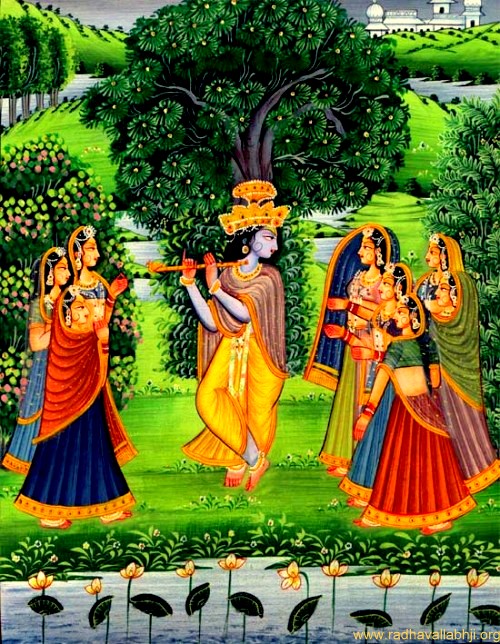
The Vara Gopis

vara gopis

Kalavati

Kalavati’s complexion is the color of yellow sandalwood and she wears garments the color of a parrot. Her husband is Kapota, the youngest brother of Vahika, and her parents are Sindhumati-devi and Kalankura-gopa, the maternal uncle of Arkamitra.

Subhangada

Subhangada is the younger sister of Visakha. She is of very fair complexion and is married to Patatri, the younger brother of Pithara.

Hiranyangi

Hiranyangi is very dear to Srimati Radharani and Srimati Radharani is very dear to her. Hiranyangi is dressed in beautiful garments that appear like a great multitude of unparalleled blossoming flowers. Her complexion is the color of gold and she appears to be a temple or palace in which all beauty is conserved. She was born from the womb of Harini-devi. Here is the story of her conception:

Her father, Mahavasu-gopa, is pious and famous for being devoted to performing Vedic sacrifices. He is decorated with wonderful good qualities and he is the close friend of Arkamitra. Mahavasu-gopa desired to beget a powerful and heroic son and a beautiful daughter. To attain this end, the self-controlled Mahavasu engaged Bhaguri Muni in performing a Vedic sacrifice. Certain nectarean foodstuffs appeared from that sacrifice and the delighted Mahavasu gave them to his wife, Sucandra-devi. As Sucandra-devi was hastily eating the sacred foodstuff on her front porch, she spilled some of it. At that time the doe named Suranga, who was the mother of the doe named Rangini, was wandering in Vrajabhumi. Seeing Sucandra-devi spill some of the foodstuff, the doe Suranga quickly came forward and ate some of it. As a result of eating this sacred foodstuff, both the gopi Sucandra and the doe Suranga became pregnant. Sucandra-devi gave birth to a son whom the gopas called Stokakrsna, and the deer gave birth to the girl Hiranyangi in the village of Vraja.

Ratnalekha

Maharaj Vrsabhanu’s maternal cousin Payonidhi had a son but no daughter. His wife Mitra-devi desired to have a daughter also and to achieve this end, she faithfully worshiped the sun-god, Vivasvan. By Vivasvan’s mercy she gave birth to a daughter who was named Ratnalekha.

Ratnalekha’s complexion is the red color of the mineral manahsila and her garments appear like a beautiful swarm of bumblebees. She is very dear to Srimati Radharani. Her mother engages both she and her friend Radharani in the devoted attentive worship of the sun-god. When Ratnalekha sees Lord Madhava, her eyes begin to roll in ferocious anger and she severly rebukes Him.

Sikhavati

Sikhavati’s complexion is the color of a karnikara flower. She is the younger sister of Kundalatika, her father is Dhanyadhanya, and her mother is Susikha-devi. She is like sweetness and charm personified. Her garments are the spotted color of an old francoline partridge. She is married to Garjara-gopa, who is also known as Garuda-gopa.

Kandarpa manjari

Kandarpa-manjari’s father is Puspakara and her mother is Kuruvinda-devi. Kandarpa-manjari’s father did not give her in marriage to anyone, for he considered in his heart that Lord Hari is the only suitable husband for his daughter. Kandarpa-manjari’s complexion is the color of a kinkirata bird and her garments are decorated with many different colors.

Phullakalika

Phullakalika’s father is Srimalla and her mother is Kamalini. Phullakalika’s complexion is dark like a blue lotus flower and her garments are like a rainbow. Her forehead is naturally marked with yellow tilaka lines. Her husband, Vidura has a loud voice and is able to call the buffaloes from a great distance.

Ananga manjari

Ananga-manjari is exquistely beautiful and therefore it is very appropriate that she is named after Ananga (cupid). Her complexion is the color of a springtime ketaki flower and her garments are the color of a blue lotus. Her proud husband Durmada is also her sister’s brother-in-law. She is especially dear to Lalita and Visakha.

“Jai Shri RadheKrishna”

Sri Radhika – Radharani

RadhaRani

Among all the beautiful gopis Srimati Radharani is the best. Radharani is the queen of Vrndavana. She has many famous friends, headed by Lalita and Visakha.

Sri Krsna, the cowherd prince whose charming sweetness has no equal or superior, is very dear to Srimati Radharani. She considers Him millions and millions of times more dear than Her own life’s breath.

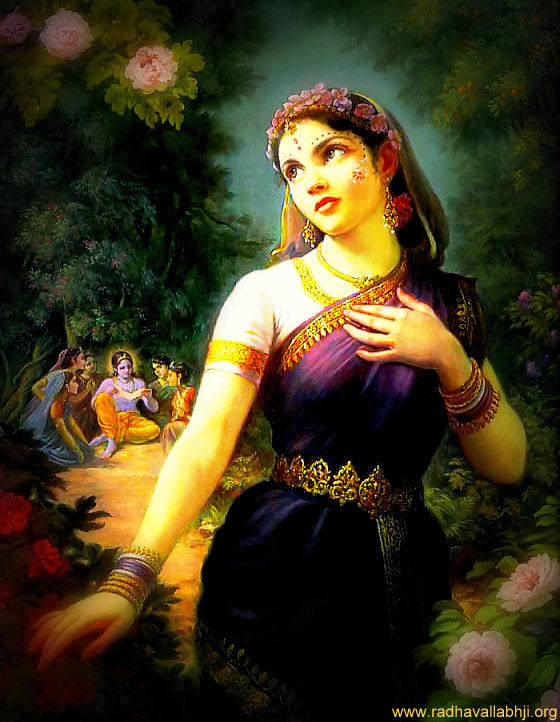
Now the beauty of Srimati Radharani’s trancendental form will be described. Srimati Radharani is expert in all the fine arts and Her transcendental form is like an ocean of nectar. Her splendid bodily luster is like the yellow pigment gorocana, molten gold, or stationary lightning. She wears wonderfully beautiful blue garments and She is decorated with various pearls and flowers.

She is very beautiful and She has long nicely braided hair. She is decorated with a garland of flowers and a beautiful pearl necklace. Her splendid forehead is decorated with the red pigment sindura and with beautiful locks of curling hair.

Decorated with blue bangles, Her arms have defeated Cupid’s staff with their beauty. Decorated with black mascara and reaching back almost to Her ears, Srimati Radharani’s lotus eyes are the most beautiful in all the three planetary systems. Her nose is as beautiful as a sesame flower and it is nicely decorated with a pearl. She is anointed with various perfumes. She is splendidly beautiful.

Her ears are decorated with wonderful earrings and Her nectarean lips defeat the red lotus flowers. Her teeth are like a row of pearls and Her tongue is very beautiful. Decorated with a nectarean smile of pure love for Krsna, Her beautiful face is a splendid as millions of moons.

The beauty of Her chin has defeated and bewildered the demigod Cupid. Decorated with a drop of musk, Her chin appears like a golden lotus flower with a bumblebee. Bearing all the marks of wonderful beauty, Her neck is decorated with a string of pearls. Her neck, back and sides are enchantingly beautiful.

Her beautiful breasts are like two splendid waterpots covered with a bodice and decorated with a necklace of pearls. Her beautiful enchanting arms are decorated with jeweled armlets. Her arms are also decorated with jeweled bracelets and other kinds of jeweled ornaments. Her hands are like two red lotus flowers illuminated by the series of moons that are Her fingernails

Srimati Radharani’s hands are decorated with many auspicious markings such as the signs of the bumblebee, lotus, crescent moon, earring, parasol, sacrificial post, conchshell, tree, flower, camara and svastika. These auspicious marks are manifest in various ways on Srimati Radharani’s lotus hands. Her splendidly beautiful fingers are also decorated with jeweled rings.

Charming, full of sweet nectar and decorated with a deep navel, Srimati Radharani’s beautiful waist enchants the three worlds. Her sloping hips lead to Her charmingly beautiful slender waist, which is bound by a creeper of three beautiful folds of skin and decorated with a sash of tinkling bells.

As beautiful as two exquisite plantain trees, Her thighs enchant the mind of Cupid. Her beautiful knees are like two reservoirs filled with the nectar of various transcendental pastimes. Her beautiful lotus feet are decorated with jeweled ankle-bells and Her toes with toe rings as beautiful as the treasure of Varuna. The auspicious markings on Srimati Radharani’s lotus feet include the signs of the conchshell, moon, elephant, barleycorn, rod for controlling elephants, chariot flag, small drum, svastika and fish.

Srimati Radharani is fifteen years old and full of the luster of youth.

Yasoda-devi, the queen of the cowherds, is more affectionate to Radharani than millions of mothers can be. Radharani’s father is King Vrsabhanu, who is as splendid as the sun.

Srimati Radharani’s mother is Kirtida-devi, who is also known in this world as Ratnagarbha-devi. Radharani’s paternal grandfather is Mahibhanu and Her maternal grandfather is Indu.

Her maternal grandmother is Mukhara-devi and Her paternal grandmother is Sukhada-devi. Her father’s brothers (Her uncles) are RatnabhanuSubhanu and Bhanu.

BhadrakirtiMahakirti and Kirticandra are Radharani’s materal uncles. Menaka-devi, Sasthi-devi, Gauri-devi, Dhatri-devi and Dhataki-devi are Radharani’s materal aunts.

Radharani’s mother’s sister is Kirtimati-devi, whose husband is Kasa. Radharani’s father’s sister is Bhanumudra-devi, whose husband is Kusa.

Radharani’s elder brother is Sridama and Her younger sister is Ananga-manjari. Radharani’s father-in-law isVrkagopa and Her brother-in-law is Durmada.

Jatila-devi is Radharani’s mother-in-law and Abhimanyu is Radharani’s so-called husband. Kutila-devi, who is always eager to find fault, is Radharani’s sister-in-law.

Lalita, Visakha, Sucitra, Campakalata, Ranga-devi, Sudevi, Tungavidya and Indulekha are the eight dearest friends of Srimati Radharani. These gopis are considered the leaders of all the others.

Kurangaksi, Mandali, Mankiundala, Matali, Candralalita, Madhavi, Madanalasa, Manjumedha, Sasikala, Sumadhya, Madhureksana, Kamala, Kamalatika, Gunacuda, Varangada, Madhuri, Candrika, Prema-manjari, Tanumadhyama, Kandarpa-sundari and Manjukesi are among the millions of dear friends (priya-sakhi) of Srimati Radharani.

Lasika, Kelikandali, Kadambari, Sasimukhi, Candrarekha, Priyamvada, Madonmada, Madhumati, Vasanti, Kalabhasini, Ratnavali, Manimati and Karpuralatika are among those friends (jivita-sakhi) for whom Srimati Radharani is as dear as life.

Kasturi, Manojna, Manimanjari, Sindura, Candanavati, Kaumudi and Madira are among Sriamti Radharani’s eternal friends (nitya-sakhi).

Ananga-manjari, Rupa-manjari, Rati-manjari, Lavanga-manjari, Raga-manjari, Rasa-manjari, Vilasa-manjari, Prema-manjari, Mani-manjari, Suvarna-manjari, Kama-manjari, Ratna-manjari, Kasturi-manjari, Gandha-manjari, Netra-manjari, Sripadma-manjari, Lila-manjari and Hema-manjari are among Srimati Radharani’s manjari friends. Prema-manjari and Rati-manjari are both also known by the name Bhanumati-devi.

Srimati Radharani’s worshipable deity is the sun-god, who enlivens the lotus flowers and acts as an eye for the entire world. Srimati Radharani’s maha-mantra is the name of Lord Krsna. Srimati Radharani’s benefactor, who brings Her all good fortune, is Bhagavati Paurnamasi.

In Radharani’s garden is a vine of golden jasmine flowers that She has named Tadidvalli (“the vine of lightning”). Her private lake bears Her own name (Radha-kunda) and on the shore of that lake is a kadamba tree that is the site of very confidential talks between Her and Lord Krsna.

Her favorite ragas are mallara and dhanasri and Her favorite dances are chalikya and rudravallaki.

Srimati Radharani’s glorious birth occured on the eighth day of the bright moon in the month of Bhadra. Although generally not full on that day, the moon appeared full to celebrate Radharani’s appearance in this world. (SSRKGD)

Sri Caitanya Mahaprabhu is Sri Krsna, the Supreme Personality of Godhead. It is therefore said, sri-krsna-caitanya, radha-krsna nahe anya: “Two personalities–Srimati Radharani and Sri Krsna–are combined in the incarnation of Sri Caitanya Mahaprabhu.” (CC Madhya 5.142-143p)

In Brhad-gautamiyatantra it is said: Sri Radha is known as Devi, Krsnamayi, Supreme Goddess in whom all Laksmis reside; Her beauty and charm defeat that of all others.

In a supplement to the Rg-veda it is said: Among all people, Radhika and Madhava together are the most beautiful. In the Matsya-purana: In Varanasi, She is known as Sri Visalaksi, and in Purusottama-ksetra, She is called Sri Vimala. In Dvaraka, She is Sri Rukmini, and as the queen of the Vrndavana forest, She is called Sri Radha.

In the Ujjvala-nilamani, a statement taken from the Padma-purana says: Just as Sri Radha is the most beloved of Sri Krsna, similarly Sri Radha-kunda is also very dear. Among all the gopis, Sri Radha is the dearest lover of Sri Krsna.

In the Radha-prakarana of Ujjvala-nilamani it is said: Sri Radhika’s body is composed of maha-bhava. The greatest of all saktis is the hladini-sakti. Therefore it is called maha-sakti. Of that, the essence is madana, which is the zenith of maha-bhava. Sri Radha is the embodiment of that highest maha-bhava. This conclusion is well established.

In the Gopalottara-tapani, She is glorified as Gandharva. This daughter of Vrsabhanu has a very beautiful form and wears 16 items of beautification (srngara) and 12 types of ornaments (abharana).

An example concerning Her beautiful form is given in Ujjvala-nîlamani, wherein Sri Krsna says, “O Radhe! The locks of Your hair curl beautifully, and You have a lotus-like face with elongated restless eyes. Your chest is adorned with lovely large and firm breasts. Your waist is attractively slender, Your head is bowed slightly in modesty, and Your fingernails are like rows of jewels. Your beautiful form is a festival of elegance and sweetness that crushes the vanity of the three worlds.”

Concerning Her sixteen items of beautification, Subala says to Sri Krsna, “After bathing, Sri Radhika decorates the tip of Her nose with an effulgent jewel. She dresses in blue clothing, with a sash (nivibandhana) around Her waist. Her hair is plaited and She wears ornaments on Her ears. Her limbs are smeared with camphor, musk and sandal paste. She wears flowers in Her hair and a garland around Her neck. In Her hand She playfully carries a lotus flower. In Her mouth She has tambula, and on Her chin a dot of musk. She wears kajjala around Her eyes and on Her cheeks are muskpaintings of dolphins, etc. The bottoms of Her lotus feet are painted red and She wears tilaka on Her forehead.”

Concerning Her twelve ornaments, Subala says, “Sri Radhika wears a diamond on Her head, golden earrings on Her ears, and tiny golden bells around Her hips. A golden locket hangs around Her neck. She wears a cakri-salaka (an elaborate ornament that encircles the entire ear and fastens at the top) over Her ears, bangles on Her hands, and a necklace around Her throat. There are rings on Her fingers and a group of star-like necklaces on Her bosom. She is adorned with jewelled armlets, jewelled ankle bells and radiant toe rings. She is very beautiful wearing these twelveornaments.”

Sri Radha’s age is in the middle of the kaisora period. Just as previously, Krsna’s age was increased by half again, so Radha’s age is increased to 14 years, 2 months and 15 days. She has a strong feeling that Krsna belongs to Her (madiyata-bhava), as well as madhu-sneha (a very sweet affectionate mood). Her love for Krsna is pure, powerful and lasting, and She has various kunjas for Her pastimes with Him. Her home is in Yavatagrama, Her mother’s name is Kirtida, and Her father’s Vrsabhanu. Her husband’s name is AbhimanyuDurmukha is Her brother-in-law,Jatila is Her mother-inlaw, and Kutila is Her sister-in-law. Just as Sri Krsna always exists as the nayaka (heroiclover), Sri Radhika is forever the principal nayika (heroine).

Sri Radha’s sakhis are of five types: sakhi, nitya-sakhi, prana-sakhi, priya-sakhi, and parama-prestha-sakhi.KusumikaVindhyaDhanistha and others are known as sakhis. KasturikaMani Manjari, etc., are known asnitya-sakhisSasimukhiVasantiLasika, etc., are known as prana-sakhis. These gopis usually have forms (or natures) similar to Sri Radha. KurangaksiSumadhyaMadanalasaKamalaMadhuriManjukesi,Kandarpasundari, MadhaviMalatiKamalata and Sasikala, etc., are priya-sakhis. LalitaVisakhaCitra,CampakalataTungavidyaIndulekhaRangadevi and Sudevi are the parama-prestha-sakhis. These eightgopis are chief amongst them all. They are worthy of being yuthesvaris (group leaders) themselves, but because they love Radha so much, they would rather be Her sakhis. 

Source: http://www.vrindavan.de/radha.htm

“Jai Shri RadheKrishna”