
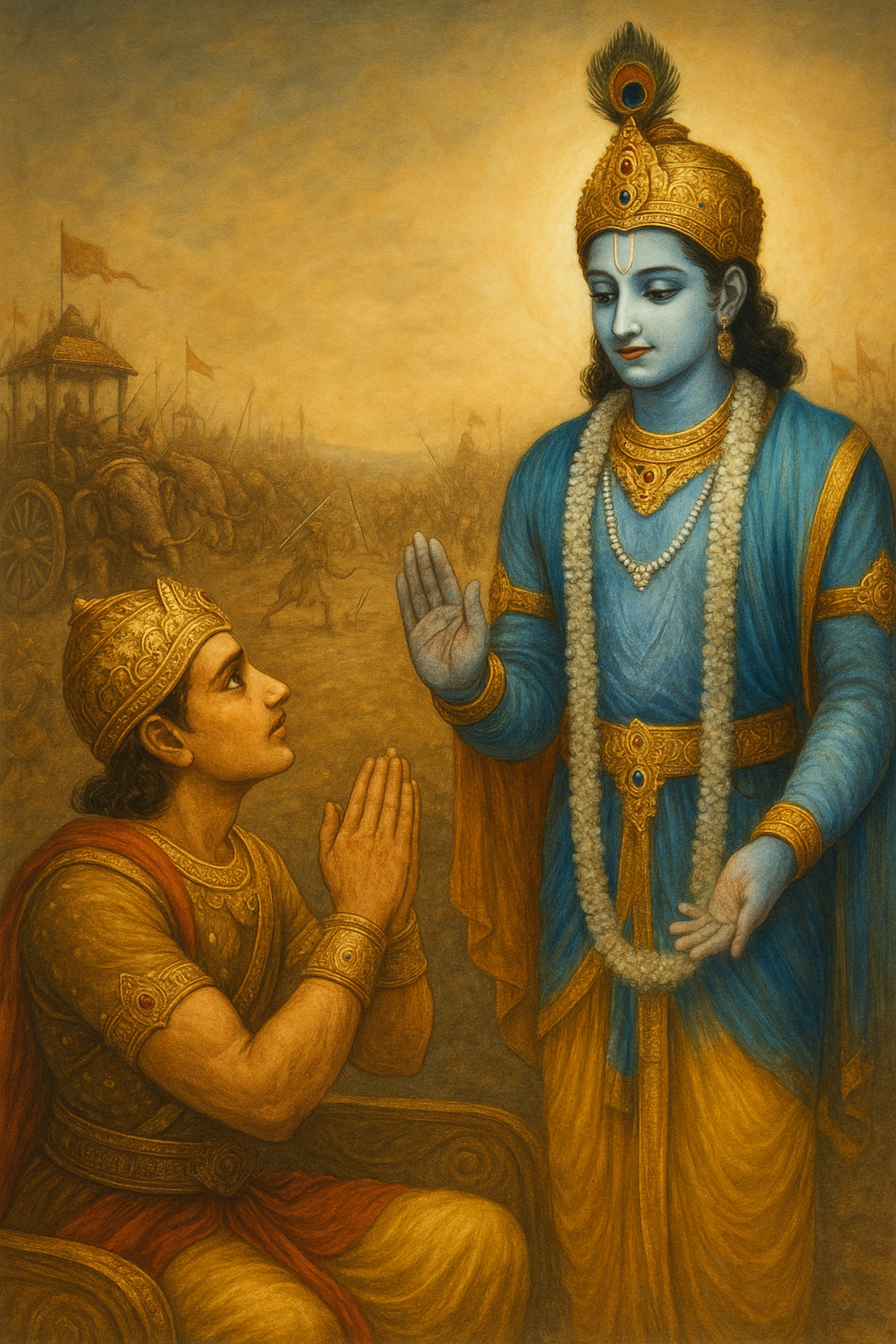
Self-discovery has become a modern buzzword. We seek it in books, travel, therapy, or even in quiet moments of reflection. Yet thousands of years ago, on the battlefield of Kurukshetra, Lord Krishna gave humanity a roadmap for true self-discovery through the timeless dialogue of the Bhagavad Gita.
What makes Krishna’s wisdom unique is that it is not abstract or detached—it is deeply human, delivered in the midst of war, doubt, and confusion. To understand self-discovery through Krishna is to recognize that the journey inward is not an escape from life, but a deeper engagement with it.
The Battlefield Within
Arjuna’s struggle was not only about facing his enemies; it was about facing himself. He was torn between duty and emotion, clarity and despair. Krishna reminds him—and us—that the greatest battlefield is often internal.
Everyday decisions, moral dilemmas, and emotional battles are our Kurukshetras. The discovery of the self begins not when we avoid these battles, but when we stand firm within them, guided by higher wisdom.
Peeling Back the Layers of Identity
Krishna emphasizes that we are not just our roles, titles, or even our bodies. These are temporary. The true self (ātman) is eternal, beyond birth and death.
- The body is the outer garment.
- The mind and emotions are like flowing rivers—powerful but ever-changing.
- The self is the still observer, unchanging and divine.
Self-discovery, in Krishna’s language, is the art of realizing this eternal dimension.
Four Paths to Self-Realization
Krishna does not prescribe a single way. Instead, he outlines different approaches, knowing that each soul is unique:
- Jnana Yoga (Path of Knowledge): Realizing the difference between the eternal self and the temporary body-mind.
- Karma Yoga (Path of Action): Acting wholeheartedly in the world, but without clinging to results.
- Bhakti Yoga (Path of Devotion): Surrendering the ego through love of the divine.
- Dhyana Yoga (Path of Meditation): Steadying the restless mind to glimpse the inner truth.
Each path is a mirror for self-discovery. Some may resonate more with devotion, others with action or meditation—but all converge in the same truth.
Discovery Through Relationship
Arjuna did not find answers alone. He found them in dialogue with Krishna. This reminds us that self-discovery is not always solitary. It unfolds in relationships—with mentors, with loved ones, with the divine presence within us.
Krishna himself says: “I am seated in everyone’s heart.” To discover the self, we must also recognize the spark of Krishna in others.
Bringing Krishna’s Wisdom into Daily Life
Self-discovery is not meant to remain in scripture; it is a living practice. A few ways to bring it into your own life:
- Pause before decisions: Ask, “Am I acting from ego or from dharma (higher duty)?”
- Practice detachment: Do your work fully, then let go of the outcome.
- Cultivate devotion: Through prayer, mantra, or simple gratitude.
- Meditate daily: Even 10 minutes of stillness brings clarity.
The Ultimate Realization
At the heart of Krishna’s teaching is this: the true self is divine, eternal, and one with the whole. To know this is to be free from fear, free from doubt, and free from the endless chase for external validation.
Self-discovery, then, is not about becoming someone new. It is about remembering who we already are.
Closing Thought
In the Bhagavad Gita, Arjuna’s self-discovery was not separate from his duty, his struggle, or his relationships—it was discovered through them, guided by Krishna.
Perhaps that is the greatest lesson: the self is not found by escaping life, but by living it with awareness, courage, and devotion.
 Self Discovery
You must be logged in to post a comment.