The Divine Genesis of Parashurama: A Tale of Vessels, Fate, and the Birth of Parashurama

Parashurama also known as Bhargava Rama

Sage Rucheeka (son of sage Chyavana) married Satyavathi, daughter of Gadhi, son of Kusika. When Satyavathi wanted children, sage Rucheeka told her that he would create a divine rice pudding, which would give her a child. Satyavathi requested her husband to help her mother too (Gadhi did not have a son and the life and marriage is considered incomplete without a male child). So, Rucheeka meditated on Para Brahma (The Ultimate Principle) and created two vessels with divine rice preparation. He showed her the two vessels and told her that one of them was brahmyam (full of the brahminic energies, Satva guna) and the second was Kshatram (full of the fighting warrior clan’s energies, rajo guna). He told her that after bath, she and her mother should hug a fig tree (Anjeer?) and an Aswattha (Pipal tree, ficus religiosa) respectively and then they should consume the respective rice puddings.
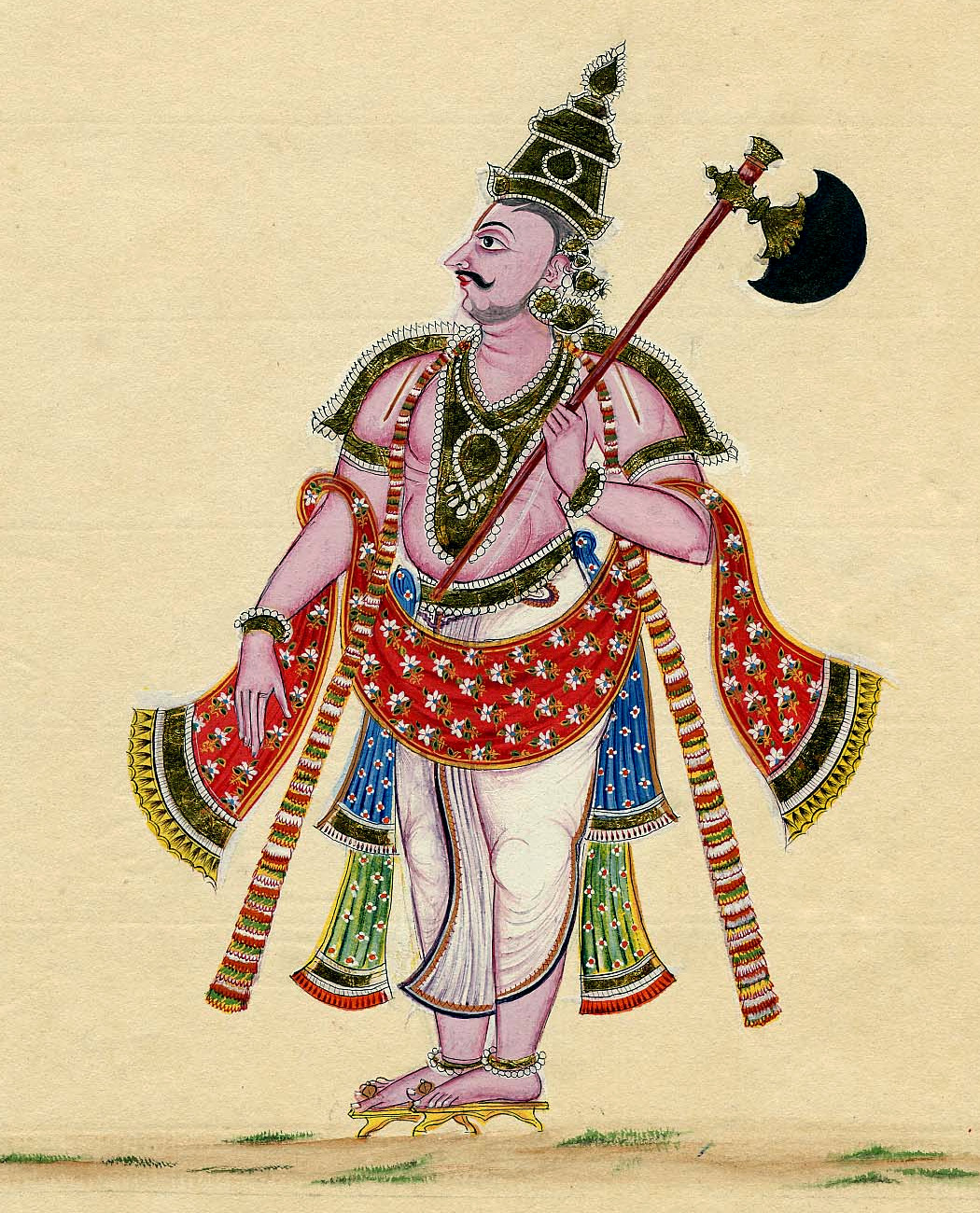

However, due to destiny, the two vessels got interchanged and Satyavathi ate the pudding bearing kshatriya energies and her mother the brahminic one. There is another variant to the story that the mother of Satyavathi interchanged the vessels deliberately because she felt that Sage Rucheeka would give the ‘better’ child to his own wife. Thus jealousy played the part of destiny! Rucheeka saw with his divine vision about the mix up and told his wife that she was bearing a cruel kshatriya foetus in her womb and not a brahminic one. Satyavathi was saddened and requested her husband to prevent the calamity through his yogic powers. He agreed and with his yogic powers transferred the change to his grandson (to the next generation). Satyavathi’s mother carried the brahminic foetus and Viswamitra, also known as Gadheya and Kausika was born. Thus, though born to a Kshatriya King, the soul inhabiting that body was that of a satvik brahmarshi. Satyavathi gave birth to a Brahmin child whom they named Jamadagni. Sage Jamadagni married Renuka and they got five sons including Rama, the incarnation of Vishnu. He was known as Bhargava Rama (to differentiate Him from Dasaratha Rama, Rama the son of King Dasaratha, also an incarnation of Vishnu) and Parashu Rama because His weapon was a divine Parashu, Axe. Thus what Sage Rucheeka foresaw came true. His name is also written as Parashuram and Parasuram etc.

Significance and Purpose of the Parashurama Avatar:

The primary and singular purpose of all Vishnu avatars is the preservation of Dharma. As the Lord declared in the Bhagavad Gita, “To protect the virtuous, to annihilate the wicked, and to establish Dharma, I manifest myself millennium after millennium.” Whenever unrighteousness exceeded bearable limits, Lord Vishnu took avatars to restore balance to the cosmic order. While the ten well-known avatars of Vishnu are celebrated, he also assumed various Amsha Avatars, where a part of his divine energy incarnated on Earth while he remained in Vaikuntha. Examples include Sage Kapila, the teacher of Samkhya, and Sage Vedavyasa.

Lord Dattatreya stands out as a unique incarnation of Vishnu, embodying the energies of the Trinity—Brahma, Vishnu, and Shiva. The curses of Sage Durvasa and the wife of Sage Bhrigu played roles in prompting Vishnu to take different avatars. Parashurama, the sixth among the ten avatars, had a specific mission: to purify the Earth of oppressive Kshatriya kings who deviated from the path of righteousness during the Satya Yuga. His purpose extended to avenging his father’s brutal murder by the sons of Kartaveerya Arjuna, a Kshatriya king. Parashurama’s actions included vanquishing the majority of Kshatriya rulers of that era, thereby relieving Mother Earth from their tyranny. Notably, a few kings such as Dasaratha and Janaka were spared, and their stories will be explored later.

Sage Parashurama is revered as a Chiranjeevi, an immortal being, and it is believed that his existence will endure until the time of Maha Pralaya, the ultimate cosmic dissolution.
Parashurama, in obedience to his father Sage Jamadagni, carried out a harrowing act by beheading his mother, Renuka, and also his brothers. The incident unfolded when Renuka, accustomed to fetching water from the river daily, encountered a Gandharva king named Chitraradha engaged in revelry with his wives. Although Renuka remained seemingly unaffected consciously, her mental equilibrium was disturbed subconsciously. On that day, her attempts to shape moist sand into a pot failed, and she returned empty-handed.

Faced with the consequences of her aura contamination, Renuka, as a devoted wife and true pativrata, relinquished individual rights over her body, mind, and soul. She chose to let her husband, Sage Jamadagni, deal with the situation as he deemed fit—a true display of egolessness, surrender, and pativrata dharma.

Sage Jamadagni, using his divine sight, witnessed the incident and, as a form of purification, instructed his sons to behead Renuka. The first four sons, unable to perceive their father’s true intentions and powers, refused the command. However, the youngest son, Rama (Parashurama), who was an incarnation of Vishnu, obediently followed his father’s command and executed the distressing act.

In accordance with the principle that accepting punishment leads to purification, Rama’s compliance pleased Sage Jamadagni. As a result, he offered Rama a boon, and Rama requested the restoration of his mother and brothers to life. Sage Jamadagni, with his sage powers, granted this request, showcasing the extraordinary abilities of the sages in those times.

The story took a further turn as Parashurama had to bear the consequences of his actions. After beheading his mother and brothers, an axe became stuck to his hands, symbolizing the lingering effects of the karma he had performed. Parashurama, seeking atonement, traveled across India, visiting holy places. However, the axe remained affixed. Finally, on the advice of sages, he arrived at Brahma Kund in the Lohit district. After taking a dip in the holy waters, the axe became unstuck and fell from his hands. In relief and frustration, Parashurama threw the axe into the mountains, splitting them. The spot where the axe landed became the source of the Lohit River, and the Kund came to be known as Parashuram Kund, attaining reverence as a holy site in the country.

The Demise of Jamadagni:

Kartaviryarjuna, a powerful king of the Haihaya clan, was born with two short and weak hands due to an intriguing tale. Sudarsana Chakra, the formidable weapon of Lord Vishnu, had become arrogant, leading to a curse from Vishnu himself. Sudarsana was destined to be born as a human with weak hands, a curse designed to humble the ego and guide it toward self-realization. Upon realizing his mistake, Sudarsana received assurance from Vishnu that he would soon reunite with the divine and attain fame. Thus, Kartaviryarjuna, born with physical limitations, became a devoted follower of Sri Dattatreya, receiving numerous boons and emerging as one of the mightiest kings on Earth. It was Kartaviryarjuna who once chastised the formidable Ravana, leading to a visit from Ravana’s grandfather, the sage Pulastya, seeking his intervention.

One of Kartaviryarjuna’s boons was that his end should come at the hands of a worthy opponent. To fulfill this boon and keep the promise made to Sudarsana, Sri Maha Vishnu incarnated as Parashurama, born to Jamadagni. The narrative now takes us through this compelling story.

Jamadagni possessed a Kamadhenu named Surabhi, a divine cow capable of fulfilling all desires. When Kartaviryarjuna visited Jamadagni’s ashram with his retinue, the king expressed a desire to obtain Surabhi. However, the sage declined the request. Enraged, Kartaviryarjuna ordered his army to seize the cow by force. Surabhi, at Jamadagni’s command, created a counter army, defeating the king’s forces in twenty consecutive battles. Frustrated, Kartaviryarjuna, ignoring the sanctity of the sage, killed Jamadagni and commenced a search for Surabhi, who had vanished and returned to heaven.

Renuka, Jamadagni’s wife, wished to accompany him on the funeral pyre. However, Sage Bhrigu, Jamadagni’s grandfather, intervened, bringing Renuka and Jamadagni back to life. In retaliation, Parashurama, angered by these tragic events, engaged Kartaviryarjuna in battle and fulfilled the boon given by Lord Dattatreya by slaying the mighty king. Upon Parashurama’s return, he recounted the events to his illustrious father, who, despite acknowledging the injustice, instructed his son to embark on a year-long pilgrimage for purification. Complying with his father’s command, Parashurama set out on a tirthayatra.

Seizing this opportunity, the sons of Kartaviryarjuna, driven by vengeance, took advantage of Jamadagni’s vulnerable state and killed him. Renuka, in a desperate attempt to seek her divine son’s protection, called out to Parashurama twenty-one times, but destiny and the curse of the Sun God dictated otherwise. The calls of the distressed mother went unanswered, and Jamadagni met his tragic end.

Parashurama conducts the final rites for his parents:

Upon his return, Parashurama learned of the tragic events that unfolded. Inspired by his mother’s twenty-one calls, he vowed to circumnavigate the earth twenty-one times to eradicate the malevolent Kshatriyas. Renuka, holding the bodies of her husband and herself, implored Parashurama to transport them to Sahyadri for their last rites.

Balancing both parents on his shoulders, Parashurama, accompanied by his brothers, set out to locate Dattatreya, guided by Renuka’s instructions. Upon reaching the meditating Dattatreya, Parashurama was directed to a cave where Datta resided. However, when he approached, he found Datta seemingly intoxicated and in the company of damsels. Initially rebuffed and cursed, Parashurama’s situation changed when he mentioned his mother’s plea. Datta, shedding his guise, guided Parashurama on how to perform the final rites.

Parashurama’s Global Journey and the Elimination of Kshatriyas:

After completing the last rites, Parashurama sought permission from Dattatreya, his revered Guru, and embarked on a journey around the earth twenty-one times. During this mission, he cleansed the world of wicked Kshatriya rulers, collecting their blood in a kund near Kurukshetra. In homage to his ancestors, Parashurama offered tarpan and received guidance to abandon the path of violence and realize his true nature.

The Encounter with Dasaratha Rama and the Surrender of His Bow:

Upon Sri Rama’s victorious return to Ayodhya after breaking Lord Shiva’s bow in Mithila, Parashurama confronted him. Furious that another, especially a Kshatriya, bore the name Rama and had dared to break his Guru Lord Shiva’s bow, Parashurama challenged Rama. Unwilling to listen to pleas, he insisted Rama attempt to string his bow or face punishment. Rama accepted the challenge, effortlessly stringing Parashurama’s bow, symbolizing the transfer of Vishnu Teja to the next incarnation.

Parashurama’s submission and withdrawal from the confrontation signified the continuity of the divine energy. In one version, it is mentioned that the loud sound of Siva’s bow breaking reached Parashurama, prompting him to investigate. When he encountered Rama, his divine vision revealed that the sound signified the transfer of Vishnu Teja. In another version, Parashurama’s inability to harm Rama was due to the sage’s blessing to Sita.

Regardless of the variations, these stories underscore the importance of recognizing the divine essence in all beings, promoting respect for each other’s divinity.

Lord Parashurama Temples in India:

1. Kolar 

  • It is the district head quarter in Karnataka State. Parashurama swamy temple is on M.B.Road. Kolar is 71kms from Bangalore and 185kms from Tirupati.

2. Kunjarugiri

  • It is a small village in Udupi district, Karnataka. Parashurama Temple is here. Kunjarugiri is just 11kms from Udipi.

3. Attirala 

  • It is a tourist place in Kadapa district, Andhra Pradesh State. Pagoda of  Parashurama Temple is here. It was constructed in 6th century. Attirala is just 10kms from Rajampet, 65kms from Kadapa and 98kms from Tirupati.

4. Mundaje

  •  It is a small town at Belthagadi taluk in Uttara kannada district, Karnataka. Kere Parashurama Temple is here. Mundaje is 15kms from Belthagadi, 75kms from Mangalore and 49kms from Mudigere.

5. Nanjangud

  •  It is the taluk town in Mysore district, Karnataka State. It is on the bank of river Kabini. Parasurama Temple is here. Nanjangud is 24kms from Mysore.

6. Irinjalkuda 

  • It is a town in Trissur district, Kerala. Ramapurath Parasurama Temple is here. Irinjalkuda is 25kms from Trichur (Trissur)

7. Thiruvallam

  • It is a temple village in Thiruvanthapuram district, Kerala State. It is on the bank of river Karamana. Parasurama Temple is here. Thiruvallam is just 6kms from Thrivendrum and 6kms from Kovalam beach on Thiruvananthapuram road.

8. Somanath

  •  It is a temple town in Junagadh district, Gujarat State. It is on the bank of Arabian Sea. It is also one of the 12 Jyothirlinga Kshetras. Parasuramji Temple is here near Triveni Ghat. Somanath is 410kms from Ahemdabad and 235kms from Dwarka.

9. Padubelle 

  • It is a small village in Udupi  district, Karnataka. State. Parashu Kshetra Temple is here. Padubelle is just 12kms away from Udupi.

10. Jalalabad

  • It is a small town in Shajahanpur district of Uttar Pradesh State. According to Indian Mythothology this is the birth place of Lord Parasurama. Parasurama Temple is here. It was constructed in early ages. Jalalabad is 35kms from Shahjahanpur.


(Excerpted from: https://divineindians.blogspot.com/ , https://isireddy.blogspot.com/)
Image Source: Unknown
The Story of Vamana and Mahabali: A Tale of Divine Deception and Redemption

Vamana, the fifth incarnation of Lord Vishnu, assumed the form of a Brahmin boy with the purpose of ending the rule of the great demon Mahabali. Mahabali, who was the grandson of Prahalad, a devoted follower of Lord Vishnu, shared his grandfather’s devotion to the deity. However, Mahabali, the powerful ruler of the Patal Lok, grew greedy for more power and aspired to rule all three realms: Heaven, Earth, and the Underworld. To achieve this, he meditated upon Lord Brahma and, upon successfully pleasing Brahma, became invincible, surpassing even the gods in strength. Mahabali then launched an assault on the heavens, seeking to conquer Indra’s kingdom.


In the ensuing battle, Indra was defeated, resulting in the gods losing their dominion and becoming homeless. Indra, who was the son of Sage Kashyap and Aditi, deeply distressed his mother, Aditi. She, following consultation with her husband, commenced a meditation upon Lord Vishnu. Pleased with her devotion, Lord Vishnu decided to fulfill her request. Aditi implored Vishnu to be born as her son, with the aim of reclaiming the kingdoms of Heaven and Earth for the gods. Vishnu granted her wish.

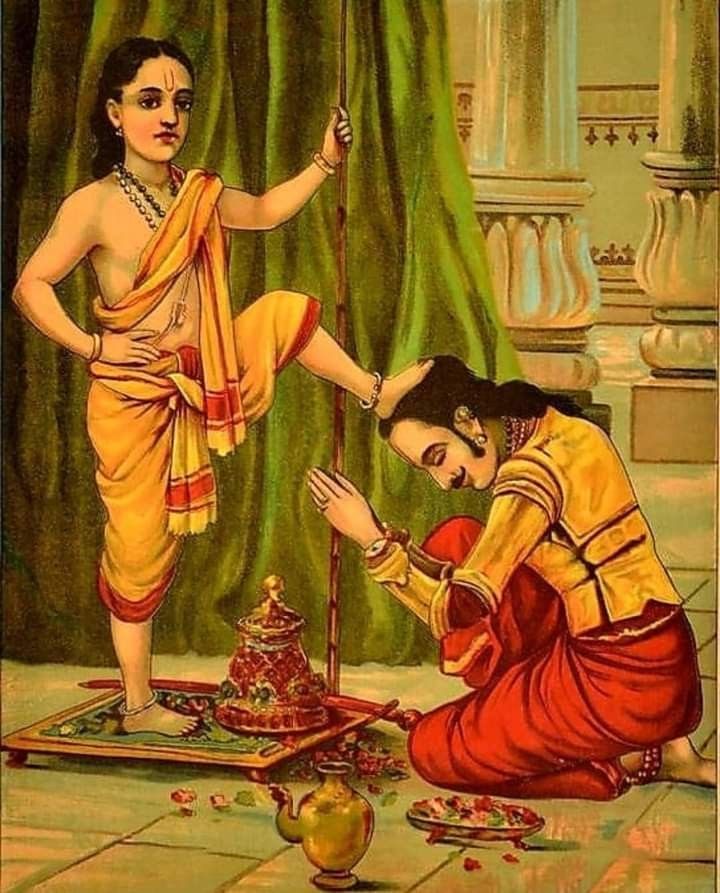
Subsequently, Vishnu was born to Aditi and Kashyap but assumed the form of a diminutive Brahmin boy. This boy decided to visit Mahabali. Despite being a demon, Mahabali was a just and benevolent king, and his rule brought prosperity to his subjects. He ensured that no one left his court empty-handed. When Lord Vishnu, taking the form of Vamana (the Brahmin boy), was about to enter Mahabali’s court, Mahabali was engrossed in a potent Yagya performed under the guidance of his teacher, Shukracharya. As Vamana entered the court, it was illuminated with divine radiance, signifying that he was no ordinary Brahmin. Mahabali accorded Vamana great respect, seating him in a special place and inviting him to express his desire. Mahabali vowed to grant whatever Vamana asked of him.

Vamana made a seemingly modest request, asking for a piece of land long enough to accommodate his three steps. Mahabali consented to this seemingly unusual wish. Sage Shukracharya, realizing that Vamana was none other than the Supreme Vishnu, cautioned Mahabali that Vishnu intended to take away his kingdom. However, Mahabali, known for his integrity, upheld his commitment and refused to retract his word.

In a matter of moments, Vamana began to grow in size, soon reaching limitless proportions that touched the boundless sky. With his first step, he covered the entire Earth, and with his second step, he traversed the entire heavenly realm. With no space remaining for his third step, Vamana inquired where he should place it. Mahabali humbly bowed and requested Vamana to place his third step on his head, as that was the only space he possessed. Complying with Mahabali’s plea, Lord Vishnu placed his foot on Mahabali’s head, sending him down to the Patal Lok (Underworld). As a result, the kingdoms of Heaven and Earth were restored to the gods.

Lord Vishnu remained pleased with Mahabali, acknowledging his virtuous nature. He granted Mahabali a boon and allowed him to wish for a blessing. Mahabali, a devout worshiper of Vishnu like his grandfather, asked Vishnu to dwell with him in the Patal Lok, desiring to worship him daily. Lord Vishnu granted this wish and left Vaikunta to reside with Mahabali.

During Lord Vishnu’s absence from Vaikunta, Goddess Lakshmi, missing her consort, decided to disguise herself as an ordinary woman and visit the Patal Lok. Upon meeting Mahabali, she expressed her desire to stay there, claiming she had nowhere else to go. Mahabali, a noble king, offered her a place in his palace and pledged to protect her virtue like a brother. With the presence of Lakshmi, Mahabali’s kingdom flourished and became filled with fortune.

One day, Mahabali found Lakshmi worshiping for his long life, and he was so pleased that he asked what she desired in return. Lakshmi requested the return of her husband. Confused, Mahabali watched as Goddess Lakshmi revealed her true form and expressed her wish for Vishnu to return to Vaikunta. Realizing his mistake, Mahabali allowed Lord Vishnu and Lakshmi to return to their celestial abode. It is believed that the festival of Raksha Bandhan originated from this story, with Goddess Lakshmi tying the sacred thread of protection on the wrist of her brother, Mahabali.

Temples dedicated to Vamana, the fifth avatar of Lord Vishnu, are not as numerous or well-known as some other major temples in Hinduism. Nevertheless, there are some temples associated with Vamana Avatar that devotees can visit. Here is a list of a few such temples:

Thrikkakara Temple (also known as Mahabali Temple)

  • Location: Thrikkakara, near Kochi, Kerala, India.
  • Significance: This temple is believed to be the place where Vamana pushed King Mahabali to the netherworld with his third step. The annual Onam festival is celebrated here with great enthusiasm.

Ankola Vamana Temple:

  • Location: Ankola, Karnataka, India.
  • Significance: This temple is dedicated to Vamana, and it’s believed to be one of the ancient temples associated with the Vamana Avatar.

Padinjarekara Azhakal Bhagavathy Temple:

  • Location: Thrissur, Kerala, India.
  • Significance: While the main deity of this temple is Goddess Bhagavathy, there is also a shrine dedicated to Lord Vamana. The temple is famous for the annual Vamana Jayanti festival.

Vamana Temple (also known as Thoopul Vilakoli Perumal Temple):

  • Location: Thoopul, near Chennai, Tamil Nadu, India.
  • Significance: This temple is dedicated to Lord Vamana. The annual Vamana Jayanti festival is celebrated with grand rituals.

Vamana Avatar Temple in Banavasi:

  • Location: Banavasi, Karnataka, India.
  • Significance: This temple is dedicated to Lord Vamana and is believed to have historical and mythological importance.

Vamanamoorthy Temple:

  • Location: Thirunavaya, Kerala, India.
  • Significance: This temple is dedicated to Lord Vamana and is associated with the famous Mamankam festival that has historical and cultural significance.

Please note that while these temples are associated with Vamana Avatar, the level of recognition and popularity may vary. It’s advisable to verify the current status and visitation details before planning a trip to these temples.


Image Credit: Unknown

The Epic of Narasimha: Triumph of Devotion and the Fierce Avatar of Lord Vishnu

In Indian Mythology, specifically the Bhagavata Purana, the narrative revolves around the divine incarnations and the clash with the demon king Hiranyakashipu. The story begins with the visit of the Kumaras, sons of Lord Brahma, to Vaikunth Loka to meet Lord Vishnu.


However, their meeting was obstructed by Jaya and Vijaya, the gatekeepers of Vaikuntha, who conveyed that Lord Vishnu was in a state of rest, believing that they were protecting their Lord from disturbance.

This incident infuriated the four Kumaras, leading them to curse the gatekeepers to be reborn as mortals on Earth and experience the suffering of ignorance. As a consequence, Jaya and Vijaya took birth as the sons of Diti and Sage Kashyap during the Satya Yuga.

The two brothers, Hiranyakashipu and Hiranyaksha, jointly referred to as the Hiranyas, grew up and embarked on distinct paths. Hiranyaksha engaged in relentless penance, ultimately seeking a boon that rendered him invulnerable. His specific conditions included being impervious to harm from any man, beast, deity, or demon, at all times of day or night, and in all locations, whether indoors, outdoors, on the earth, or in the sky.

Brahma, initially hesitant, granted this wish with the word “Tathastu” before vanishing.

Simultaneously, Hiranyaksha, the younger sibling, initiated a reign of terror and chaos, tormenting humans, deities, and innocent beings. In response, the 33 Koti gods sought the aid of Lord Vishnu, who incarnated as Lord Varaha to eradicate the adharma caused by Hiranyaksha and restore balance to the Earth. An intense battle ensued between Varaha and Hiranyaksha, lasting a millennium, with Varaha emerging victorious and restoring the Earth’s stability.

Amidst these events, while Hiranyakashipu was engaged in severe penance to secure a boon from Lord Brahma, Indra seized the opportunity to attack his kingdom and destroy his residence, even attempting to abduct Queen Kayadhu, who was pregnant with a child.

Sage Narada intervened at this juncture, offering protection and guidance to Kayadhu and her unborn child, Prahlad. Prahlad, nurtured on stories of Lord Vishnu narrated by Narada, developed transcendent love for the Lord from a tender age.

Upon returning to his kingdom, Hiranyakashipu, keen to spend time with his son, discovered that Prahlad was fervently praising Lord Vishnu. Enraged, Hiranyakashipu subjected Prahlad’s teacher to punishment, unable to tolerate his son’s devotion to Lord Vishnu, whom he regarded as an adversary.

Hiranyakashipu’s subsequent attempts to influence Prahlad and turn him against Lord Vishnu proved fruitless. Frustrated, he ordered demons to crush his son beneath an elephant, but Prahlad emerged unscathed. They attempted various means, including poison, starvation, and enchantments, but Prahlad remained unharmed, protected by his unwavering devotion.

In a final bid to eliminate the devotee of his adversary, Hiranyakashipu sought the assistance of his sister, Holika, who possessed the ability to remain unharmed in fire. Holika was instructed to sit in the fire with Prahlad on her lap to incinerate him into ashes.

Unperturbed by the imminent danger, Prahlad chanted the name of Lord Vishnu, and as the flames intensified, he remained untouched, while Holika perished in the fire.

This episode gave rise to the tradition of Holika Dahan, observed the day before Holi.

Following these events, Prahlad refused to recognize Hiranyakashipu as his father and affirmed that Lord Vishnu was omnipresent. In a fit of rage, Hiranyakashipu pointed to a pillar in his palace and asked Prahlad if his Lord Vishnu was present there. To this, Prahlad confidently responded that the Lord was indeed present.

Incensed, Hiranyakashipu approached the pillar with his mace and struck it. The pillar shattered with a burst of light and a deafening roar, revealing the fearsome form of Lord Narasimha, a half-man, half-lion incarnation of Lord Vishnu. Narasimha appeared with disheveled hair, a formidable mustache, and menacing teeth, his claws resembling sharp blades poised to rend the demon into two.

Ferocious and unrestrained, Narasimha roared in anger, while the gods from heaven bore witness to the spectacle. Hiranyakashipu attempted to flee the palace to escape Narasimha’s wrath but was apprehended by the divine incarnation. Narasimha placed him on his thighs, neither on the earth nor in the sky, and eviscerated him with his razor-sharp claws.

Even after the demon’s demise, Narasimha remained uncalmed, impervious to the efforts of Lord Brahma, Lord Shiva, and Goddess Lakshmi to soothe his fury. It was only when Prahlad approached Narasimha, touched his feet, and requested a boon that the avatar’s anger subsided.

Prahlad, acknowledging Narasimha as his Lord, was granted the title of king and instructed to rule with devotion and righteousness. Humbly, Prahlad requested to be free from worldly desires, a wish Narasimha kindly granted.

Here is a list of some prominent Narasimha temples in India:

  1. Ahobilam Narasimha Temple, Andhra Pradesh: Ahobilam is one of the most significant Narasimha temples in India, with nine different forms of Lord Narasimha enshrined in the region.
  2. Singaperumal Koil, Tamil Nadu: This temple in Singaperumal Koil, near Chennai, is known for its deity, “Prahlada Varadar,” in a sitting posture.
  3. Simhachalam Narasimha Swamy Temple, Andhra Pradesh: Located in Visakhapatnam, this temple is renowned for its beautifully adorned deity of Lord Narasimha.
  4. Kadiri Lakshmi Narasimha Temple, Andhra Pradesh: Kadiri in Andhra Pradesh houses a temple dedicated to Lord Narasimha, and it’s a popular pilgrimage site.
  5. Narasimha Jharni, Karnataka: This cave temple is situated in Bidar, Karnataka, and is known for its natural springs and the idol of Lord Narasimha.
  6. Lakshmi Narasimha Temple, Nuggehalli, Karnataka: This Hoysala temple is famous for its exquisite architecture and the idol of Lord Narasimha.
  7. Yadagirigutta Narasimha Temple, Telangana: Located in Yadagirigutta, this temple is dedicated to Lord Lakshmi Narasimha.
  8. Karimnagar Narasimha Swamy Temple, Telangana: A prominent temple in the state of Telangana, it is dedicated to Lord Narasimha.
  9. Kalamalla Narasimha Swamy Temple, Telangana: Situated in Kalamalla, this temple is known for its beautiful idol of Lord Narasimha.
  10. Jwala Narasimha Temple, Samalkot, Andhra Pradesh: This temple is known for the fiery form of Lord Narasimha, and it’s located in Samalkot.
  11. Narasimha Temple, Sholingur, Tamil Nadu: Sholingur is home to two Narasimha temples on twin hills, collectively known as “Sholingur Ahobilam.”
  12. Bhadrachalam Narasimha Temple, Telangana: While Bhadrachalam is famous for Lord Rama, it also has a shrine dedicated to Lord Narasimha in the vicinity.
  13. Lower Ahobilam, Andhra Pradesh: This is one of the temples in the Ahobilam complex, known for its peaceful and serene surroundings.
  14. Sri Narasimha Swamy Temple, Simhanagadde, Karnataka: This ancient temple is located in the Hassan district of Karnataka and is dedicated to Lord Narasimha.

Please note that there are many more Narasimha temples in India, and this list provides just a glimpse of the diversity and significance of these temples across the country. Each temple has its unique history and significance in Hindu mythology and is worth visiting for devotees and those interested in Indian temple architecture and culture.

Image Credit: Subhajit Biswas – Pixels