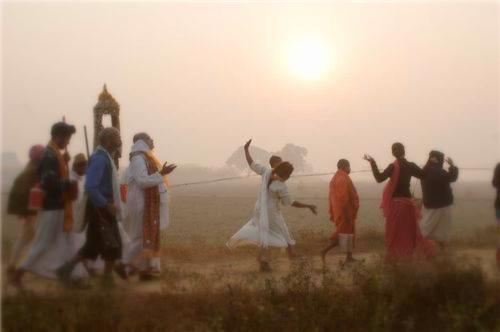
Braj Chaurasi Kos Darshan Yatra

Braj Chaurasi Kos YatraOnce upon a time God Shiva was staying at Mount Kailash. God Shiva was looking tensed; looking at him Goddess Parvati asked him the reason for it. God replied to her “I have heard that everyone should have a spiritual guru in his life, but I don’t have anyone, it is said that unless you meet a spiritual guru a human doesn’t get the benefit of his virtuous deeds.” No matter how much we pray to God we never get any yield. That’s why I am thinking to find a spiritual guru.

Hearing this Goddess Parvati suggested that “to whom you worship day and night make him your spiritual guru?” God replied that there is nothing special in this since everybody in this universe pray to him. Goddess suggested that he should make God Krishna and Goddess Radha his guru. God Shiva became very happy and said “I will go and meet him today itself and will request to be my spiritual guru”.

God Shiva and Goddess Parvati than went to Vishnu Lok to meet God Vishnu. On reaching they told the reason to come to Vishnu Lok. God Vishnu accepted his request to become his Guru and agreed to meet him at the Bank of river Birija.

On decided day God Vishnu and Shiva met at the banks of river Virija. God Shiva and Goddess Parvati gave a huge welcome to Mata Lakshmi and Vishnu Ji. God Shiva created a new city on the banks of river Birija. In this city there were numerous cows, tree with fruits, bountiful birds etc. There was a huge Throne of Gold named as “Shree Golok Dham”.

After performing the rituals God Shiva and Goddess Parvati gave new identity to God Vishnu and Goddess Lakshmi as Krishna and Radha. With rituals and prayer he made God Krishna his spiritual guru. And told that all the animals, birds, trees etc dedicated to you. Shiva also requested both of them to reside in Golok Dham forever.

Once Radha and Krishna were enjoying in Shree Golok Dham and they were engrossed in the beauty of the place. Same time Radha’s brother came there. Radha & Krishna could not see him. He became very angry and cursed them “you are so busy among yourself that you couldn’t see me I curse you that henceforth you will not see each other although still loving.”

God Vishnu said we need to go to earth to live the curse. Goddess Lakshmi replied that she will not go to earth as there is lot of bad thing on earth. It’s not a livable place. God Vishnu suggested why not to bring the Golok Dham to Earth and staying it.

To bring Golok Dham on earth God Vishnu requested Yamuna Ji to come on earth. After that Water of river Birija was poured into it. God Krishna than took sand (Raj) to the size of his 84 fingers. This sand was spread across river Yamuna in the area of 84 Kos (252 Kilometers). Joining the name of river Birija and Raj of Golok Dham gave the name as and Birija.

In this area there are 12 Van (Forest) 24 Upvan (Gardens) 20 Kund (Tanks),and village namely as Nand-Goan, Barsana, Govardhan Vrindavan, Mathura, Kosi, Radha Kund etc. After the city was created God Krishna requested all the trees, birds etc in Golok Dham to come to Brij and stay in there.

After some time Radha was born in village Barsana. Few years later of her birth God Krishna was born in a prison in Mathura. All his childhood activities happened in Brij area. To complete the curse of Radha’s brother Krishna left Brij and went to Dwarka and Radha Ji remained in Brij. After completing the term of curse Radha Ji left for Golok Dham.

As per Bhagvat Gita and other books its mentioned that in Kalyug anyone who completes the Yatra of 84Kos will get rid of all his evil deeds.

Mukti Kahe Gopal se, meri mukti batao,

Brij raj jab maathe chade mukti mukt ho jaye||

Brij chourasi kos ki parikamma jo det,

To lakh chorasi janm ke paap hari har let||

 “Jai Jai Shri Radhe”
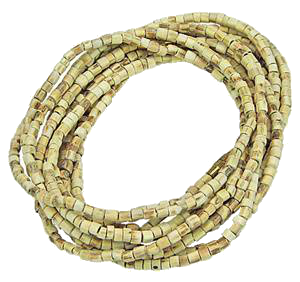
Wearing Tulsi Beads Around The Neck

Tulsi BeadsTulsi is thought to be the most sacred of woods in India and Indian worship, and the plant of Tulsi is believed to be the incarnation of the Divine itself. The Tulsi Mala is made of the wood or the seeds of Tulsi and is used for name chanting and worship.

Moreover, the Tulsi Mala is said to have incredible spiritual and physical healing powers apart from helping the mind to focus during prayers. Like the Sphatik Mala and the Rudraksh Mala.

The Tulsi Mala is made of Tulsi wood and consists of 108 beads wound around a strong string, with a 109th bead called the Sumeru bead of some other material like a metal or crystal, or a bigger Tulsi bead itself. One starts counting the beads from the bead adjacent to the Sumeru bead of the Tulsi Mala and completes one full round. On second round the Tulsi Mala needs to be counted in the reverse direction again as the Sumeru bead should not be crossed while praying. Depending on the type of the Tulsi plant, the Tulsi Mala is available in various colors like black, brown or sandalwood color.

The Tulsi Mala can be worn on the neck or tied around the fist. The benefits of the leaves of Tulsi is well proven, and owing to its spiritual and physical healing powers, the touch of the Tulsi wood acts as a rejuvenator for the stressed mind and brings the spiritual self of a person closer to God. On top of that, wearing the Tulsi Mala is supposed to bring good luck and fortune to the devoted wearer. It is said to balance the kapha and the vata dosha. Tulsi clears the aura, and its subtle smell fills the heart with sensation of the divine. The Tulsi Mala is used to worship Lord Ram and Krishna, different incarnations of Lord Vishnu who is believed to be the creator and the beloved of the Tulsi.

The Lord says that one who wears the beads made out of the wood of Tulsi in one’s neck, even if he is untidy and ill- charactered, will undoubtedly attain Me only. Sri Krishna will grant the fruit of being the resident of Dvarka immediately to those who wear Tulsi beads around the neck. The sins of the person who wears neck beads made of Tulsi with devotion after offering to Sri Vishnu will get vanquished and Devakinandan Sri Krishna will always remain pleased with him, he does not need to undergo further atonement, no more sins remain in his body. In Kaliyuga, one, who is bedecked with the beads made of Tulsi, performs ritual activities and activities pertaining to ancestors and demigods, obtains crores times more results. The messengers of Yama will flee away by the sight of the Tulsi beads just as leaves are blown off by wind.

In Skanda-puran it is stated :- Those who wear neck beads made of Tulsi after offering it to Sri Hari are definitely foremost among the devotees of Lord. After presenting the mala, it should be purified with panca-gavya; after that the mula -mantra should be recited followed by the recitation of the gayatri mantra for eight times. Touching with incense, worship with this

Sadyojata -mantra with utmost devotion:

Om sadyojatah prapadyami sadyojataya vai namo namah.

Bhave tave nadi bhave bhajeswamam bhavod-bhavaya namah After that, this prayer should be made, “Oh! Mala ! You are made of Tulsi and are dear to Vaisnavas . I wear you around my neck; you make me dear to Sri Krishna. ‘Ma’ means ‘me’, ‘La’ means ‘to give’. Oh Hari-Vallabhe ! You have given me to Vaisnava devotees, hence you are known as mala . Those Vaisnavas who pray in accordance with rituals in this manner and first offer the mala in the neck of Sri Krishna and then puts it to themselves attain the Lotus feet of Sri Vishnu.” It is stated in Padma Purana : either during morning ablutions or bathing or eating or at any state which is clean or unclean, Tulsi mala has to be worn always; that means mala should not be removed under any circumstance.


Health Benefits of Tulsi (Sciance)

– It acts as anti bacterial and anti parasitic, therefore is widely used in infectious diseases.- Tulasi act on nervous system providing them strength, relieves stress and helps in relieving
pain.

– It work as appetizer and promotes digestion by helping in secretion of digestive enzymes.

– Tulsi juice when mixed with ginger juice is very effective in abdominal disorder in children.

– It helps in preventing flatulence and avoids constipated stool.

– It is an effective natural cure for upper respiratory tract infection (URTI).

– Tulasi works as good expectorant relieving from wet cough.

– It is very useful in bronchitis and asthmatic conditions.

– It works as antibiotic eliminating the bacteria.

– It is widely used in fever as it act as antipyretic, pain reliever, and provides strength to our body.
Take powder of Tulasi leaves with saunth (dried ginger) and sugar with hot water in fevers.

– It also possesses anti-cancerous properties.

– Tulsi juice drops are very effective in earache.

– Keep powder of tulsi root in water for overnight and take it early morning for diabetes natural cure.

– It works as a powerful antioxidant thereby helps in preventing early aging signs and makes the skin
young.

“Jai Shri Radhe”

How to perform a simple Tulsi Vivah Puja Aarti Ceremony at Home

Tulsi Vivah
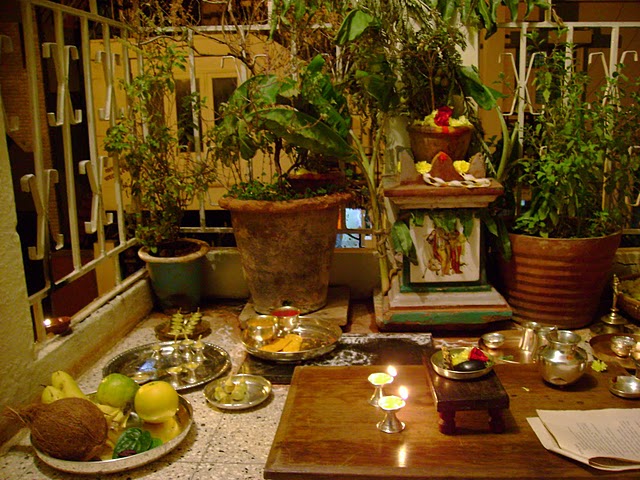
Step 1: Clean the area around the Tulsi plant. Sprinkle a little water on the tulsi plant and clean the idol ofimage or picture of Lord Vishnu (or Lord Krishna).  The idol can be a substitute for the shaligram, which is generally brought by the priest who can be called to perform the Tulsi Vivah ceremony. You can do a small rangoli design in front of the tulsi plant pot.

Step 2: Prepare a thali having a diya and red flowers (hibiscus flowers can be used); and another thali containing a saree, a blouse piece, a packet of mahendi, a kohl stick or box, a box of sindoor (red vermillion powder) and a few green bangles.Also keep a thali of fruits, tamarind and amla pieces. The reason for this: The tulsi is considered to be a plant of the forest (van), so anything which grows on the trees is offered as part of the Tulsi Vivah ceremony.

Step 3: Take 4 sugarcane sticks and place it at 4 corners around the tulis plant pot, connecting them with strong threads. This is the traditional way, done in the courtyards of villages. Alternatively, you can gently insert the  sugarcane sticks in the soil around the tulsi plant.

Step 4: Place a small bright cloth (this is generally red in colour and resembles a scarf or odhni) on the tulsi plant. Apply a bit of the sindoor on a leaf of the Tulsi plant. Throw the red flowers on the tulsi plant. Offer the fruits, tamarind and amla pieces. Say the Tulsi Aaarti.

Place the thali for the wedding (saree, blouse, bangles, etc) in front of the tulsi plant pot. Light the diya in the thali and perform the aarti of the tulsi plant. Apply a tika of sandalwood paste on the forehead of the idol/image/shaligram of Lord Vishnu (in some homes, a thali of men’s clothing is also offered with a sacred thread). Offer a little of the pre-pared poha dish (you can put it in the same thali as the fruits).

Step 5: Once the aarti is completed, a little of the poha is offered to family members and guests. The fruits can also be eaten later. In many homes, the lady who performed the Tulsi Vivah ceremony also eats a leaf of the tulsi plant, symbolically implying that the Goddess has entered her body.

Step 6: The thali containing the wedding items is generally offered to a Brahmini (female ascetic).


“Jai Shri Radhe”