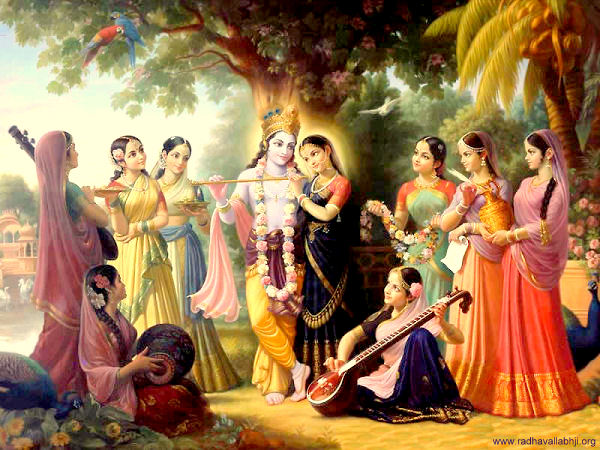
The Gopis Attracted by the Flute

krishna&gopis2

Krsna was very pleased with the atmosphere of the forest where flowers bloomed and bees and drones hummed very jubilantly. While the birds, trees and branches were all looking very happy, Krsna, tending the cows, accompanied by Sri Balarama and the cowherd boys, began to vibrate His transcendental flute. After hearing the vibration of the flute of Krsna, the gopis in Vrndavana remembered Him and began to talk amongst themselves about how nicely Krsna was playing His flute. When the gopis were describing the sweet vibration of Krsna’s flute, they also remembered their pastimes with Him; thus their minds became disturbed, and they were unable to describe completely the beautiful vibrations. While discussing the transcendental vibration, they remembered also how Krsna dressed, decorated with a peacock feather on His head, just like a dancing actor, and with blue flowers pushed over His ear. His garment glowed yellow-gold, and He was garlanded with a vaijayanti necklace. Dressed in such an attractive way, Krsna filled up the holes of His flute with the nectar emanating from His lips. So they remembered Him, entering the forest of Vrndavana, which is always glorified by the footprints of Krsna and His companions.

Krsna was very expert in playing the flute, and the gopis were captivated by the sound vibration, which was not only attractive to them, but to all living creatures who heard it. One of the gopis told her friends, “The highest perfection of the eyes is to see Krsna and Balarama entering the forest and playing Their flutes and tending the cows with Their friends.”

Persons who are constantly engaged in the transcendental meditation of seeing Krsna, internally and externally, by thinking of Him playing the flute and entering the Vrndavana forest, have really attained the perfection of samadhi. Samadhi (trance) means absorption of all the activities of the senses on a particular object, and the gopis indicate that the pastimes of Krsna are the perfection of all meditation and samadhi. It is also confirmed in the Bhagavad-gita that anyone who is always absorbed in the thought of Krsna is the topmost of all yogis.

Another gopi expressed her opinion that Krsna and Balarama, while tending the cows, appeared just like actors going to play on a dramatic stage. Krsna was dressed in glowing garments of yellow, Balarama in blue, and They held new twigs of mango tree, peacock feathers, and bunches of flowers in Their hands. Dressed with garlands of lotus flowers, They were sometimes singing very sweetly among Their friends. One gopi told her friend, “How is it Krsna and Balarama are looking so beautiful?” Another gopi said, “My dear friend, we cannot even think of His bamboo flute–what sort of pious activities did it execute so that it is now enjoying the nectar of the lips of Krsna?” Krsna sometimes kisses the gopis; therefore the transcendental nectar of His lips is available only to them, and His lips are considered their property. Therefore the gopis asked: “How is it possible that the flute, which is nothing but a bamboo rod, is always engaged in enjoying the nectar from Krsna’s lips? Because the flute is engaged in the service of the Supreme Lord, the mother and the father of the flute must be happy.”

The lakes and the rivers are considered to be the mothers of the trees because the trees live simply by drinking water. So the waters of the lakes and rivers of Vrndavana were full of happy lotus flowers because the waters were thinking, “How is it our son, the bamboo rod, is enjoying the nectar of Krsna’s lips?” The bamboo trees standing by the banks of the rivers and the lakes were also happy to see their descendant so engaged in the service of the Lord, just as persons who are advanced in knowledge take pleasure to see their descendants engage in the service of the Lord. The trees were overwhelmed with joy and were incessantly yielding honey, which flowed from the beehives hanging on the branches.

Sometimes the gopis spoke thus to their friends about Krsna: “Dear friends, our Vrndavana is proclaiming the glories of this entire earth because this planet is glorified by the lotus footprints of the son of Devaki. Besides that, when Govinda plays His flute, the peacocks immediately become mad. When all the animals and trees and plants, either on the top of Govardhana Hill or in the valley, see the dancing of the peacock, they all stand still and listen to the transcendental sound of the flute with great attention. We think that this boon is not possible or available on any other planet.” Although the gopis were village cowherd women and girls, they had knowledge of Krsna. Similarly, one can learn the highest truths simply by hearing the Vedas from authoritative sources.

Another gopi said, “My dear friends, just see the deer! Although they are dumb animals, they have approached the son of Maharaja Nanda, Krsna. Not only are they attracted by the dress of Krsna and Balarama, but as soon as they hear the playing of the flute, the deer, along with their husbands, offer respectful obeisances unto the Lord by looking at Him with great affection.” The gopis were envious of the deer because the deer were able to offer their service to Krsna along with their husbands. The gopis thought themselves not so fortunate because whenever they wanted to go to Krsna, their husbands were not very happy.

Another gopi said, “My dear friends, Krsna is so nicely dressed that He appears to be the impetus to various kinds of ceremonies held by the womenfolk. Even the wives of the denizens of heaven become attracted after hearing the transcendental sound of His flute. Although they are traveling in the air in their airplanes, enjoying the company of their husbands, on hearing the sound of Krsna’s flute, they immediately become perturbed. Their hair is loosened and their tight dresses are slackened.” This means that the transcendental sound of the flute of Krsna extended to all corners of the universe. Also, it is significant that the gopis knew about the different kinds of airplanes flying in the sky.

Another gopi said to her friends, “My dear friends, the cows are also charmed as soon as they hear the transcendental sound of the flute of Krsna. It sounds to them like the pouring of nectar, and they immediately spread their long ears just to catch the liquid nectar of the flute. As for the calves, they are seen with the nipples of their mothers pressed in their mouths, but they cannot suck the milk. They remain struck with devotion, and tears glide down their eyes, illustrating vividly how they are embracing Krsna heart to heart.” These phenomena indicate that even the cows and calves in Vrndavana knew how to cry for Krsna and embrace Him heart to heart. Actually, Krsna conscious affection can be culminated in shedding tears from the eyes.

A younger gopi told her mother, “My dear mother, the birds, who are all looking at Krsna playing on His flute, are sitting very attentively on the branches and twigs of different trees. From their features it appears that they have forgotten everything and are engaged only in hearing Krsna’s flute. This proves that they are not ordinary birds; they are great sages and devotees, and just to hear Krsna’s flute they have appeared in Vrndavana forest as birds.” Great sages and scholars are interested in Vedic knowledge, but the essence of Vedic knowledge is stated in the Bhagavad-gita: vedais ca sarvair aham eva vedyah. Through the knowledge of the Vedas, Krsna has to be understood. From the behavior of these birds, it appeared that they were great scholars in Vedic knowledge and that they took to Krsna’s transcendental vibration and rejected all branches of Vedic knowledge. Even the river Yamuna, being desirous to embrace the lotus feet of Krsna after hearing the transcendental vibration of His flute, broke her fierce waves to flow very nicely with lotus flowers in her hands, just to present flowers to Mukunda with deep feeling.

The scorching heat of the autumn sunshine was sometimes intolerable, and therefore the clouds in the sky appeared in sympathy above Krsna and Balarama and Their boy friends while They engaged in blowing Their flutes. The clouds served as a soothing umbrella over Their heads just to make friendship with Krsna. The wanton aborigine girls also became fully satisfied when they smeared their faces and breasts with the dust of Vrndavana, which was reddish from the touch of Krsna’s lotus feet. The aborigine girls had very full breasts, and they were also very lusty, but when their lovers felt their breasts, they were not very satisfied. When they came out into the midst of the forest, they saw that while Krsna was walking, some of the leaves and creepers of Vrndavana turned reddish from the kunkuma powder which fell from His lotus feet. His lotus feet were held by the gopis on their breasts, which were also smeared with kunkuma powder, but when Krsna travelled in the Vrndavana forest with Balarama and His boy friends, the reddish powder fell on the ground of the Vrndavana forest. So the lusty aborigine girls, while looking toward Krsna playing His flute, saw the reddish kunkuma on the ground and immediately took it and smeared it over their faces and breasts. In this way they became fully satisfied, although they were not satisfied when their lovers touched their breasts. All material lusty desires can be immediately satisfied if one comes in contact with Krsna consciousness.

Another gopi began to praise the unique position of Govardhana Hill in this way: “How fortunate is this Govardhana Hill, for it is enjoying the association of Lord Krsna and Balarama who are accustomed to walk on it. Thus Govardhana is always in touch with the lotus feet of the Lord. And because Govardhana Hill is so obliged to Lord Krsna and Balarama, it is supplying different kinds of fruits, roots and herbs, as well as very pleasing crystal water from its lakes, in presentation to the Lord.” The best presentation offered by Govardhana Hill, however, was newly grown grass for the cows and calves. Govardhana Hill knew how to please the Lord by pleasing His most beloved associates, the cows and the cowherd boys.”

Another gopi said that everything appeared wonderful when Krsna and Balarama travelled in the forest of Vrndavana playing Their flutes and making intimate friendship with all kinds of moving and nonmoving living creatures. When Krsna and Balarama played on Their transcendental flutes, the moving creatures become stunned and stopped their activities, and the nonmoving living creatures, like trees and plants, begin to shiver with ecstasy.

Krsna and Balarama carried binding ropes on Their shoulders and in Their hands, just like ordinary cowherd boys. While milking the cows, the boys bound the hind legs with a small rope. This rope almost always hung from the shoulders of the boys, and it was not absent on the shoulders of Krsna and Balarama. In spite of Their being the Supreme Personality of Godhead, They played exactly like cowherd boys, and therefore everything became wonderful and attractive.

While Krsna was engaged in tending the cows in the forest of Vrndavana or on Govardhana Hill, the gopis in the village were always absorbed in thinking of Him and discussing His different pastimes. This is the perfect example of Krsna consciousness: to somehow or other remain always engrossed in thoughts of Krsna. The vivid example is always present in the behavior of the gopis; therefore Lord Caitanya declared that no one can worship the Supreme Lord by any method which is better than the method of the gopis. The gopis were not born in very high brahmana or ksatriya families; they were born in the families of vaisyas, and not in big mercantile communities but in the families of cowherd men. They were not very well educated, although they heard all sorts of knowledge from the brahmanas, the authorities of Vedic knowledge. The gopis’ only purpose was to remain always absorbed in thoughts of Krsna.

“Jai Shri RadheKrishna”

Radha’s wonderful beauty

radha-rani-

Sri Krishna praised Srimati Radharani:

“My dear Radha, Your curling locks of hair, long restless eyes, firm breasts, slender waist, shyly lowered head, creeper-like arms and jewel-like fingernails are all exquisitely beautiful. The jubilant festival of Your beauty makes the three worlds tremble in transcendental bliss”.

“The beauty of Srimati Radharani’s eyes forcible devours the beauty of the newly grown blue lotus flower, and the beauty of Radha’s face surpasses that of an entire forest of fully blossomed lotuses. Radha’s bodily luster seems to place even gold in a painful situation. Thus the wonderful unprecedented beauty of Srimati Radharani is awakening in Vrindavana”. (Vidagdha-madhava)

“Entwining this way and that with decorations of fresh forest flowers, and bound and tied up with jewel-threads; Adorned with jasmine garlands of exotic fragrance and hanging down very best of noble gemstones; Your hair style arranged by the hand of Hari, will I ever see it, Oh Radhe?

“Teeth like rows of pearls and lovely lips like bimba berries; Thin waist, wide hips and a deep navel like a whirlpool of newer youth; This indescribable lover – the very heart of the cleverest maidens – May Radha protect us!

“Oh moon-faced one! O doe-eyed one! O Goddess! Oh lovely-nosed one! O one with reddish lips! O sweet smiler! O Supreme Laksmi! O creeper-armed one! O lustrous one of conch shell-smooth neck! O one with plantain tree shaped thighs! Oh whose collection of lotus toenails brightly illuminates all directions! When, Oh Radhe, will You be worshipped by me?”

Radha’s wonderful beauty:

Srimati Radharani is fifteen years old and full of the luster of youth. Radha is expert in all the sixty-four fine arts and Her transcendental form is like an ocean of nectar. Radha’s splendid bodily luster is like molten gold or stationary lightning. Radha wears wonderfully beautiful blue garments, and She is decorated with various pearls and flowers. Gandharvika (Radha) is very beautiful, and has long, nicely braided hair. Radha’s splendid forehead is decorated with the red pigment, sindura, and with beautiful locks of curling hair.

Decorated with blue bangles, Sri Radha’s arms have defeated Cupid’s staff with their beauty. Decorated with black mascara, Radhika’s expanded lotus eyes are the most beautiful in all the three planetary systems.

Radhika’s nose if as beautiful as a sesame flower and the tip is nicely decorated with a pearl. Anointed with carious perfumes, Sri Radha is splendidly beautiful. Radha’s ears are decorated with wonderful earrings and Her nectarean lips defeat red lotus flowers. Srimati Radharani’s teeth are a row of pearls and Her tongue is very beautiful.

Decorated with a smile of pure love for Krishna, Radha’s beautiful face is as splendid as millions of moons. The beauty of Radhika’s chin has defeated and bewildered Cupid. Decorated with a drop of musk, Radha’s chin appears like a golden lotus flower with a bumblebee.

Bearing all the marks of wonderful beauty, Radha’s neck, back and sides are enchantingly gorgeous. Radhika’s breast is like splendid golden waterpots covered by a bodice decorated with a pearl necklace. Srimati Radharani’s beautiful enchanting arms are two red lotus flowers illuminated by the series of moons that are Her fingernails.

Jeweled rings decorate Radha’s splendidly beautiful fingers. Charming, full of sweet nectar, and decorated with a deep navel, Sri Radha’s beautiful waist enchants the three worlds. Radhika’s sloping hips lead to Her charmingly beautiful slender waist which is bound by a creeper of three beautiful folds of skin and decorated with a sash of tinkling bells.

As beautiful as two exquisite plantain trees, Sri Radha’s thighs enchant the mind of Cupid. Sri Radha’s beautiful knees are two reservoirs filled with the nectar of various transcendental pastimes. Radha’s beautiful feet are decorated with jeweled ankle-bells, and Her toes with toe rings as beautiful as the treasure of Varuna. (RKG)


Sri Radha’s Gold and Flower Ornaments:

Srimati Radharani wears twelve different ornaments on Her transcendental form. These ornaments which include Radha’s crown, earrings, belt, ankle-bells, finger and toe rings, armlets, and jewel necklaces that look like strings of stars are all fashioned from pure gold; they appear like myriad shining suns. Sri Radha wears a locket containing a picture of Sri Krishna and a signet ring that is engraved with “Radha”. Radha’s Syamantaka jewel is also known as Sankhacuda-siromani” (Sankhacuda’s crest jewel). Srimati Radhika’s ankle-bells stun Sri Krishna with their tinkling sounds.

Besides jewels and gold, Radha wears a variety of flower crowns, necklaces, armlets, sashes, earrings, bracelets, anklets and blouses. Radha taught Lalita-sakhi how to make these flower decorations, which Radharani prefers over the jeweled variety. Srimati Radhika’s favorite crown is made from flowers and buds of five colours arranged in five points. The gopis also artistically arrange flowers to create five different kinds of earrings; resembling objects like a peacock, lotus, shark or half-moon.

“The glaringly effulgent tiara’s shimmering halo; beautifully sports in all directs stretching to the horizon. Glistening, sleek armlets, bracelets and necklaces refract a collective, flickering of jewel-like coronas. Hip-spanning belt of softly tinkling bells. Anklets charming musical chimes embellishing the majesty of Her divine lotus feet. Oh, my dear mind! Just worship the effulgence known as ‘Radha’”.

Srimati Radharani’s Clothing:

Wearing light-colored clothes during the full moon and dark colours in the moon’s absence, Sri Radha dresses to please Her beloved Krishna, and to facilitate Her nightly meetings with Her gallant lover, Sri Syamasundara. Radha’s favourite outfit is a “Krishna-blue” sari and shawl matched with a pink blouse that delights Sri Krishna.

“Radharani’s upper garment is red like a ruby, and it is the favourite of Lord Hari. Radha’s lower garment is the color of a blue cloud, and it is Her favourite.”

“Sri Krishna said to Sri Radha, ‘All glories to Your wonderful ruby-red silk sari. O Radha, this sari has doubled the passionate love I bear for You in My heart’”.

 Among Radha’s innumerable transcendental attributes, She has twenty-five principal qualities

1) Radharani is very sweet and most charming to look at;

2) Radha is adolescent and always freshly youthful;

3) Radhika’s eyes are doe-like and restless;

4) Sri Radha’s face is smiling and every blissful’

5) Auspicious, beautiful lines adorn Sri Radha’s lotus hands and feet;

6) Radharani maddens Krishna with Her fragrant bodily aroma;

7) Srimati Radharani is the most exceptional singer and vina player;

8) Radha’s words are charming and pleasing;

9) Radha is expert at telling jokes that delight Krnsa;

10) Srimati Radhika is exceptionally humble;

11) Radha is the embodiment of mercy and compassion;

12) Sri Radha’s intelligence and wit surpasses all;

13) Radharani is expert at performing all activities of love:

14) Shyness is the shining gem in Radha’s character’

15) Srimati Radharani is the beacon light of modesty and never swerves from the path of honesty;

16) radha is never perturbed by worldly sorrow or misery;

17) Sri radha has unbounded gravity and sublimity;

18) Radhika is ever fascinated to unite Herself with Krishna;

19) Radha possesses Mahabhava, the highest sentiments of love;

20) Radharani is the reservoir of loving affairs in Gokula;

21) Radha’s transcendental glories are shining in all the worlds;

22) Sri Radha is most affectionate to her superiors;

23) Radhika is submissive to the love of Her senior girlfriends;

24) Radharani is the chief among Krishna’s gopi lovers;

25) Radha always keeps Sri Krishna under Her control. Krishna submissively obeys Radha’s command.

“Jai Shri RadheKrishna”

The Eight Topmost Varistha Gopis

varistha

Lalita-devi

Of the varistha gopis, Lalita is the most important, being the leader and controller. She and the other eight principal gopis, the other gopis and the manjari have forms that are for the most part like the transcendental form of Srimati Radharani, the queen of Vrndavana.

Lalita is famous as Srimati Radharani’s constant companion. Her complexion is like the yellow pigment gorocana and her garments are like peacock feathers. Her mother is Saradi-devi and her father is Visoka. Her husband is named Bhairava. He is a close friend of Govardhana-gopa. Her age is 14 years, 8 months and 27 days. Her home is in Yavata and her nature is vama-prakhara. In gaura-lila, she has assumed the form of Sri Svarupa Damodara Gosvami.

The beauty of all the other gopis appears to be conserved in the form of Lalita-devi. She is contrary and hot-tempered by nature. In an argument, her mouth becomes bent with ferocious anger and she expertly speaks the most outrageous and arrogant replies. When the arrogant gopis pick a quarrel with Krsna, she is at the forefront of the conflict. When Radha and Krsna meet, she audaciously remains standing a little away from them.

Lalita-devi is full of ecstatic love for the Divine Couple. She is expert at arranging both Their meetings and Their conjugal struggles. Sometimes, for Radha’s sake, she offends Lord Madhava. With the help of Purnamasi-devi and the other gopis Lalita arranges for the meetings of Radha and Krsna. She carries the parasol for the Divine Couple, she decorates Them with flowers, and she decorates the cottage where They rest at night and rise in the morning.

On the northern petal of Ananga-sukhada Kunja, there is a beautiful kunja covered with various kinds of flowers and trees. This place is known as Lalitanandada Kunja and it is the color of lightning. The lovely Lalita Sakhi always lives here. She has a beautiful bright yellow (gorocana) complexion and wears a dress the color of peacock feathers. She is adorned with celestial ornaments and personifies the type of bhava known as khandita. She and Sri Krsna are very, very dear to each other and her seva is to bring camphor and tambula to Him.

The chief sakhis in Lalita’s group are Ratnarekha (Ratnaprabha), Ratikala, Subhadra, Candrarekhika (Bhadrarekhika), Sumukhi, Dhanistha, Kalahamsi and Kalapini.


Visakha-devi

Visakha is the second most important of the eight varistha-gopis. Her attributes, activities and resolve are all much like those of her friend Lalita. Visakha was born at the exact same moment as her dear friend, Srimati Radharani, appeared in this world. Visakha’s garments are decorated with stars and her complexion is like lightning, being cream-colored with a tinge of red (gaurangi). She is 14 years, 2 months and 15 days in age. Her father is Pavana, the son of the sister of Mukhara-gopi, and her mother is Daksina-devi, the daughter of the sister of Jatila. Her husband is Bahuka (Vahika-gopa). Her residence is cloudlike in color. She appears in gaura-lila as Sri Ramananda Raya.

Visakha-devi is the intimate friend of the Divine Couple. Although she is more exalted than the younger gopis (the gopi messengers lead by Vrnda devi), she also takes up the work of carrying messages between Radha and Krsna and she is the most intelligent and expert of all the gopi messengers. Loquacious Visakha is expert at joking with Lord Govinda, and she is the perfect counsellor of the Divine Couple. Being expert at all aspects of amorous diplomacy, she knows all the arts of how to conciliate an angered lover, how to bribe him, and how to quarrel with him.

Visakha is very dear to Sri Krsna and has the bhava known as svadhina-bhartrka. Her seva is dressing and decorating. In Sri Visakha’s yutha the chief sakhis are Malati, Madhavi, Candrarekha, Subhanana, Kunjari, Harini, Surabhi and Capala.


Campakalata (Campakamallika)

Campakalata is the third of the varistha-gopis. Her complexion is the color of a blossoming yellow campaka flower and her garments are the color of a blue-jay’s. She is one day younger than Srimati Radharani, and her age is 14 years, 2 months and 13 1/2 days. Her father is Arama, her mother is Vatika-devi and her husband is Candaksa. Her qualities are much like those of Visakha. In gaura-lila she appears as Sri Sivananda.

Campakalata veils her activities in great secrecy. She is expert at the art of logical persuasion, and she is a skilled diplomat who knows how to thwart Srimati Radharani’s rivals.

Campakalata is expert at collecting fruits, flowers, and roots from the forest. Of all the gopis who are appointed as protectoresses of the trees, creepers, and bushes of Vrndavana, the leader is Campakalata-devi. She is an expert cook who knows all the literatures describing the six flavors of gourmet cooking. She is so expert at making various kinds of candy that she has become famous by the name Mistahasta (sweet hands). Using only the skill of her hands, she can artistically fashion things from clay.

On the southern petal of Madana-sukhada Kunja lies Kamalata Kunja, the home of Sri Krsna’s beloved Sri Campakalata. This extremely blissful kunja is the color of molten gold. Campakalata, who loves Krsna very much, personifies the stage of a nayika known as vasaka-sajja. Her nature is vama-madhya, and her seva is to offer jewelled necklaces and to fan with a camara. The chief gopis in Campakalata’s yutha are Kurangaksi, Suracita, Mandali, Manimandana, Candika, Candralatika, Kandukaksi and Sumandira.


Citra-devi

Citra is the fourth of the varistha gopis. Her beautiful saffron complexion resembles the color of kunkuma, and her garments are the color of crystal. She is 26 days younger than Srimati Radharani, being 14 years, 7 months and 14 days of age. Her father is Catura, the paternal uncle of Suryamitra. Her mother is Carcika-devi and her husband is Pithara. She is an adhika-mrdvinayika, and her home is in Yavata. In gaura-lila she appears as Sri Govindananda.

She and Sri Krsna are very affectionate toward each other, and she is very devoted to her seva of bringing cloves and garlands. She is especially expert in the lover’s quarrel between Radha and Krsna (the third of the six definitions of the word abhisarana). When Lord Madhava is full of bliss, she becomes satisfied.

Citra-devi can read between the lines of books and letters written in many different languages, perceiving the hidden intentions of the author. She is a skilled gourmet and can understand the tastes of various foods made with honey, milk, and other ingredients simply by glancing at them. She can nicely make various kinds of nectarean beverages. (There are also eight other gopi maidservants, headed by Rasalika-devi, who are expert at making various nectarean beverages.)

Citra-devi is expert in playing music on pots filled with varying degrees of water. She is learned in the literature describing astronomy and astrology, and she is well versed in the theoretical and practical activities of protecting domestic animals. She is especially expert at gardening. There are other gopis who mostly collect transcendental herbs and medicinal creepers from the forest and do not collect flowers or anything else. Citra-devi is the leader of these gopis. The chief gopis in Sri Citra’s yutha are Rasalika, Tilakini, Saurasen, Sugandhika, Vamani, Vamanayana, Nagari and Nagavallika.


Tungavidya

Tungavidya is the fifth of the varistha gopis. Her complexion is the color of kunkuma and the fragrance of her body is like sandalwood mixed with camphor. Her dress is pandu-mandana (pale yellow). She is fifteen days younger than Srimati Radharani, and her age is 14 years, 2 months and 22 days. She wears white garments. Her parents are Puskara and Medha-devi and her husband is Balisa. On the western petal of Madana-sukhada Kunja lies the extremely beautiful crimson-colored Tungavidyanandada Kunja, where Sri Tungavidya Sakhi always resides. In gaura-lila she appears as Sri Vakresvara Pandita.

She loves Sri Krsna very much and, filled with eagerness for that prema, she exhibits the bhava known as vipralabdhatva. She is very devoted to her seva of dancing and singing, and is a celebrated music teacher who is expert at playing the vina and singing in the style known as marga. She has full faith in Krsna. She is very expert at arranging the meetings of the Divine Couple. She is learned in rasa-sastra (transcendental mellows), is learned in the eighteen branches of knowledge, in niti-sastra (morality), dancing, drama, literature and all other arts and sciences.

Being hot-tempered and expert at dissimulation, Tungavidya is one of the leaders of the gopis. Some of the sakhis in Tungavidya’s yutha are Manjumedha, Sumadhura, Sumadhya, Madhureksana, Tanu madhya, Madhusyanda, Gunacuda and Varangada. These gopis are the best of dancers. They are musicians expert at playing the mrdanga and singing in recital halls. They are especially engaged in fetching water from the streams in Vrndavana. Eight gopi messengers headed by Manjumedha-devi are especially expect at arranging political alliances (sandhi) the first of diplomatic maneuvers in the art of politics between Radha and Krsna.


Indulekha

Indulekha is the sixth of the varistha gopis. She has a lemon-yellow (tan) complexion and wears garments the color of a pomegranate flower. She is three days younger than Srimati Radharani, being 14 years, 2 months and 10 1/2 days of age. Her parents are Sagara and Vela-devi and her husband is Durbala. On the southeastern petal of Madana-sukhada Kunja lies the golden-colored Purnendu Kunja, where Sri Indulekha lives. In gaura-lila she appears as Vasu Ramananda.

Indulekha-devi has a deep love for Sri Krsna and possesses the prosita-bhartrka-bhava. She often serves Krsna by bringing Him nectar-like delicious meals. She is vama-prakhara and her principal seva is fanning with a camara.

Indulekha is contrary and hot-tempered by nature. She is learned in the science and mantras of the Naga-sastra, which describes various methods of charming snakes. She is also learned in the Samudraka-sastra, which describes the science of palmistry. She is expert at stringing various kinds of wonderful necklaces, decorating the teeth with red substances, gemology and weaving various kinds of cloth.

In her hand she carries the auspicious messages of the Divine Couple. In this way she creates the good fortune of Radha and Krsna by creating Their mutual love and attraction. Indulekha-devi is fully aware of the confidential secrets of the Divine Couple. Some of her friends are engaged in providing ornaments for the Divine Couple, others provide exquisite garments, and others guard their treasury.

In Sri Indulekha’s yutha the chief gopis are Tungabhadra, Citralekha, Surangi, Rangavatika, Mangala, Suvicitrangi, Modini and Madana. The group of gopis headed by Tungabhadra-devi are the friends and neighours of Indulekha. Among these gopis is a group, headed by Palindhika-devi, which acts as messengers for the Divine Couple.
Rangadevi

Rangadevi is the seventh of the varistha gopis. Her complexion is the color of a lotus filament and her garments are red like a jaba flower. She is seven days younger than Srimati Radharani, and is 14 years, 2 months and 4 1/2 days of age. Her parents are Karuna-devi and Rangasara, and her husband is Vakreksana.

On the southwest petal of Madana-sukhada Kunja lies the dark blue, cloudlike Sukhada Kunja, where Sri Krsna’s beloved Sri Rangadevi always resides. She possesses the utkanthita-bhava, and in every way she is very attached to Sri Krsna. Her seva is offering candana, and her nature is vama-madhya. In Kali-yuga she appears in gaura-lila as Govindananda Ghosa.

Rangadevi’s personal qualities are much like those of Campakalata. She is always like a great ocean of coquettish words and gestures. She is very fond of joking with her friend Srimati Radharani in the presence of Lord Krishna.

Among the six activities of diplomacy she is especially expert in the fourth: patiently waiting for the enemy to make the next move. She is an expert logician and because of previous austerities she has attained a mantra by which she can attract Lord Krsna.

The chief gopis in Sri Rangadevi’s yutha are Kalakanthi, Sasikala, Kamala, Prema Manjari, Madhavi, Madhura, Kamalata and Kandarpa-sundari. Kalakanti-devi is the leader of the eight most important friends of Ranga-devi. These friends are all expert in the use of perfumes and cosmetics and burning aromatic incense, carrying coal during the winter and fanning the Divine Couple in the summer. Ranga-devi’s friends are able to control the lions, deer and other wild animals in the forest.
Sudevi

Sudevi is the eighth of the varistha gopis. She is sweet and charming by nature. She is the sister of Rangadevi. Her husband is Vakreksana, the younger brother of Bhairava. Her marriage with Vakreksana was arranged by his younger brother. Her form and other qualities are so similar to those of her sister Rangadevi that they are often mistaken for one another. Like Rangadevi, she has a complexion the color of a lotus stamen and wears a dress the color of a red jaba flower. Being slightly older than her sister, her age is 14 years, 2 months and 4 days. On the northwest petal of Madanananda Kunja lies the beautiful emerald-colored Vasanta-sukhada Kunja, the residence of Sri Sudevi. In gaura-lila she appeared as Sri Vasudeva Ghosa.

She is very loving toward Sri Hari, and possesses the bhava known as kalahantarita. Her seva is to bring water. Sudevi always remains at the side of her dear friend Srimati Radharani, and arranges Radharani’s hair, decorates Her eyes with mascara, and massages Her body.

She is expert in training male and female parrots and she is also expert in the pastimes of roosters. She is an expert sailor and she is fully aware of the auspicious and inauspicious omens described in the Sakuna-sastra. She is expert at massaging the body with scented oils, she knows how to start fires and keep them burning and she knows which flowers blossom with the rising of the moon.

The principal gopis in Sri Sudevi’s yutha are Kaveri, Carukavari, Sukesi, Manjukesika, Harahira, Harakanthi, Haravalli and Manohara. Kaveri-devi and the other friends of Sudevi are expert at constructing leaf-spitoons, playing music on bells and decorating couches in various ways. Sudevi’s friends are also entrusted with the decoration of the Divine Couple’s sitting place. Sudevi’s friends act as clever spies, disguising themselves in various ways and moving among Radharani’s rivals (Candravali and her friends) to discover their secrets. Sudevi’s friends are the deities of Vrndavana forest and they are charged with the protection of the forest birds and bees.