Dasavtar – The 10 Incarnations of Lord Vishnu

The Avatar concept is a corner stone in Hindu philosophy. Avatar is a descent or a direct incarnation of God to ascent the mankind. Periodically the Supreme Lord Vishnu descents upon the earth, in animal or human forms and the  mission is to preserve the world from the increasing evil. There are 10 avatars of Vishnu.

Narrates Krishna to Arjuna Whenever Dharma, or the situation of law and order, is endangered on this world, I incarnate onto this world to re establish Dharma, law and  order, and to protect the Sadhus or saints and to destroy the evil elements of the society.  – Bhagavat Gita
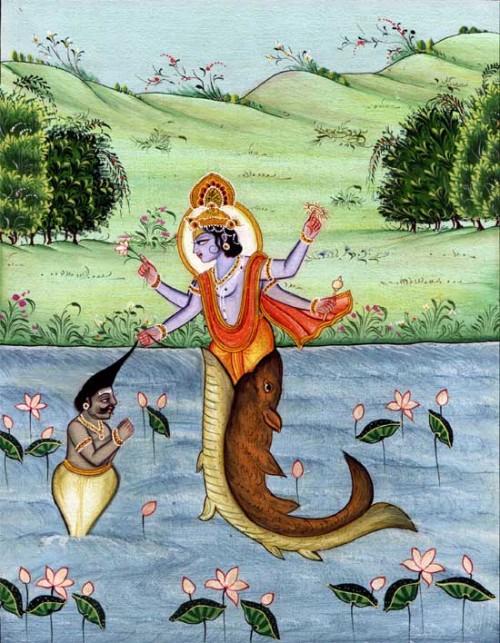
Matsya Avatar  Matsya the fish

In the earliest yuga (era) of Sata-yuga, a king named Manu was performing severe penance for thousands of years. One day as he was performing ablutions with river water, a small fish came into his hands and just as he was about to throw the fish back into the river, the fish requested the king to save its life. Heeding its request, the king put the fish into a jar of water but the fish started growing and the jar was not big enough for it. Then the king threw it into the river, but it soon it outgrew the river and the king then threw it into Ganges and then into the ocean. The king realised that it was Lord Vishnu himself and then the lord made an appearance and made a special request to the king. It predicted that the world would come to an end by a huge flood in seven days and requested the king to build a huge boat and take the seven sages(hermits), seeds of all plants, one animal of each type and told him that he would appear as a fish to propel the boat to Mount Himavan for surviving the flood to the next yuga(eon). True to his word, after seven days the Lord appeared and the king tied the boat to the fish by using the royal serpent Vasuki and the fish took all of them to Mt Himavan and kept them there till the flood was over and in the new era, the king started procreation a for the new era.
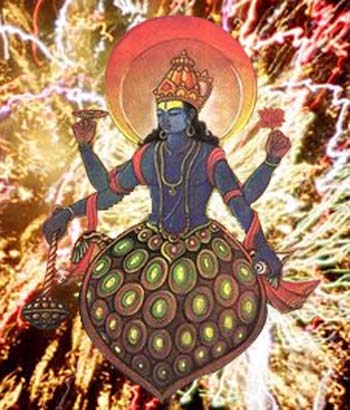
Kurma 1Kurma  the Tortoise

Further to Pralaya- deluge at the beginning of the present Kalpa the Gods (devas) lost their immortality due to a curse by the short-tempered sage Durvasa.The sage had once presented a garland of flowers to Indra,king of gods, who carelessly gave it away to his elephant which trampled it.  The Devas approached Vishnu for help. Vishnu then asked them to churn the ocean of milk after adding medicines into the ocean. Mt Mandara could be used a the churning stick he said. He requested them to ask them help of Asuras in lifting the mountain in exchange for offer of the share of nectar of immortality that would ensue from the churning. Both the devas and the asuras churned the ocean using the serpent Vasuki as the rope. At the start, playing a Machiavellian trick, Indra, king of the gods asked the asuras for the head end of vasuki. But asuras suspecting foul play, took the head end, only to be deceived as the poison from Vasuki was slowly weakening them. But as churning was proceeding the mountain was sinking and then Lord Vishnu took the form of the tortoise KURMA and kept the mountain afloat. As soon as the bowl of amrita, the nectar of immortality was out, the asuras grabbed it. Then Lord Vishnu took the form of an apsara, a beautiful maiden, and seduced the asuras into letting her distribute the nectar and also to abide by her order of distribution. As soon as the devas were served the maiden disappeared thus totally deceiving the asuras and making them totally weak.
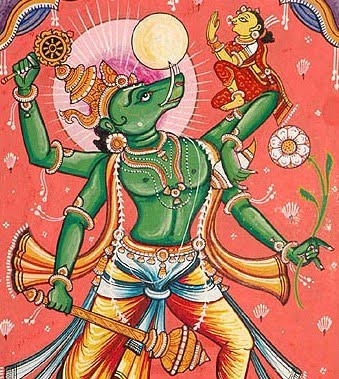
Varaha Varaha  the Boar

A demon Hiranyaksha, had prayed for Lord Brahma and got awarded a boon that no beast nor man nor god could kill him. But somehow from the list of beasts the name of boar was missing. This proved to be his lacunae. He then started a campaign of plunder across the worlds. He pushed the world to the Pataal loka, or the under of the sea. He stole the Vedas, the holy scriptures from the Lord Brahma, while he was asleep and performed huge atrocities.To retrieve the Vedas and to save the world the Lord Vishnu assumed the role of a boar and brought out the earth from the under of the ocean, using its two tusks. It then killed Hiranyaksha and retrieved the Vedas from the asura and brought it back to the safe custody of the Lord Brahma.
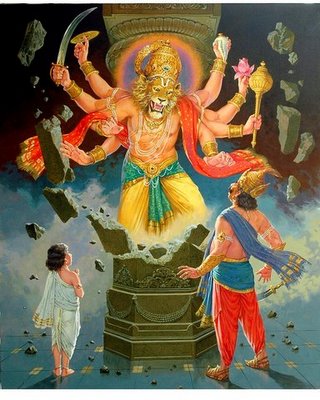
Narsimha 2Narashima  giant lion-man

In NARASIMHA Avatar, Lord Vishnu incarnates himself as a semi-man,semi-lion in this world. The king of demons(asuras), Hiranyakasyapu, wanted to become immortal and wanted to remain young forever. To this end, he meditated for Lord Brahma and because of his severe penance, the gods were frightened and asked Brahma to pacify the king. Brahma was impressed by his austerity and granted him a wish. Hiranyakasyapu wished that he be  killed neither by a man or beast, nor in daylight or at night and neither inside or outside a building. Having obtained the wish he considered himself the supreme God and forbade all worship of gods by anyone. But his son Prahlada, was an ardent devotee of Vishnu. This enraged Hiranyakasyapu very much. He ordered numerous ways to kill Prahlada including asking his sister Holika to sit with Prahlada in the fire. But every time Prahlada escaped unhurt. Enraged, once he asked Prahlad to show him the Lord Vishnu. Prahlad said, “He is everywhere”. Further enraged, Hiranyakasyapu knocked down a pillar, and asked if Lord was present there. Lord Vishnu then emerged as a half lion, half man from the pillar, and carried him under the arch of the doorway (neither indoors nor outdoors), and the time was evening (in the twilight), neither night nor day. He then killed Hiranyakasyapu with his  claws by keeping him on his thighs (neither on earth nor in the sky) thus saving the life of his devotee Prahlada.

vaman 1 Vamana  the dwarf

BALI, the grandson of Prahlada was a very valorous and mighty asura. By his penance and might, he conquered the whole world. Indra and other gods fearing that he and the asuras would conquer all the three worlds, went to Lord Vishnu for help. Lord Vishnu was then born as a dwarf Vamana in the household of a brahman priest. He went to Bali on growing up and asked for alms. Bali was delighted to offer him anything he requested even though his royal guru warned him that it was Lord Vishnu. Vamana then requested for the amount of land that could come under his three feet. Bali gracefully agreed. Lord Vishnu then grew in size and covered the earth and heaven in two stride. And due to lack of space, he put his third leg on Bali himself and crushed Bali to the nether or the Patala loka (underground world), thus helping the Gods out.

Parasurama Rama with the axe
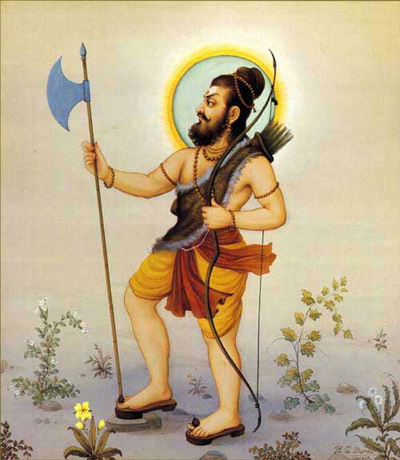
Parsuram1

In PARASURAMA Avatar, Lord Vishnu incarnates himself as a brahman priest in this world. He was brought in this world to avenge all kshatriyas who had become arrogant and were suppressing the brahmans in the world. He was born with unusual physical power, and became better fighter than any Kshatriya.He was born to Jamadagni and Renuka, and belonged to the Brighu clan. Parashurama was always carrying an axe presented to him by Lord Shiva of whom he was an ardent devotee. Kartavirya a powerful king, once went to Jamadagni’s home when he was out, and after a meal, stole the Kamadhenu cow, which was supposed to give endless quantity of milk. Jamadgni was enraged and he went and killed the king and brought Kamadhenu back. On hearing this the son of the king came back and killed Jamdagni. Parasurama was enraged at this and went and avenged the death of his father by killing all kshatriyas in 21 battles. His life is story of the supremacy of brahmans over the kshatriyas.

Shri Ram3

 Sri Ram

It is the most important Avatar of Vishnu. Rama represents the peak of the historic incarnations, and by him it is defined the ideal character of Indian people.He is Vishnu descended upon earth to conquer all the Indian peninsula, included Sri Lanka, under the Bharata rule. Lord Rama is one of the most adored gods in India. He is always holding a bow and arrow indicating his readiness to destroy evils.His story forms the epic Ramayana. He is perfect in every aspect; the perfect man, the perfect husband, the perfect brother, the perfect king, etc. and the obedient son. Commonly he is pictured in a family style, with his wife Sita, and brother Lakshman.
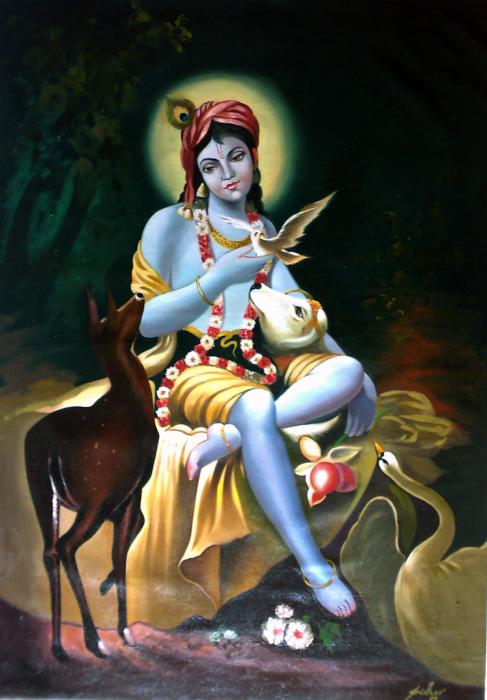
krishna1Sri Krishna

In KRISHNA Avatar, Lord Vishnu incarnates himself as KRISHNA , the central character in the epic MAHABHARATA. In this biggest epic of Indian mythology a myriad of topics are covered, including war, love, brotherhood, politics etc. It is essentially the story of two warring groups of cousin brothers, the PANDAVAs and the KAURAVAs. As a part of the Mahabahrata, during the war KRISHNA, gives a long discourse to his disciple ARJUNA, collectively termed as Bhagvad-Gita. Krishna, during his child-hood was responsible for the killing of Kansa. Krishna is also considered to be an ultimate playboy who was resonsible for charming all gopikas (cowherdesses) around him. Unlike Ramayana, Mahabharata deals with more down to earth issues like politics, human nature, human weaknesses, and does not attempt to idealise the characters as in RAMAYANA. His death marks the beginning of Kali yuga.
budhha

Buddha

With the departure of Lord Krishna (Krishna Avatar), the Kali yuga set in. In this age, the true devotion to Vedas was replaced by empty rituals.  To enlighten the world, Lord Vishnu descended the earth as Buddha, the enlightened one.

He was born as the crown prince of the Kapilavastu to King  Suddhodana and Maya. He was named Siddhartha, meaning “All thing fulfilled”. But his mother died soon after his birth and was broughtup by Prajapati, the sister of Maya. Buddha was saddened by death of living creatures, and vices like poverty. He wasn’t happy with any answers that were provided to him and he decided to find out the meaning and the absolute truth and he left his wife and child to a hermit’s life in the forest and became the enlightened one.

His preachings spawned off the religion of Buddhism now popular across the whole world. Buddha advocated the Middle Path, in which he offered a balanced, harmonious way of life, steering between two extremes of self-indulgence and total abstinence. Buddhism rests upon four Noble Truths:

  • Suffering is universal,
  • It is caused by desire and yearning
  • Suffering can be prevented and overcome and
  • Eradication of desires can lead to removal of suffering.

To prevent suffering one has to conquer craving and desire and this conquest leads to the attainment of nirvana or complete enlightenment.

Kalki

Kalki is believed as the next Avatar of Vishnu.

It is believed that He will appear, riding his white horse and drawing a flaming sword, at the end of the Kali Yuga, the dark age through which we are now passing. His task will be to exterminate the evil and restore the Dharma. Thus will begin a new cycle, starting with the new Satya Yuga.
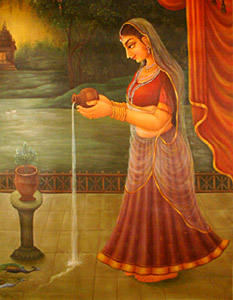


Holy Tulsi

Tulsi Devi

The Tulasi tree is a most important plant, and is often seen at numerous Hindu temples, especially those dedicated to Vishnu and Krishna. At such temples you are likely to find one or more in the courtyard wherein pilgrims circumambulate it, water it, or even offer prayers to it. Some temples will even have Tulasi groves, wherein you will see numerous Tulasi plants growing in a garden. Some temples will even have a special greenhouse just for taking care of Tulasi plants. At such temples, they may even prepare large garlands of Tulasi leaves and manjaris (the ends of the branches) for the deity of Lord Krishna to wear. It is said that Tulasi will not grow well where there is no devotion to the Lord. In fact, how well Tulasi grows is said to be like a barometer that indicates how high the devotional attitude is of the devotee community around the temple.

Vaishnava devotees also use the wood to make neck beads and wear two or three strands of them around their necks signifying their devotion to the Lord. They also make their japa mala or chanting beads from wood of the Tulasi tree as well. Tulasi is considered to be a pure devotee of the Lord who has taken the form of a tree. Therefore she is given the utmost respect. This is also why many devotees and Hindus in general also grow Tulasi in their homes. In this way, the Tulasi plant plays an important part in the spiritual life of many devotees. So what is the significance, history and legends behind this little tree?

To begin with, the Basil plant (Ocimum sanctum) is commonly called Tulasi (pronounced tulsi). In some accounts of the Puranic story of the Churning of the Ocean (samudramathana), the Tulasi is added to the list of articles which emerged from it, and is sacred to Krishna (according to Wilson’s VishnuPurana p, 67. n.8). It is also sacred to his Lord Vishnu’s consort Laksmi, and hence it is itself an object of worship.

The Tulasi plant also possesses curative properties and is said to be an antidote to snake-venom. It destroys mosquitoes and other pests and purifies the air. It even is said to ward off the messengers of Yama, the ruler of the dead, who will not enter a house containing a sprig of Tulasi. This is also one of the reasons why devotees wear the Tulasi as neck beads. When death occurs, the funeral pyre should be constructed of Tulasipalasha, and sandal-wood.

There is further Puranic background for Tulasi attaining this spiritualistic importance. In fact it is Mahalaksmi, wife of Visnu, who had herself taken the form of Tulasi. There is a story about it in the Devi Bhagavata. The Puranic Encyclopedia summarizes these legends.

1) The curse of Sarasvati. Sarasvati, Ganga and Laksmi were all, in the beginning, wives of MahaVishnu. The Lord loved all the three equally. One day all the four were sitting together when Ganga sent lustful glances at Vishnu which was immediately noticed by both Sarasvati and Laksmi. Sarasvaii got angry and rising up caught hold of the hair of Ganga and dragged her to the ground. Laksmi then caught hold of Saras­vati to prevent farther assault but Sarasvati then poured all her rage on Laksmi and cursed her to be born as a plant on earth. Gangadevi could not bear this and she cursed Sarasvati to be born as a river on earth. Sarasvati retorted with a curse that Ganga also would be born as a river. When the whole tumult was over Vishnu called Laksmi to his side and said, “Oh Devi, do not worry. Things have happened as predes­tined. You go and be born as the daughter of Dharma-dhvaja and grow up there. From there by divine grace you will be transformed into a plant sacred enough to make all the three worlds pure. That plant will be named Tulasi. When you will be thus living as Tulasi, a demon named Sankhacuda with part of my virile strength will be born and he will marry you. Then you can come back to me. The holy river Padmavati will also be another form of your spirit.”

2) The story of Dharmadhvaja. Who was this Dharma-dhvaja to whom was born Mahalaksmi as a daughter? In times of old there was a Manu called Daksasavarni who was extremely virtuous and a part of Vishnu. Descending from Daksasavarni were Brahmasavarni-Dharmasavarni-Rudrasavarni-Devasavarni-Indrasavarni Vrsadhvaja. This last named was a great devotee of Shiva and because of his great affection for this devotee Shiva lived a whole period of a devayuga in the ashrama of Vrsadhvaja. King Vrsadhvaja by an edict prohibited the worship of any other deity than Shiva in his country. Even the worship of Mahalaksmi ordained by the Vedas during the month of Bhadra (September) became extinct. All Yagyas and worship of Vishnu came to a stop.Surya (Sun-god) got angry al this belittling of other gods than Shiva and cursed the King Vrsadhvaja that he would cease to be prosperous. Shiva did not like it and he went to punish Surya holding his trident in his hand. Surya was frightened and he approached his father Kasyapa. Kasyapa and Surya went to Brahma and acquainted him with all details. Brahma also was helpless in the matter and so all the three of them went to Mahavishnu. They prostrated before Vishnu and told him all. At that time Shiva also came there. Addressing all of them, Vishnu said “Oh. Devas, wilhinthis half an hour twenty-one yugas have passed by on the earth. He about whom you have come to speak to me is dead and gone. Even his son Rathadhvaja is dead. The latter has two sons named Dharmadhvaja and Kusadhvaja. They are dull and splendorless now because of the curse of Surya and are now worshipping Laksmi.” Saying thus Vishnu disappeared.

3) Birth of Tulasi. Dharmadhvaja and Kusadhvaja did penance to propitiate Mahalaksmi. Kusadhvaja had a wife named Malavati. She bore a daughter named Vedavati. Sita, wife of SriRama, was a rebirth of this Vedavati.

King Dharmadhvaja had a wife named Madhavi. Maha­laksmi entered her womb as an embryo and after a hund­red years Madhavi gave birth to a daughter. Even at the time of birth the child looked like a matured girl and was extremely pretty. She was therefore, called Tulasi, meaning matchless. (Tula= match). This Tulasi, abandoning all worldly pleasures, went toBadarikashrama and started doing penance there with the prayer that MahaVishnu should become her husband. She did penance for twenty-four thousand years sitting amidst fire in the hot season and sitting in water in the cold season and taking only fruits and water as food. Then she did penance for ano­ther thirty thousand years eating leaves only, another forty thousand years taking air only as food and another ten thousand years without any food. At this stage Brahma appeared and asked her the object of her penance. She replied she wanted MahaVishnu to be her husband. Hearing this Brahma said thus: “Devi, you know the cowboy Sudama born of a part of Sri Krishna. That brilliant cowboy has now been born on earth, due to a curse of Radha, as a demon named Sankhachuda. He is matchlessly eminent and has once fallen in love with you seeing you at Goloka. You will become his wife and later you can become the wife of Narayana. At that time a part of your divine body will remain on earth as a plant named Tulasi. Tulasi will become the most sacred of all plants, dear to Vishnu, and all worship without using Tulasi leaves would be ineffective.”

4) Marriage of Tulasi. Due to a curse of Radha, Sudama, the cowboy, was born on earth as a demon named Sankhachuda. He did penance sitting at Badarikashrama and obtainedVishnukavaca. Another object of his was to marry Tulasi. He obtained a boon from Brahma that his death would occur only when the Vishnu Kavaca was removed from his body and the chastity of his wife was lost. At that time Sankhachuda and Tulasi met each other in the forests and were married. Sankhachuda, brilliant and majestic, went about with Tulasi in amorous sports creating jealousy even among the devas. His arrogance gave innumer­able troubles to the devas and they along with Brahma and Shiva approached MahaVishnu for a remedy. Vishnu then sent Shiva with his spike to kill Sankhachuda and he himself started to molest the chastity of his wife Tulasi. Sankhachuda took leave of Tulasi to go and fight with Shiva. When Tulasi was thus left alone,MahaVisnu in the form of Sankhachuda approached Tulasi and after some preliminary talks entered into sexual acts. Tulasi found some difference in the usual affairs and suspecting foul play jumped up to curse the impostor. At once MahaVishnu appeared in his true form and said “You have been doing penance for a lone time to get me as your husband. Your husband Sankhachudawas the chief of my Parsadas, Sudarna. It is time for him to go back to [the spiritual abode of] Goloka get­ting himself released from the curse. By this time Shiva would have killed him and he would have gone to Goloka as Sudama. You can now abandon your body and come with me to Vaikuntha to enjoy life as my wife.

Your body will decay and become a holy river named Gandaki; your hair will become the Tulasi plant, the leaves of which will be held sacred in all the three worlds.”

Tulasi then changed herself into the form of Laksmi and went to Vaikuntha with MahaVishnu. (9th Skandha, Devi Bhagavata).

5) The greatness of Tulasi. Everything of the Tulasi plant, leaves, flowers, fruits, roots, twigs, skin and even the soil around is holy. The soul of a dead one whose dead body is cremated using Tulasi twigs for firewood would attain a permanent place in Vishnuloha [the spiritual abode]. Even great sinners would be absolved of their sins if their dead bodies are cremated with Tulasitwigs [or are wearing Tulasi beads]. If at the time of death one thinks of God and mutters His name and if his dead body is later cremated with Tulasi twigs, he would have no rebirths. Even he who has done a crore of sins would attain moksha [liberation] if at the time of cremating his dead body a piece of Tulasi twig is placed at the bottom of the funeral pyre. Just as all waters become pure by the union with Ganga water, all firewood is made pure by the addition of a small piece of Tulasi twig. If the dead body of one is cre­mated using Tulasi twigs alone, one’s sins for a crore of Kalpayears [1 kalpa is 4,800,000 years] would be washed away. Yamadutas [the soldiers of Lord Yama, the king of death] would keep away from one whose dead body is cre­mated with Tulasi twigs and servants of Vishnu would come near. If a light is burnt for Vishnu with a Tulasi stick it would be equal to burning several lakhs of lights for Vishnu. If one makes the Tulasi leaves into a paste and smears it on one’s body and then worships Vishnu for one day, one would be getting the benefit of a hundred ordinary worships and also the benefit of doing a hundred godanas (gifts of cows). (Chapter 24, Padma Purana)

It is also accepted that if ever a person leaves his or her body while wearing Tulasi beads, either around the neck or elsewhere, it creates the same affect as described above as having one’s cremation fire burnt using Tulasi.

“Shri Harivansh Shri RadhaVallabh”

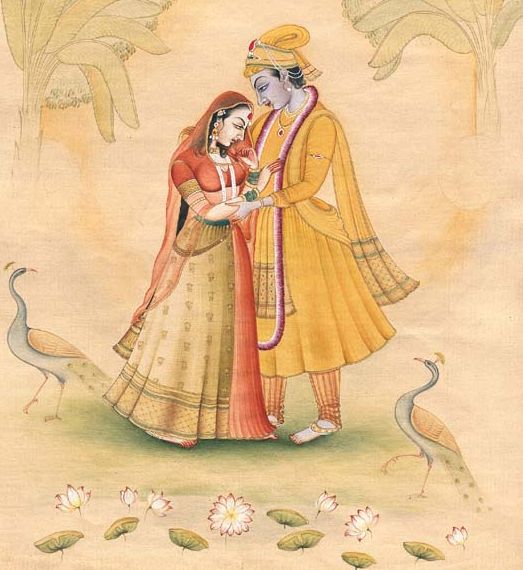
Radha Krishna: A Divine Love

radha-krishnalove

The Radha-Krishna amour is a love legend of all times. It’s indeed hard to miss the many legends and paintings illustrating Krishna’s love affairs, of which the Radha-Krishna affair is the most memorable. Krishna’s relationship with Radha, his favorite among the ‘gopis’ (cow-herding maidens), has served as a model for male and female love in a variety of art forms, and since the sixteenth century appears prominently as a motif in North Indian paintings. The allegorical love of Radha has found expression in some great Bengali poetical works of Govinda Das, Chaitanya Mahaprabhu, and Jayadeva the author ofGeet Govinda.

Krishna’s youthful dalliances with the ‘gopis’ are interpreted as symbolic of the loving interplay between God and the human soul. Radha’s utterly rapturous love for Krishna and their relationship is often interpreted as the quest for union with the divine. This kind of love is of the highest form of devotion in Vaishnavism, and is symbolically represented as the bond between the wife and husband or beloved and lover.

Radha, daughter of Vrishabhanu, was the mistress of Krishna during that period of his life when he lived among the cowherds of Vrindavan. Since childhood they were close to each other – they played, they danced, they fought, they grew up together and wanted to be together forever, but the world pulled them apart. He departed to safeguard the virtues of truth, and she waited for him. He vanquished his enemies, became the king, and came to be worshipped as a lord of the universe. She waited for him. He married Rukmini and Satyabhama, raised a family, fought the great war of Ayodhya, and she still waited. So great was Radha’s love for Krishna that even today her name is uttered whenever Krishna is refered to, and Krishna worship is though to be incomplete without the deification of Radha.

“Radhe Krishna Radhe Krishna Krishna Krishna Radhe Radhe…..Radhe Shyam Radhe Shyam Shyam Shyam Radhe Radhe…….”