The Divine Tale of Matsya Avatar: Preservation Amidst Cosmic Deluge

In Hindu mythology, there exist four cosmic ages or “yugas”: Satya yuga, Treta yuga, Dwapara yuga, and Kali yuga, with each yuga corresponding to a single day in the life of Lord Brahma. A day of Lord Brahma is an astonishing 4320 million human years long, and the conclusion of each yuga sees Lord Brahma entering a state of rest, during which cosmic creation halts. The foundation of Lord Brahma’s creative power lies within the Vedas, making them paramount.
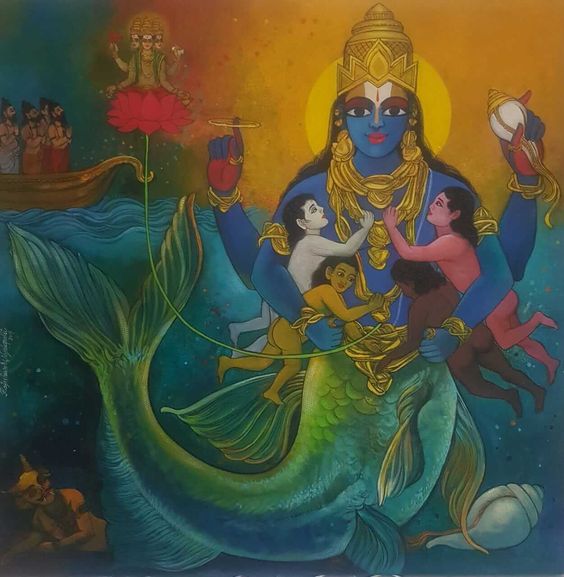

Matsya Avatar is the first incarnation of Lord Vishnu in Hindu mythology. The term “Matsya” translates to “fish” in Sanskrit. This avatar is associated with the preservation of life and knowledge during a catastrophic deluge.

The story of Matsya Avatar is often narrated as follows:

  1. The Great Deluge: The Matsya Avatar takes place during the Satya Yuga, the first age in Hindu cosmology. At this time, the world was plagued by moral decay and corruption, and a massive deluge was prophesied to cleanse the Earth, much like the biblical story of Noah’s Ark.
  2. The Divine Intervention: To preserve life and knowledge, Lord Vishnu assumed the form of a gigantic fish, Matsya. He appeared to King Manu, a virtuous ruler and devotee of Lord Vishnu, who was meditating by the river.
  3. The Rescue of Knowledge: Matsya informed Manu of the impending deluge and instructed him to build a massive boat or ark. Manu obeyed the divine guidance and gathered the seeds of all plants, pairs of animals, and the seven great sages (Saptarishi) to accompany him on the boat. Additionally, Matsya guided Manu in preserving the sacred Vedas (ancient scriptures) by keeping them safe from the floodwaters.
  4. The Cataclysm: As the deluge began, Matsya used its enormous form to tow Manu’s boat to safety. The floodwaters rose to unimaginable heights, submerging the entire Earth.
  5. The New Beginning: After the deluge had subsided, Matsya deposited Manu’s boat on the summit of Mount Himavan, where life could begin anew. The knowledge contained in the Vedas was protected, ensuring that it could be passed on to future generations.

Matsya Avatar symbolizes the divine principle of preservation and the importance of safeguarding knowledge and life in the face of imminent destruction. It is also a reminder of the cyclical nature of time in Hindu cosmology, with each yuga (age) having its own unique set of challenges and divine interventions.

Temple dedicated to Vishnu matsya avatara: Vedanarayana Swamy Temple, Nagalapuram, Andhra Pradesh (WiKi)
Image Credit: Artflute
The Divine Love: Krishna’s Adornment of Radharani’s Hair


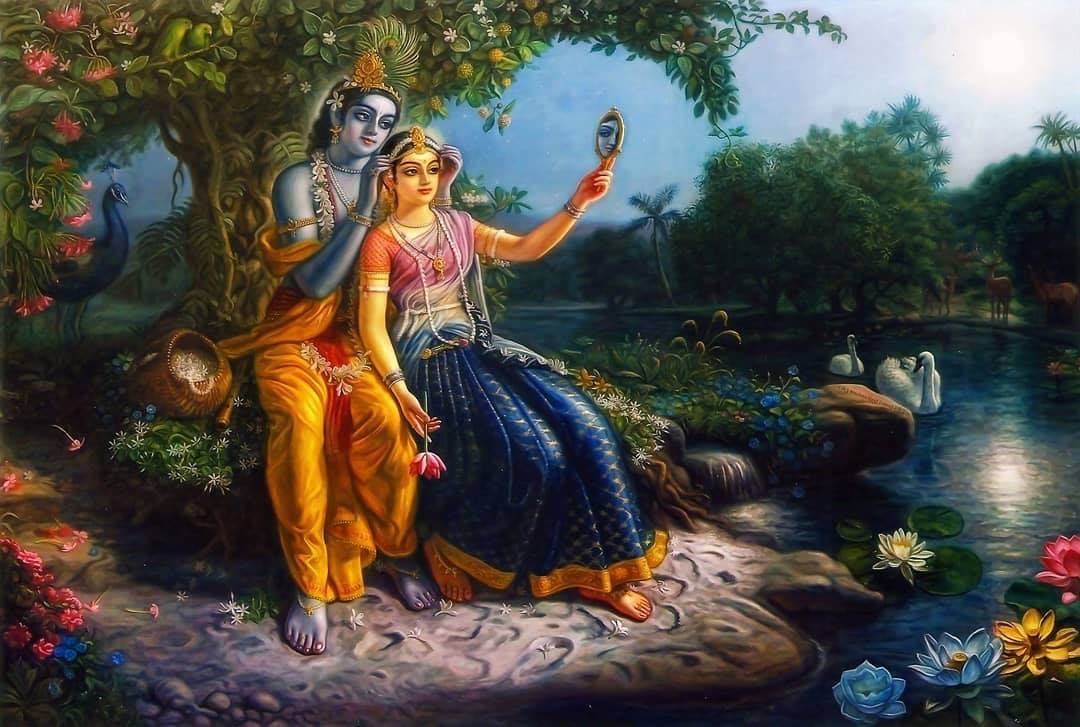
Once upon a time in the idyllic village of Vrindavan, the divine love between Lord Krishna and Radharani blossomed. Their love was pure, boundless, and filled with playful moments. One sunny morning, as Radharani was getting ready for her day, she sat by the Yamuna riverbank, combing her long, ebony hair.

Radharani’s hair was like a river of midnight, cascading down her back. The beauty of her hair was a source of admiration among the gopis (cowherd girls) and the talk of the town. As Radharani combed her hair, the sun’s golden rays danced upon each strand, creating a mesmerizing play of light and shadow.

Krishna, who was known for his mischievous nature, couldn’t resist the temptation to join in this intimate moment. With a playful grin, he approached Radharani, who was lost in the rhythm of combing her hair. Krishna gently sneaked up behind her and, with the deftness of a divine lover, started dressing her hair.

He wove fragrant flowers into her dark tresses, each one selected with care. Jasmine, marigold, and lotus flowers intertwined with the ebon strands, forming a tapestry of vibrant colors. Krishna’s fingers moved with the grace of an artist, and Radharani couldn’t help but smile as she realized what he was doing.

The gopis, who had been watching this enchanting scene from a distance, marveled at Krishna’s love and artistry. They whispered among themselves, “Krishna is not just the divine lover, but also the divine beautician!”

As Krishna finished adorning Radharani’s hair, he leaned in and whispered sweet words into her ear, making her blush like a radiant sunrise. The love between them transcended the material world, for it was a love that connected their souls.

This simple act of dressing Radharani’s hair was a manifestation of their deep affection and a reminder of their eternal love story. It served as an enduring symbol of the devotion and playful love between Lord Krishna and Radharani, celebrated for generations in the land of Vrindavan, and continues to inspire devotees and admirers of their divine love.

Image Credit: Unknown

Laddu Gopal’s Sweet Mischief: A Tale of Divine Playfulness


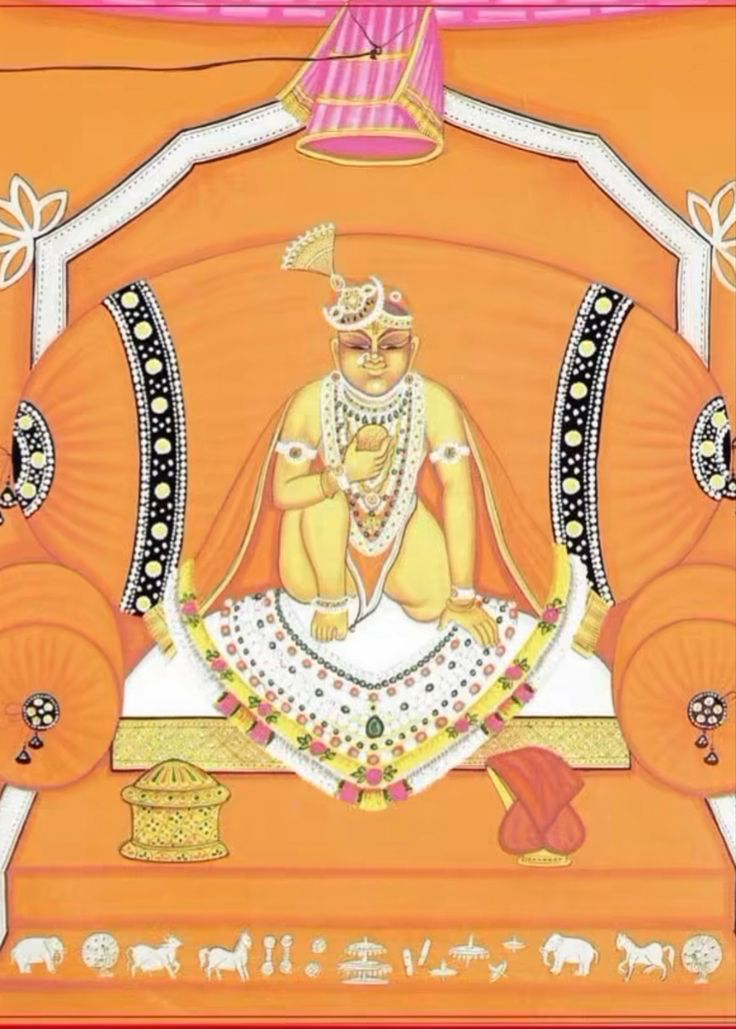
The story of “Laddu Gopal” is a delightful tale that celebrates the childhood of Lord Krishna, particularly during his time in Vrindavan. “Laddu” is a sweet Indian delicacy, and “Gopal” is a name for Krishna as a young cowherd. The term “Laddu Gopal” is often used to refer to the child form of Lord Krishna, where his playful and endearing antics are celebrated.

One of the most charming stories associated with Laddu Gopal is his love for sweets, especially laddus. Here’s a classic story that highlights this aspect of his childhood:

In the village of Vrindavan, little Krishna, known as Laddu Gopal, was notorious for his love of laddus. His mother, Yashoda, would prepare delicious laddus for him. However, the playful Lord Krishna would often try to steal laddus from the kitchen.

One day, Yashoda decided to teach Krishna a lesson about being truthful and sharing. She placed a plate of laddus on a high shelf, thinking that it would be beyond Krishna’s reach. She told Krishna that he could have the laddus if he could reach them without any tricks.

Krishna, always up for a challenge, accepted his mother’s condition. He climbed onto a friend’s shoulders and made a tower of stools, pots, and pans to reach the laddus. With great effort, he finally managed to get his hands on the plate of laddus.

As he was about to enjoy the sweet treats, Yashoda entered the kitchen and saw the elaborate tower Krishna had constructed. She laughed heartily at her child’s determination and playfulness and allowed him to relish the laddus. She realized that Krishna’s love for sweets was an expression of his love for her.

This story captures the essence of Laddu Gopal’s childhood, where his love for sweets and his playful spirit endeared him to everyone in Vrindavan. It symbolizes the purity, innocence, and love that define Lord Krishna’s divine character, particularly during his formative years.

Image Credit: Suresh Dhawan