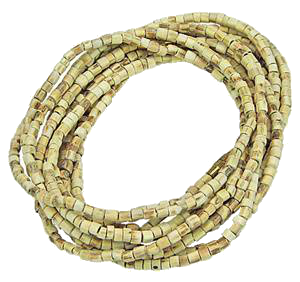
Wearing Tulsi Beads Around The Neck

Tulsi BeadsTulsi is thought to be the most sacred of woods in India and Indian worship, and the plant of Tulsi is believed to be the incarnation of the Divine itself. The Tulsi Mala is made of the wood or the seeds of Tulsi and is used for name chanting and worship.

Moreover, the Tulsi Mala is said to have incredible spiritual and physical healing powers apart from helping the mind to focus during prayers. Like the Sphatik Mala and the Rudraksh Mala.

The Tulsi Mala is made of Tulsi wood and consists of 108 beads wound around a strong string, with a 109th bead called the Sumeru bead of some other material like a metal or crystal, or a bigger Tulsi bead itself. One starts counting the beads from the bead adjacent to the Sumeru bead of the Tulsi Mala and completes one full round. On second round the Tulsi Mala needs to be counted in the reverse direction again as the Sumeru bead should not be crossed while praying. Depending on the type of the Tulsi plant, the Tulsi Mala is available in various colors like black, brown or sandalwood color.

The Tulsi Mala can be worn on the neck or tied around the fist. The benefits of the leaves of Tulsi is well proven, and owing to its spiritual and physical healing powers, the touch of the Tulsi wood acts as a rejuvenator for the stressed mind and brings the spiritual self of a person closer to God. On top of that, wearing the Tulsi Mala is supposed to bring good luck and fortune to the devoted wearer. It is said to balance the kapha and the vata dosha. Tulsi clears the aura, and its subtle smell fills the heart with sensation of the divine. The Tulsi Mala is used to worship Lord Ram and Krishna, different incarnations of Lord Vishnu who is believed to be the creator and the beloved of the Tulsi.

The Lord says that one who wears the beads made out of the wood of Tulsi in one’s neck, even if he is untidy and ill- charactered, will undoubtedly attain Me only. Sri Krishna will grant the fruit of being the resident of Dvarka immediately to those who wear Tulsi beads around the neck. The sins of the person who wears neck beads made of Tulsi with devotion after offering to Sri Vishnu will get vanquished and Devakinandan Sri Krishna will always remain pleased with him, he does not need to undergo further atonement, no more sins remain in his body. In Kaliyuga, one, who is bedecked with the beads made of Tulsi, performs ritual activities and activities pertaining to ancestors and demigods, obtains crores times more results. The messengers of Yama will flee away by the sight of the Tulsi beads just as leaves are blown off by wind.

In Skanda-puran it is stated :- Those who wear neck beads made of Tulsi after offering it to Sri Hari are definitely foremost among the devotees of Lord. After presenting the mala, it should be purified with panca-gavya; after that the mula -mantra should be recited followed by the recitation of the gayatri mantra for eight times. Touching with incense, worship with this

Sadyojata -mantra with utmost devotion:

Om sadyojatah prapadyami sadyojataya vai namo namah.

Bhave tave nadi bhave bhajeswamam bhavod-bhavaya namah After that, this prayer should be made, “Oh! Mala ! You are made of Tulsi and are dear to Vaisnavas . I wear you around my neck; you make me dear to Sri Krishna. ‘Ma’ means ‘me’, ‘La’ means ‘to give’. Oh Hari-Vallabhe ! You have given me to Vaisnava devotees, hence you are known as mala . Those Vaisnavas who pray in accordance with rituals in this manner and first offer the mala in the neck of Sri Krishna and then puts it to themselves attain the Lotus feet of Sri Vishnu.” It is stated in Padma Purana : either during morning ablutions or bathing or eating or at any state which is clean or unclean, Tulsi mala has to be worn always; that means mala should not be removed under any circumstance.


Health Benefits of Tulsi (Sciance)

– It acts as anti bacterial and anti parasitic, therefore is widely used in infectious diseases.- Tulasi act on nervous system providing them strength, relieves stress and helps in relieving
pain.

– It work as appetizer and promotes digestion by helping in secretion of digestive enzymes.

– Tulsi juice when mixed with ginger juice is very effective in abdominal disorder in children.

– It helps in preventing flatulence and avoids constipated stool.

– It is an effective natural cure for upper respiratory tract infection (URTI).

– Tulasi works as good expectorant relieving from wet cough.

– It is very useful in bronchitis and asthmatic conditions.

– It works as antibiotic eliminating the bacteria.

– It is widely used in fever as it act as antipyretic, pain reliever, and provides strength to our body.
Take powder of Tulasi leaves with saunth (dried ginger) and sugar with hot water in fevers.

– It also possesses anti-cancerous properties.

– Tulsi juice drops are very effective in earache.

– Keep powder of tulsi root in water for overnight and take it early morning for diabetes natural cure.

– It works as a powerful antioxidant thereby helps in preventing early aging signs and makes the skin
young.

“Jai Shri Radhe”
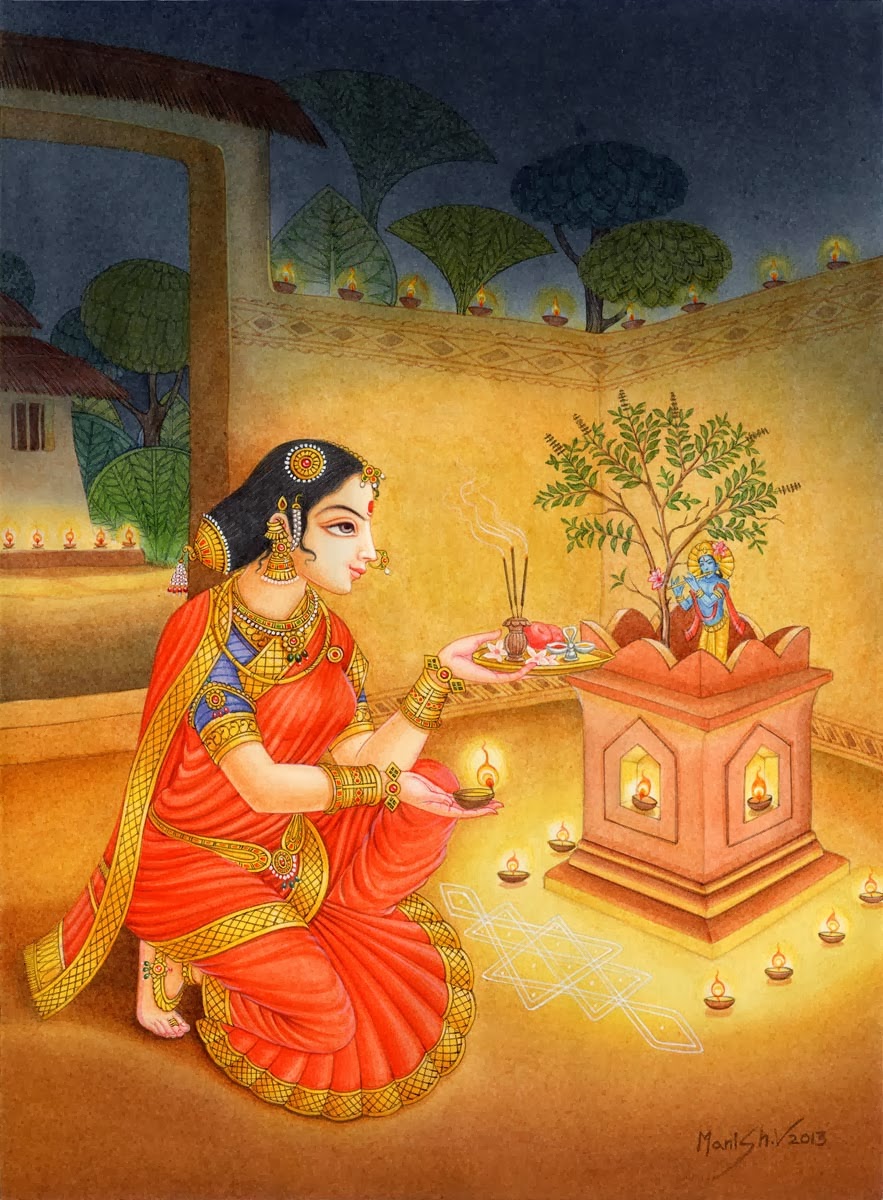
Tulsi Marriage Story – Tulsi Vivah Katha – Tulsi Marriage

Tulasi Vivah


The Tulsi plant is a variety of the spice we know as basil. The story of Tulsi and the holiday known as Tusli Vivaha is a wonderfully symbolic story that resonates even today.

Tulsi Vivaha, is the mythical marriage of the tulsi plant and Krishna, is celebrated on the 11th day of the bright half of the lunar month of Kartika. The festival is popular in all parts of India and particularly in the south.

In the Vedic tradition there is a rishi by the name of Narada who is the son of Brahma, the creator. He takes the role of cosmic instigator. He is always sneaking in and out of these stories, usually starting things off by making devious suggestions which his unsuspecting target eagerly agrees to. Of course there are all sorts of interesting consequences and they are what make up the core of these stories.

During the time that Krishna was here on earth, the gods in heaven decided that he had been away long enough and that they missed him. They wanted him to come back to heaven. So with Narada, they hatched a plan to get Krishna to return.

While here on earth, Krishna had 2 wives; Satyabhama and Rukmini. Queen Satyabhaama enquired of the Rishi Narada how she could ensure that she would have Krishna as her husband in her next life. Narada told the Queen, and truthfully so, that you receive in the next life that which you give away in this life as charity (Daan in sanskrit). So Satyabhaama immediately gave Krishna away to Narada and they left immediately so that Krishna could go back to heaven.

But Krishna’s wives Rukmini and Satyabhama sorely missed their husband, and both requested Narada to bring Krishna back. Narada said that they would have to give the gods something equal to the weight of Krishna if he was to return from heaven. Proud of all the jewels and valuables that Krishna had given her, Satyabhama set up a large weighing balance scale. Krishna came and sat on one side. Satyabhama, who as befits a Queen, was rather arrogant and brought out all her jewels and gold and silver pots to weigh against Krishna. But the more she piled onto the balance scale, the lighter her side became. Krishna just became heavier and heavier. Reduced to angry tears, she finally gave up.

Satyabhama asked Rukmini to do what she could. Rukmini removed all the gold and gems from the scale and plucked a few leaves of the wild tulsi plant growing nearby. She put them on the scale with all her love. The leaves proved to be far heavier than Krishna. With a smile, Krishna returned to earth to be with his wives.

Since that time, a tulsi leaf is added to any auspicious gift. A father also places a tulsi leaf in his daughter’s hand during the Kanyadaan – giving away of the daughter during a Hindu marriage ceremony.

On Tulsi Vivaha the yagya tradition is for the tulsi plant to be dressed up as if it were a murti. The ceremony of Vishnu’s marriage is reenacted in a uja called Kalyana Utsavam. A dainty wedding pavilion (mandap) is made of sugarcane stalks and the tulsi plant is decorated with a yellow bridal sari, miniature jewellery and red kumkum powder. Krishna wears a golden crown and the traditional bridegroom’s attire. The wedding is conducted with complete wedding puja and homa rites. The Tulsi plant is offered a feast of seasonal berries, new tamarind, turmeric, amla fruit and rice. Krishna is offered sweets made of milk.

You might ask why it was that Rukmini, who was really Lakshmi, offered the tulsi plant to Krishna in this story. As is frequently the case in Vedic stories, it begins with a demon who has gained too much power and is troubling the gods. Since the strength of the gods can not always equal that of the demons, the gods have to win by some form of trickery. Of course ultimately it backfires and the gods have make amends.

In this case, there was a demon who was a famous warrior by the name of Jalandhar. By constantly annoying, fighting and defeating the gods he made his fellow demons happy and more and more of the universe came under their control. Jalandhar had a wonderful wife by the name of Vrinda who was a pure and spiritually dedicated soul and a powerful yogi in her own right. Because of her purity and spiritual strength, Jalandhar became invincible in all three worlds.

Desperately, the gods tried to find some way to defeat Jalandhar. Vishnu developed a plan and sent messengers to tell Vrinda that her husband had been killed in battle. The severed head and body of two monkeys were put in front of her, and after reciting some mantras, Vishnu, through his magical powers made her believe it was her husband’s dead body and she was plunged into grief.

Then Vishnu snuck away and took the form of a sadhu and seemingly innocent, walked by Vrinda. Faking compassion, Vishnu recited some mantras and joined the head and the body together again. Vishnu quickly took the form of Vrinda’s husband who thought that her husband Jalandhar stood there in front of her. She embraced him with passion and relief. But quickly she realized her mistake and discovered that it was in fact, Vishnu. In that conservative era, she immediately lost her spiritual virtue and power for having touched the body of man who was not her husband. She was distraught at having been tricked, but it was of no use. After Vrinda had lost her holiness and purity, Jalandhar lost the source of his power, and was killed in battle.

When Vrinda came to know the full truth of her husband’s death, she was wild with anger and cursed Vishnu saying, “Your wife will be taken away from you and you will have to ask help from monkeys to recover her.” A rishi’s curse is a powerful thing and not even the gods can escape it. It was after all, the result of Vishnu’s own actions coming back to him.

As we well know, this curse was realized when Vishnu took the form as Rama and Sita was taken from him only to be saved again by Hanuman, the monkey god.

After issuing her curse, Vrinda prepared the funeral pyre for her husband and jumped into the fire. Vishnu, whose job it is to protect everyone in creation, was very sorry because as a result of his deceit the poor widow had committed suicide. He remained sitting at the side of the pyre for many days, deep in depression. Worried about him because he was neglecting his cosmic duties, the gods planted three medicinal trees in the cremation ground; Tulsi, Amala, and Jasmine. Of these three trees the Tulsi was most dear to Vishnu and to this day is used in his worship rituals

Because Vrinda had for a while truly believed Vishnu to be her husband, when Vishnu appeared as Krishna, Vrinda came in the form of Rukmini and on the day which we celebrate as Tulsi Vivaha, they were married.