Yogini Ekadashi in Krishna Paksha

Krishna and Brahma

Yudhishthira Maharaj said, “Oh Supreme Lord, I have heard the glories of the Nirjala Ekadashi, which occurs during the light fortnight of the month of Jyeshtha (May – June). Now I wish to hear from You about the Shuddha Ekadashi that occurs during the dark fortnight of the month of Ashadha (June – July). Kindly describe to me all about it in detail.”

Sri Krishna, then replied, “Oh king, I shall indeed tell you about the best of all fasting days, the Ekadashi that comes during the dark part of the month of Ashadha. Famous as Yogini Ekadashi, it removes all kinds of sinful reactions and awards liberation.

This Ekadashi delivers people who are drowning in the vast ocean of material existence and transports them to the shore of the spiritual world. In all the three worlds, it is the chief of all sacred fasting days. I shall now reveal this truth to you by narrating a history recounted in the Puranas.

The king of Alakapuri – Kuvera, the treasurer of the demigods – was a steadfast devotee of Lord Shiva. He had a servant named Hemamali who was his gardener. Hemamali, a Yaksha like Kuvera, was lustfully attracted to his wife, Swarupavati, who had enchanting eyes.

Hemamali’s daily duty was to visit Manasarovara lake and bring flowers for his master, Kuvera, which he would use in the puja offerings to Lord Shiva. One day, after picking the flowers, Hemamali went to his wife instead of returning directly to his master. Absorbed in loving affairs with his wife, he forgot to return to the abode of Kuvera.

While Hemamali was enjoying with his wife, Kuvera had begun the worship of Lord Shiva and soon discovered that there were no flowers ready to be offered. The lack of such an important item angered Kuvera, and he asked a Yaksha messenger, ‘Why has dirty-hearted Hemamali not come with the daily offering of flowers? Go find out the exact reason.’ The Yaksha returned and told Kuvera, ‘Oh lord, Hemamali has become lost in the company of his wife.’

Kuvera became extremely angry and at once summoned Hemamali before him. Hemamali approached his master in great fear. Enraged, Kuvera cried out to Hemamali, ‘Oh you sinful rascal! I curse you to suffer from leprosy and to become separated from your beloved wife! Leave this place immediately and betake yourself to the lower planets to suffer!’

And so Hemamali fell at once from grace in Alakapuri and became ill with the terrible affliction of leprosy. He awoke in a dense and fearful forest, where there was nothing to eat or drink. Thus he passed his days in misery, unable to sleep at night due to pain. He continued to worship Lord Shiva with faith, his consciousness remained purely fixed and steady. Although implicated by great sin and its attendant reactions, he remembered his past life because of his piety.

After wandering for some time Hemamali eventually came upon the vast expanse of the Himalayan mountain ranges. There he had the good fortune to come in contact with the great saintly soul Markandeya Rishi, whose duration of life it is said, extends to seven of the days of Brahma.

Markandeya Rishi was seated peacefully at his ashrama. Hemamali, feeling very sinful, stood at a distance and offered his humble obeisances. Markandeya Rishi saw the leper and called him near, ‘What sort of sinful deeds have you done to earn this dreadful affliction?’ Hearing this, Hemamali painfully replied, ‘I am a Yaksha servant of lord Kuvera, and my name is Hemamali. It was my daily service to pick the flowers from the Manasarovara lake for my master’s worship of lord Shiva, but one day I was negligent and was late in returning with the offering because I had become overwhelmed with passion for my wife. When my master discovered this, he cursed me in great anger to be as I am before you. But fortunately I have come upon you, and now I hope to receive from you an auspicious benediction, for I know that devotees such as you are as merciful as the Supreme Lord. Oh best of sages, please help me!’

Softhearted Markandeya Rishi replied, ‘Because you have told me the truth, I shall tell you about a fast day that will benefit you greatly. If you fast on the Ekadashi that comes during the dark fortnight of the month of Ashadha, you will surely be freed of this terrible curse.’

Hemamali fell to the ground in complete gratitude and offered him his humble obeisances. As the sage had instructed him, Hemamali dutifully observed the Ekadashi fast, and by its influence he again became a handsome Yaksha. Then he returned home, where he lived happily with his wife.”

Lord Sri Krishna concluded, “So, you can readily see, Oh Yudhishthira that fasting on Yogini Ekadashi is very powerful and auspicious. Whatever merit one obtains by feeding eighty-eight thousand brahmanas is also obtained simply by observing a strict fast on Yogini Ekadashi. For one who fasts on this sacred Ekadashi, she (Ekadashi Devi), destroys heaps of past sinful reactions and makes him most pious.”

Thus ends the narration of the glories of Ashadha-krishna Ekadashi, or Yogini Ekadashi, from the Brahma-vaivarta Purana.

“Jai Shri RadheKrishna”
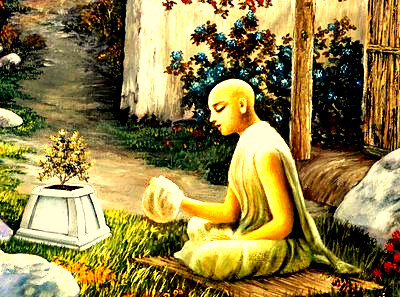
Kamada Ekadashi in Shukla Paksha

Kamadi Ekadasi

Great learned sages have selected the twenty-four narrations from the eighteen Puranas. The narration for this Ekadashi is taken from the Varaha Purana.

Yudhishthira Maharaja said, “O Lord Krishna, please describe to me the Ekadashi that occurs during the light part of the month of Chaitra.” [March-April].

Lord Sri Krishna replied, ‘I shall narrate the ancient history of this sacred Ekadashi, a history which Vasishtha Muni once related to King Dilipa, the great-grandfather of Lord Ramachandra. King Dilipa asked the great sage Vasishtha, “I wish to hear about the Ekadashi that comes during the light part of the month of Chaitra. Please describe it to me.”

Vasishtha Muni replied, “O king, the Ekadashi that occurs during the light fortnight of Chaitra is named Kamada Ekadashi. It consumes all sins. It is very purifying, and it bestows the highest merit upon one who faithfully observes it. Now hear an ancient history, which is so meritorious that it removes all one’s sins simply by being heard.

‘Long ago, there existed a kingdom named Ratnapura, which was decorated with gold and jewels and in which sharp fanged snakes would enjoy intoxication. King Pundarika was the ruler of this most beautiful kingdom, which had many Gandharvas, Kinnaras, and Apsaras among its citizens.

Sri Suta Gosvami said, “O sages, by the mercy of the Supreme Lord Sri Krishna, I can describe the fasting day that removes all kinds of sins. It was to the devoted Yudhishthira that Lord Krishna glorified the twenty-four primary Ekadashis, which destroy sin, and now I shall recount one of those narrations to you.”

Great learned sages have selected the twenty-four narrations from the eighteen Puranas. The narration for this Ekadashi is taken from the Varaha Purana.

Yudhishthira Maharaja said, “O Lord Krishna, please describe to me the Ekadashi that occurs during the light part of the month of Chaitra.” [March-April].

Lord Sri Krishna replied, ‘I shall narrate the ancient history of this sacred Ekadashi, a history which Vasishtha Muni once related to King Dilipa, the great-grandfather of Lord Ramachandra. King Dilipa asked the great sage Vasishtha, “I wish to hear about the Ekadashi that comes during the light part of the month of Chaitra. Please describe it to me.”

Vasishtha Muni replied, “O king, the Ekadashi that occurs during the light fortnight of Chaitra is named Kamada Ekadashi. It consumes all sins. It is very purifying, and it bestows the highest merit upon one who faithfully observes it. Now hear an ancient history, which is so meritorious that it removes all one’s sins simply by being heard.

‘Long ago, there existed a kingdom named Ratnapura, which was decorated with gold and jewels and in which sharp fanged snakes would enjoy intoxication. King Pundarika was the ruler of this most beautiful kingdom, which had many Gandharvas, Kinnaras, and Apsaras among its citizens.

Among the Gandharvas were Lalita and his wife Lalita, who was an exceptional dancer. Lalita loved her husband dearly, and likewise he constantly thought of her.

Once at the court of King Pundarika, many Gandharvas were dancing and Lalita was singing alone, without his wife. He could not help thinking about her as he sang, and because of this distraction he lost track of the song’s melody. One of the envious snakes complained to the king that Lalita was absorbed in thinking of his wife instead of his sovereign. The king became furious upon hearing this, and he shouted, ‘Because you were lustfully thinking of a woman instead of reverently thinking of your king as you performed your court duties, I curse you to at once become a cannibal!’

Lalita immediately became a fearful cannibal, a great man-eating demon whose appearance terrified everyone. Thus poor Lalita, the loving Gandharva singer, had to suffer the reaction of his offense against King Pundarika. Seeing her husband suffering as a horrible cannibal, Lalita became overwhelmed with grief. Instead of enjoying life as a Gandharva’s wife, she had to wander everywhere in the thick jungle with her monstrous husband.

However by good fortune, Lalita came upon the sage Sringi one day. He was sitting on the peak of the famous Vindhyachala Hill. Noticing her, the sage asked, ‘Whose daughter are you, and why have you come here?’

She replied, ‘I am the daughter of the great Gandharva Viradhanva, and my name is Lalita. I roam the forests and plains with my dear husband, whom King Pundarika has cursed to become a man-eating demon. Please tell me how I can perform some act of atonement on behalf of my husband to free him from this demoniac form?’

The sage replied, ‘There is an Ekadashi named Kamada that occurs in the light fortnight of the month of Chaitra. If you observe this Ekadashi fast according to its rules and regulations and give the merit you thus earn to your husband, he will be freed from the curse at once.’

Lalita faithfully observed the fast of Kamada Ekadashi according to the instructions of the sage Sringi, and on Dvadashi she appeared before him and the Deity of Lord Vasudeva and said, ‘I have faithfully observed the fast of Kamada Ekadashi. May the merit I have gained thus free my husband from his misery.’

As Lalita finished speaking, her husband was at once freed from the king’s curse. He immediately regained his original form as the Gandharva Lalita. Now, with his wife Lalita, he could enjoy even more opulence than before. All this was accomplished by the power and glory of Kamada Ekadashi.

Lord Sri Krishna continued, ‘O Yudhishthira, anyone who hears this wonderful narration should certainly observe this Ekadashi to the best of his ability. I have therefore described its glories to you for the benefit of all humanity. There is no better Ekadashi than Kamada Ekadashi. It can nullify curses and cleanse the consciousness. In all the three worlds, among movable and immovable living entities, there is no better day.’

“Jai Shri RadheKrishna”

Papamochani Ekadashi in Krishna Paksha

ekadashi 1

Addressing Lord Sri Krishna, Yudhishthira Maharaja said, “O Supreme Lord, I wish to hear about the Ekadashi that occurs during the dark fortnight of the month of Chaitra [March-April]. What is its name and what results can one attain by observing it?”

Lord Sri Krishna, replied, “O best of kings, for the benefit of everyone I shall describe to you the glories of this Ekadashi which is known as Papamochani. The history of this Ekadashi was once narrated to the emperor Mandhata by Lomasa Rishi.”

Lomasa Rishi narrates, “The Ekadashi that occurs during the dark part of the month of Chaitra is named Papamochani Ekadashi.  For the faithful devotee it removes the influences of ghosts and demons. This Ekadashi also awards the eight perfections of life, fulfills all kinds of desires and purifies one’s life of all sinful reactions.

Now please listen to a historical account concerning this Ekadashi and Chitraratha, the chief of the Gandharvas (heavenly musicians). During the spring season, in the company of heavenly dancing girls, Chitraratha once came upon a beautiful forest with a great variety of flowers. There he and the girls joined other Gandharvas and many Kinnaras, along with Lord Indra himself, the king of heaven, who was enjoying a visit there. Many sages were also present; performing their austerities and penance.  The demigods particularly enjoyed visiting this celestial garden during the months of Chaitra and Vaishakha [April-May].

A great sage named Medhavi resided in that forest and the very attractive dancing girls would always attempt to seduce him. One famous girl in particular, Manjughosha, contrived many ways to allure the exalted muni, but out of great respect for the sage and fear of his power, which he had attained after years and years of asceticism, she would not come very close to him. At a spot two miles from the sage, she pitched a tent and began singing very sweetly as she played a tamboura. Cupid himself became excited when he saw and heard her perform so nicely and smelled the fragrance of her sandal-paste. He remembered his own unfortunate experience with Lord Shiva and decided to take revenge by seducing Medhavi.

Cupid engaged Manjughosha as his assistant, and when she looked at that powerful and attractive young sage, she also became agitated by lust. Seeing that he was highly intelligent and learned, wearing a clean white brahmana’s thread draped across his shoulder, holding a sannyasi’s staff, and sitting handsomely in the ashrama of Chyavana Rishi, Manjughosha came before him.

She began to sing seductively, and the small bells around her ankles, together with the bangles on her wrists, produced a delightful musical symphony. Medhavi was enchanted. He understood that this beautiful young woman desired union with him, and at that instant Cupid increased his attraction for Manjughosha by releasing his powerful weapons of taste, touch, sight, smell and sound.

Manjughosha slowly approached Medhavi and embraced the sage with her arms. Captivated, Medhavi gave up his meditation and decided to sport with her – and instantly his purity of heart and mind abandoned him. Forgetting even the difference between night and day, he went away with her to sport for a long, long time.

Seeing that the young yogi’s sanctity had become seriously eroded, Manjughosha decided to abandon him and return home. She said, “O great one, please permit me to return home.”

Medhavi replied, “But you have only just arrived, O beautiful one. Please stay with me at least until tomorrow.”

Fearful of the sage’s yogic power, Manjughosha stayed with Medhavi for precisely fifty-seven years, nine months, and three days, but to Medhavi, all this time seemed like a moment. Again she asked him, “Please permit me to leave.”

Medhavi replied, “O dear one, listen to me. Stay with me for one more night, and then you may leave tomorrow morning. Just stay with me until after I have performed my morning duties and chanted the sacred Gayathri mantra. Please wait until then.”

Manjughosha was still fearful of the sage’s great yogic power, but she forced a smile and said, “How long will it take you to finish your morning hymns and rituals? Please be merciful and think of all the time you have already spent with me.”

The sage reflected on the years he had been with Manjughosha and then said with great astonishment, “Why, I have spent more than fifty-seven years with you!” His eyes turned red and began to emanate sparks. He now regarded Manjughosha as death personified and the destroyer of his spiritual life. “You have turned all the hard-earned results of my austerities to ashes!” He cursed Manjughosha “O degraded one! May all terrible fortune be yours! I curse you to become an evil pishacha!”

Cursed by the sage Medhavi, the beautiful Manjughosha humbly beseeched him, “O great one, it is said that association with pure devotees gives immediate results but their curses take effect only after seven days. I have been with you for fifty-seven years, so please be kind to me!”

Medhavi Muni replied, “You have destroyed all my austerities. But even though you have done this sinful deed, I shall tell you a way you can be released from my wrath. In the dark fortnight of the month of Chaitra there is an all auspicious Ekadashi that removes all of one’s sins. Its name is Papamochani, and whoever fasts on this sacred day becomes completely freed from having to take birth in any kind of devilish form.”

With these words, the sage left at once for his father’s ashrama. Seeing him enter the hermitage, Chyavana Muni said, “O son, by acting unlawfully you have squandered the wealth of your penances and austerities.”

Medhavi replied, “O Father, kindly reveal what atonement I must perform to remove the obnoxious sin I have incurred by privately associating with the dancing girl Manjughosha.”

Chyavana Muni answered, “Dear son, you must fast on Papamochani Ekadashi which occurs during the dark fortnight of the month of Chaitra. It eradicates all sins, no matter how grievous they may be.”

Medhavi followed his father’s advice and fasted on Papamochani Ekadashi. Thus all his sins were destroyed and he again became filled with excellent merit. Similarly, Manjughosha observed the same fast and became free of the pishacha curse. Ascending once again to the heavenly spheres, she too returned to her former position.

Lomasa Rishi continued, ‘Thus, O king, the great benefit of fasting on Papamochani Ekadashi is that whoever does so with faith and devotion will have all his sins completely destroyed.’

Sri Krishna concluded, “O King Yudhishthira, whoever reads or hears about Papamochani Ekadashi, obtains the very same merit he would get if he donated a thousand cows in charity, and he also nullifies the sinful reactions he may have incurred by killing a brahmana, killing an embryo through abortion, drinking liquor, etc. Such is the incalculable benefit of properly observing this holy day of Papamochani Ekadashi, which is so dear to Me and so meritorious.”

“Jai Shri RadheKrishna”