Vaikuntha Ekadasi Festival /Story of Vaikuntha Ekadashi

vaikuntha-ekadashi-vishnu

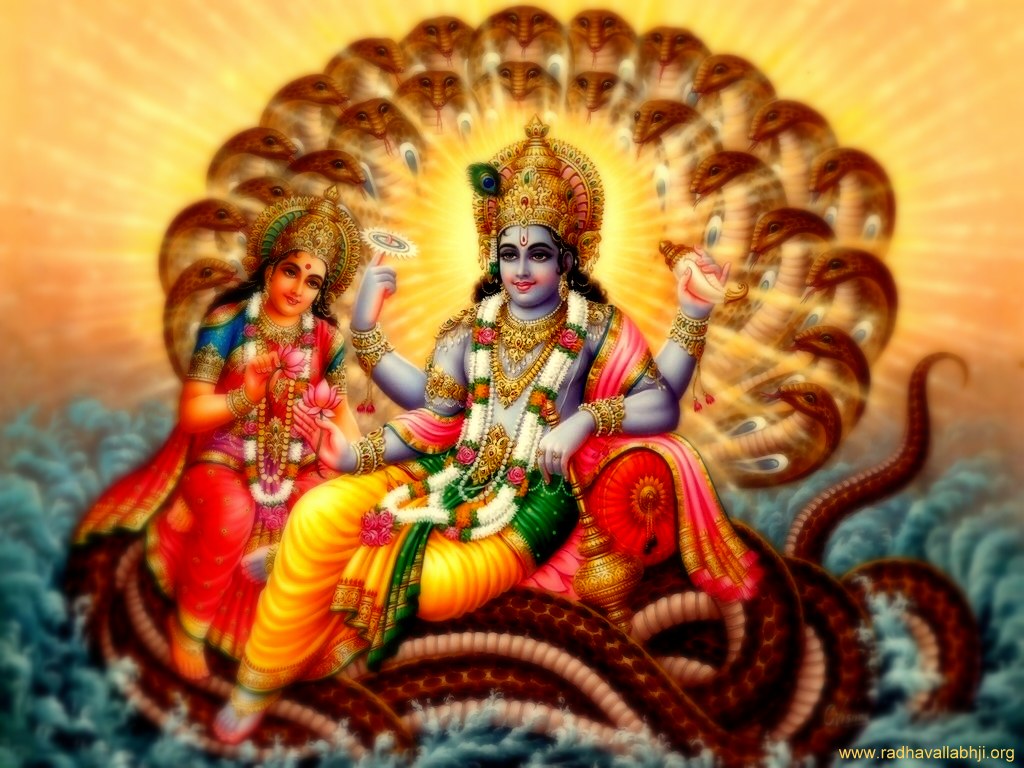
The month of Margashirsha (Dec-Jan) also known as Dhanur masa is of great importance to the devotees of Lord Krishna. Lord Krishna says in the Bhagavad-gita  masanam margasirso ham – of the months, I amMargashirsha. The Ekadashi, 11th day of the waxing moon of Margashirsha masa is popularly known asVaikuntha Ekadashi. This Ekadashi acquires significance because the great devotee Nammalwar, who comes in the disciplic succession of Sri Ramanuja, went back to Godhead on this day. Lord Vishnu, the Lord of Vaikuntha was at the door to receive His pure devotee. To commemorate this great event, generally all Vishnu temples create a Vaikuntha dwara – a special entrance – in the temple and the utsava Deities of the temple are installed near the dwara. It is said that anyone who passes through the Vaikuntha dwara is guaranteed to go back to Godhead.

Apart from this, Vaikuntha Ekadashi is the day on which the epic churning of the ocean of milk was completed by the demons and demigods and the proverbial nectar obtained. It was also on this day that Lord Krishna spoke the Bhagavad-gita to Arjuna on the battlefield of Kurukshetra.

Ekadashi and the killing of the demon Mura

The Padma Purana describes that once during the Krita (Satya) Yuga, a great demon, Mura attained immense powers by performing great austerities. The demigods were defeated by him and headed by Indra they took shelter of Lord Shiva, who guided them saying that Lord Vishnu alone could solve their tribulation. Accepting the prayers of the demigods, Lord Vishnu fought with Mura. During the long battle, which lasted one thousand celestial years, Vishnu needed to rest for a while. He also realized that Mura could not be destroyed by His conventional ayudhas, and needed a different ayudha, one against which Mura would be vulnerable. He entered a beautiful cave called Himavati in Badarikashrama to rest, and formed the new ayudha. Mura wanted to strike Vishnu while He was sleeping. However, Vishnu made Shakti (Vishnu’s female energy) emerge out of His body and assume the form of a beautiful damsel who fought Mura and reduced him to ashes with one look.

When Vishnu awoke He was very pleased and named this maiden as Ekadashi and granted her a boon. The maiden said, “O Lord, if You are pleased with me and wish to give me a boon, then give me the power to deliver people from the greatest sins if they fast on this day.” Vishnu granted her the boon and declared that people worshipping her would reach Vaikuntha. Thus, it is said, was born the first Ekadashi, which was aDhanur masa shukla paksha Ekadashi.

One earthly year corresponds to one day in deva loka. The earthly year is divided into two parts based on the transit of Sun. The northerly transit of the Sun is called Uttarayana. This corresponds to the calendar months from January to June and lunar months from Margashirsha masa to Ashada masa. The southern transit of the Sun is termed as Dakshinayana which corresponds to the calendar months from June to December. For the heavenly planets Uttarayana corresponds to the day and Dakshinayana to the night. Margashirsha masa,which generally falls in last month of Dakshinayana corresponds to the pre-dawn and during the 11th day of lunar month (Ekadashi), is the time when the dawn just about begins. Hence it is considered auspicious for the propitiation of the supreme Lord Vishnu, as He appears to the denizens of heaven and blesses them.

How is Vaikunta Ekadasi Celebrated?  (by: Surya Prakash Rao vadlamani Venkata)

It is believed that the gates of the heaven- the Gate of Vaikunta open on the Vaikunta Ekadasi day. Temples prepare what is called as ‘Vaikunta Dwaram’ or ‘the gate to the heaven‘ and This gate is opened on this day. In all Vaishnava temples, the northern doors remains open on this day and it is on this day, devotees visit the Lord through this northern entrance.

Fasting is an important aspect of Vaikunta ekadasi and is believed to help in redemption of sins and in attaining Moksha. devotees who observe fast on Vaikunta Ekadashi attain salvation by going to Heaven. people fast for the whole day and maintain vigil. Rice is not eaten on this day.it is believed that demon Muran dwells in the rice and eating of rice could get one feel heavy and hamper the vigil to be kept up. People visit temples offer prayers to Lord Vishnu.

Vaikunta Ekadasi festival is more elaborately celebrated by Vaishnavites. This festival is celebrated with lot of fervour at Vishnu temples in Tamil Nadu, Andhra Pradesh, Kerala and Karnataka. Vaikunta Ekadashi is very important day and celebrated with utmost fervour and devotion in Tirumala Venkateswara Temple at Tirupati, Sri Ranganathaswamy Temple at Srirangam and in Trivandrum Padmanabha Swamy temple.

Source:  Glories of Ekadashi by A. C. Bhaktivedanta Swami Prabhupada

“Jai Shri RadheKrishna”
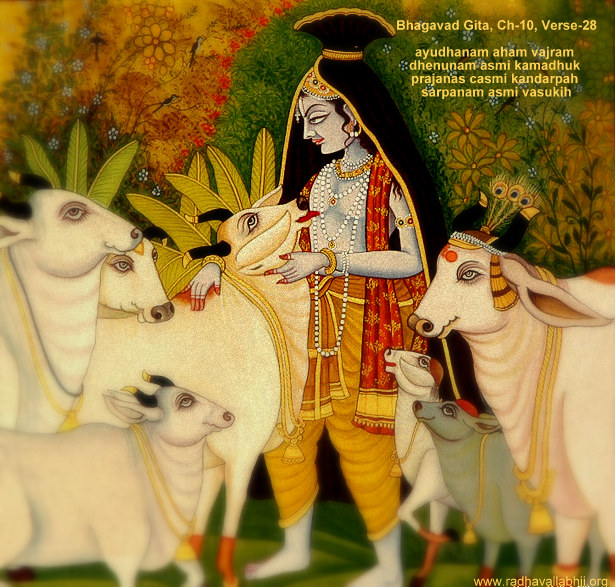
The Sacredness of the Holy Cow – Bhagavad Gita – Ch-10, Verse- 28

gopala_krishna

In this verse Lord Krishna reveals that among cows He is manifested as the kamadhuk meaning kamadhenu the original wish fulfilling cows known as the surabhi cows. Just who and what are the surabhi cows and how the surabhi cows attained such an elevated and exalted position that they are able to represent a portion of the energy of the supreme Lord Krishna will be revealed in the following information given in the Anusasana Parva of the Mahabharata by Krishna Dvaipayana Vyasa.

The surabhi cow descended from the spiritual worlds and manifested herself in the heavenly spheres from the aroma of celestial nectar for the benefit of all created beings. The direct descendants of the surabhi cows are the sacred cows from the continent India which are uniquely distinguished the same as the surabhi by the beautiful hump on their backs and the wonderfully soft folds of skin under their necks. Since all cows in existence in the world today are factual descendants of the sacred cows of India they are all holy as well and should always be lovingly cared for and protected with the highest esteem and greatest respect. One should never cause harm to cows in any way even in a dream and one should never ever even think of eating the flesh of cows as there is no action more sinful in all of creation then cow killing.

Cows are the mothers of all creatures. Cows are verily the mothers of the 33 crores of demigods that administrate creation in the material existence throughout all the universes. Cows are the goddesses of the gods and the refuge of all auspiciousness. Cows bestow every kind of happiness and for these reason they always are worshippable. Cows are the support of all the worlds for by their milk they nourish terrestrials beings and by their ghee offered in sacrifice they nourish the denziens of the celestial realms. Nothing superior to cows.

A cow should not be owned by one who is a killer of cows or a seller to killers of cows, by one who is unrighteous, by one who is sinful, by one who is untruthful in speech, and by one who is outside of the Vedic culture nor should cows ever be given to one such as these. Gifts of cows should be made after ascertaining and determining the qualification of the receiver. Cows should never be given unto those whose residence they are likely to suffer from fire or sun. Cows should always be given away accompanied by their calves. Those cows who have been rescued from situations of distress or have been received from humble farmers unable to continue to take care of them properly are considered to be most auspicious.

One should never show disrepect for cows in any way nor should one feel any repugnance towards the urine and dung of a cow because these things are also pure. When cows are grazing or laying down relaxing one should never disturb or annoy them in any way. Cows should never be killed in any type of sacrifice or slaughtered in any way for food as the killing of cows constitutes the most heinous of all sins in existence.

Cows are the foremost of all creatures in all the worlds. It is from cows that the means for sustaining the worlds has established. Cows are auspicious and sacred and the bequeathers of every blessing. Cows benefit humans with milk, yoghurt, cheese, butter and ghee. The Vedas have stated that the milk of a cow is equivalent to ambrosial nectar and that ghee derived from cows milk is the best of all libations poured onto the sacred fires of brahmins.

Cows of various kinds and diverse colors are always worshippable. They are the foremost of all creatures existing in all of creation. Morning and evening one should bow ones head in reverence to cows. One should never show any disregard to cows in any way but should always show them respect. When one awakes in the morning one should always remember cows. Before falling to sleep at night one should always remember cows. Cows are always auspicious. Cows are also fragrant. The wonderful scent of the amytis agallochum emantes from out of their sacred bodies.

Cows are the great refuge of all creatures. Cows constitute the greatest source of blessings for all creatures. Cows are the past. Cows are the future. Cows are the source of evolution and eternal growth. Cows are the root of prosperity. Whatever is given to cows always produces good fortune and is never in vain. It is solely and exclusively from the ghee of cows that the sacred rituals prescribed and authorised in the Vedas are empowered and able to be performed. Without the presence of cows ghee there is no possibiity of performing sacred rituals that will gratify the 33 million demigods who are responsible for universal management. Neither will the Supreme Personality of Godhead, Lord Krishna be pleased and satisfied. Ghee comes exclusively only from cows from whom flow offerings of milk and milk products. Thus cows verily establish the purity of all sacred rituals and constitute the very essence of performing all sacred activities being the very source of sacred activities.

Cows represent sacred acts themselves and without cows there can be no performance of any sacred act. This is the pure, sublime and supremely exalted position and pre-eminence of cows above all creatures in all the worlds. One who knows the pre-eminence of cows and the selfless service cows render to all creatures and does not protect them affectionately is a sinner and offender and their destination is certainly hell. Cows are equal to the rays of the sun that travel through the universe giving light, warmth and nourishment.

In previous yugas the Vedic injunction was given jiyaite pare yadi tabe mare prani veda-purane ache hena ajna vane that means in the Vedic scriptures known as Puranas there are injunctions declaring that one can take the life of a living being only if they are able to revive it back to life again by chanting Vedic mantras. But we find that this injunction has been terminated in todays age of kali yuga by the Brahma-Vaivarta Purana where it is stated that in the present age of kali yuga it is forbidden to kill cows under any circumstances.

Cows are equivalent to our mothers for when the mothers milk has dried up the cow gives her milk unselfishly to noursih and strengthen us. How can one who has ever drunk cows milk justify the killing and eating of such a mother as the sacred cow. One should never even in one’s mind do injury to a cow or ever think of harming cows as well as bulls. One should show all respect and compassion for cows and sincere reverence should be offered unto them all without reservation.

Those who fail to give cows reverence and protection and choose to foolishly oppose and whimsically ignore the injunctions of the Vedic scriptures by selling a cow for slaughter, by killing a cow, by eating cows flesh and by permittings the slaughter of cows will all rot in the darkest regions of hell for as many thousands of years as there are hairs on the body of each cow slain. There is no atonement for the killing of a cow.

“Jai Shri RadheKrishna”

Aisi lagi lagan meera ho gayi magan

Meerabai

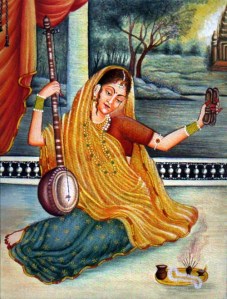
1498 CE. The royals of Merta, a small state in Rajasthan were rejoicing. A baby girl was born to them.  She was named Meera. Her father, Ratan Singh had to travel a lot. Meera stayed home with her mother in the household of her grandfather, Rao Duda ji Rathore. They were devotees of Lord Krishna. Like other Rajput girls, Meera had to learn a lot of things. She learned music and many stories from the Scriptures, but also how to fight with bows and arrows, and with a sword, how to ride a horse and drive a horse-drawn chariot. She had to. Her people were counting on theirs and the other royal families of Rajasthan to lead them in war against the Mughal rulers. But Meera was only a little girl. She listened to her elders talk about the fighting, cried in sadness for the dead, but could not understand why they are always fighting. She liked playing with her mother much better. One day, when Meera was about four years old, she heard the sounds of joyful music just outside their palace walls. She ran excitedly to her mother.   “Ma! Ma! Do you hear the music? Can we go watch? Please, Please?”   “Okay, Meera”, her mother said. “Let’s watch them from upstairs, through the lattice walls.”   It was a marriage procession. The groom was leading it, riding a white horse. He was wearing a jeweled turban, looking like a young king. Everyone in the party was happy, singing and dancing as they went! Meera was happy watching them.   “May we go with them, Ma?” Meera asked. “No, Meera, not this time. You are too young.” Her mother replied. Then she picked Meera up and said, “Can you see the handsome fellow on the white horse?” “Yes, Ma. I see him. He is wearing a turban like father does. Where is he going?” “He is the groom. He is going over to marry his bride.” After watching the marriage party for sometime, Meera thought of another question. “Will I be married, Ma? Who will be my groom?” “O, Meera, you are too young.” “No, no, Ma! Please tell me who?” “Hmm…let’s see who will be my Meera’s groom.. who will he be? Why yes, I know. You will marry Thakurji, Krishna Bhagavan.” Meera’s mother said half in jest as she ran her fingers through Meera’s pretty curls, tousling them.   “Is that so, Ma? Please give me my husband, Krishna Bhagavan.” So they went to the shrine. Meera’s mother picked up a really beautiful, black stone statue of Lord Krishna, playing the flute and gave it to her. “Here is your groom.” That was how Meera knew that she was to marry Lord Krishna. Not too long after that, Meera’s mother passed away. And then her grandfather also passed away. Meera’s elder uncle, Viram Dev became the new head of the household. Little Meera didn’t know who to go to anymore, and grew increasingly close to her husband, Lord Krishna. Do you know what the name “Krishna” means? It means the “all-attractive one”, God in His most charming. It is true.  Love Lord Krishna for one instant, you will see how you too will become permanently attracted to Him. What to say about Meera? She was only a guileless child. Lord Krishna became her life in no time. Meera grew up to be a most beautiful young princess. Everyone far and wide heard about her beauty. But few knew about her love and devotion to Lord Krishna. Meera had many talents, she was a poet and a singer. She wrote songs and sang them to Lord Krishna. One day, when Meera was eighteen years old, they had a visitor. It was Rana Singh Sisodiya, king of neighboring Mewar. He wanted to join forces with the Rathores in their common battles against the Mughals. He proposed that Rathore princess be wed to his son crown prince Bhoj Raj. The marriage was settled, and Meera was to be married to prince Bhoj. Meera herself was not keen about the marriage, but agreed to it only to honor her uncle’s word. Before the marriage, she ceremoniously married Lord Krishna.  Her uncle and aunt gave many gifts, and send them off to the house of Sisodiyas at Chittor. Meera’s marriage to Bhoj was in name only. At heart, Meera was married only to Lord Krishna. She was gentle with her husband Bhoj and her family, and served them with all her abilities, but loved only Lord Krishna. Prince Bhoj loved Meera, and tried his best to make her happy. He wanted her company, but Meera spent all her free time for Lord Krishna, writing songs and singing them. She sang: My only husband is Giridhar Gopal (Lord Krishna), and nobody else. Other members of the Sisodiya family began to disapprove of her ways. They thought that Meera was too proud and did not want to belong to their family. Bhoj Raj tried his best to make peace in the family, but that was not to be. None of the discontent was noticed by Meera. She couldn’t think of anything else other than her true love, Lord Krishna. Meera would go to temples of Lord Krishna and sing with other devotees of Lord Krishna. Sometimes, she visited Sant Ravidas for Spiritual guidance. The Sisodiyas did not think that Meera should go out of the home. They became very unhappy with Meera. Her uncle and aunt also did not approve that Meera went outside of the home. Three years later, Bhoj Raj died in battle with the Mughals. With his death, there was nobody else in the Sisodiya family to speak for her.  Her in-laws even tried to kill her, by giving her a poison drink, but she was miraculously saved. Meera sang: O Rana! You gave me poison drink but I became gold burned in fire. At the end, Meera’s in-laws suggested that she should go to the river and drown herself. Meera decided to do this. When she went to the river, she heard a Divine voice, “Meera, it is a very grave sin to kill oneself. Go to Vrindavan.” Vrindavan is the holy land where Lord Krishna spent his childhood days. Meera left her home for Vrindavan, singing love songs for Lord Krishna.  She sang: That dark Dweller in Braj (Lord Krishna)  is my only refuge. In Vrindavan, Meera came to the monastery of Jiva Goswami. She wanted to see him. Goswamiji had earlier taken a vow that he will not see any woman. The disciples of Goswamiji did not want to let her in. Meera said, “I thought that in Vrindavan, Lord Krishna is the only male person. Now I see that Jiva Goswamiji is another.” All devotees, man and woman, consider themselves to be Spiritual brides of Lord Krishna, just as the gopis did. When the disciples brought the news to Goswamiji, he realized that he had a really special visitor and came out to greet her with folded hands. Meera became Sant Meerabai. Meera spent some time in Vrindavan, singing for Lord Krishna at every temple. Let me be your servant, O Lord. Afterwards, Meera went to Dwarka, in Gujarat. She went to the Ranachodji Krishna temple. She wrote more songs, and sang them. She had no more wordly distractions. Meera wrote more than 400 songs. Her songs are a journal of the deep love she had for Lord Krishna. She wrote in Rajasthani and Vraj dialects. The lyrics are reverently called pada. Devotees get inspiration from her songs. Some of her songs are set in tunes created by her, including Raag Govind and Raag Mira Malhar.  Her writings are in the Madhurya (sweet love) tradition of devotion. The Rajputs fought on till 1535 CE, when the nawab of Gujarat, Bahadur Shah, defeated them. To avoid being captured, Rajput women committed mass suicide in fire. Later, in 1547 CE, the elder Rajputs sent for her, asking her to return home. Meera refused to go. Then they sent a group of priests to reason with her. The priests told her that they will fast until she relents. Meera entered the temple, to pray and ask Lord Krishna what she should do. Lord Krishna told her to come to Him. As she approached the stone image of the Lord, her body disappeared into it. Only her sari was found draped around the image.