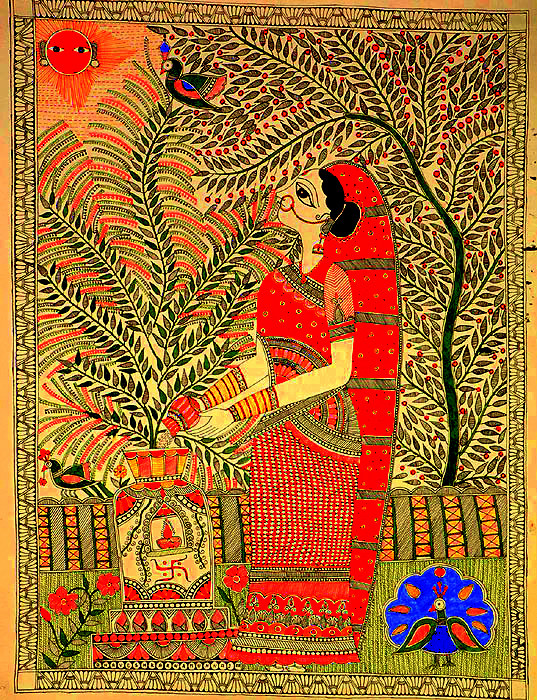
Kamada Ekadashi in Shukla Paksha

Kamadi Ekadasi

Great learned sages have selected the twenty-four narrations from the eighteen Puranas. The narration for this Ekadashi is taken from the Varaha Purana.

Yudhishthira Maharaja said, “O Lord Krishna, please describe to me the Ekadashi that occurs during the light part of the month of Chaitra.” [March-April].

Lord Sri Krishna replied, ‘I shall narrate the ancient history of this sacred Ekadashi, a history which Vasishtha Muni once related to King Dilipa, the great-grandfather of Lord Ramachandra. King Dilipa asked the great sage Vasishtha, “I wish to hear about the Ekadashi that comes during the light part of the month of Chaitra. Please describe it to me.”

Vasishtha Muni replied, “O king, the Ekadashi that occurs during the light fortnight of Chaitra is named Kamada Ekadashi. It consumes all sins. It is very purifying, and it bestows the highest merit upon one who faithfully observes it. Now hear an ancient history, which is so meritorious that it removes all one’s sins simply by being heard.

‘Long ago, there existed a kingdom named Ratnapura, which was decorated with gold and jewels and in which sharp fanged snakes would enjoy intoxication. King Pundarika was the ruler of this most beautiful kingdom, which had many Gandharvas, Kinnaras, and Apsaras among its citizens.

Sri Suta Gosvami said, “O sages, by the mercy of the Supreme Lord Sri Krishna, I can describe the fasting day that removes all kinds of sins. It was to the devoted Yudhishthira that Lord Krishna glorified the twenty-four primary Ekadashis, which destroy sin, and now I shall recount one of those narrations to you.”

Great learned sages have selected the twenty-four narrations from the eighteen Puranas. The narration for this Ekadashi is taken from the Varaha Purana.

Yudhishthira Maharaja said, “O Lord Krishna, please describe to me the Ekadashi that occurs during the light part of the month of Chaitra.” [March-April].

Lord Sri Krishna replied, ‘I shall narrate the ancient history of this sacred Ekadashi, a history which Vasishtha Muni once related to King Dilipa, the great-grandfather of Lord Ramachandra. King Dilipa asked the great sage Vasishtha, “I wish to hear about the Ekadashi that comes during the light part of the month of Chaitra. Please describe it to me.”

Vasishtha Muni replied, “O king, the Ekadashi that occurs during the light fortnight of Chaitra is named Kamada Ekadashi. It consumes all sins. It is very purifying, and it bestows the highest merit upon one who faithfully observes it. Now hear an ancient history, which is so meritorious that it removes all one’s sins simply by being heard.

‘Long ago, there existed a kingdom named Ratnapura, which was decorated with gold and jewels and in which sharp fanged snakes would enjoy intoxication. King Pundarika was the ruler of this most beautiful kingdom, which had many Gandharvas, Kinnaras, and Apsaras among its citizens.

Among the Gandharvas were Lalita and his wife Lalita, who was an exceptional dancer. Lalita loved her husband dearly, and likewise he constantly thought of her.

Once at the court of King Pundarika, many Gandharvas were dancing and Lalita was singing alone, without his wife. He could not help thinking about her as he sang, and because of this distraction he lost track of the song’s melody. One of the envious snakes complained to the king that Lalita was absorbed in thinking of his wife instead of his sovereign. The king became furious upon hearing this, and he shouted, ‘Because you were lustfully thinking of a woman instead of reverently thinking of your king as you performed your court duties, I curse you to at once become a cannibal!’

Lalita immediately became a fearful cannibal, a great man-eating demon whose appearance terrified everyone. Thus poor Lalita, the loving Gandharva singer, had to suffer the reaction of his offense against King Pundarika. Seeing her husband suffering as a horrible cannibal, Lalita became overwhelmed with grief. Instead of enjoying life as a Gandharva’s wife, she had to wander everywhere in the thick jungle with her monstrous husband.

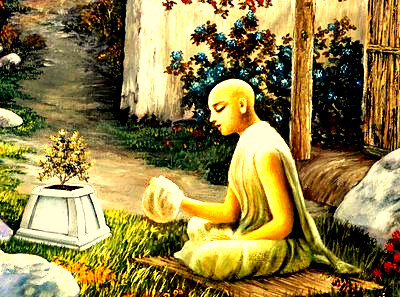
However by good fortune, Lalita came upon the sage Sringi one day. He was sitting on the peak of the famous Vindhyachala Hill. Noticing her, the sage asked, ‘Whose daughter are you, and why have you come here?’

She replied, ‘I am the daughter of the great Gandharva Viradhanva, and my name is Lalita. I roam the forests and plains with my dear husband, whom King Pundarika has cursed to become a man-eating demon. Please tell me how I can perform some act of atonement on behalf of my husband to free him from this demoniac form?’

The sage replied, ‘There is an Ekadashi named Kamada that occurs in the light fortnight of the month of Chaitra. If you observe this Ekadashi fast according to its rules and regulations and give the merit you thus earn to your husband, he will be freed from the curse at once.’

Lalita faithfully observed the fast of Kamada Ekadashi according to the instructions of the sage Sringi, and on Dvadashi she appeared before him and the Deity of Lord Vasudeva and said, ‘I have faithfully observed the fast of Kamada Ekadashi. May the merit I have gained thus free my husband from his misery.’

As Lalita finished speaking, her husband was at once freed from the king’s curse. He immediately regained his original form as the Gandharva Lalita. Now, with his wife Lalita, he could enjoy even more opulence than before. All this was accomplished by the power and glory of Kamada Ekadashi.

Lord Sri Krishna continued, ‘O Yudhishthira, anyone who hears this wonderful narration should certainly observe this Ekadashi to the best of his ability. I have therefore described its glories to you for the benefit of all humanity. There is no better Ekadashi than Kamada Ekadashi. It can nullify curses and cleanse the consciousness. In all the three worlds, among movable and immovable living entities, there is no better day.’

“Jai Shri RadheKrishna”
Ekadasi – The Auspicious 11th Day of the Lunar Cycle

ekadashiEkadasi in Sanskrit means ‘the Eleventh Day,’ which occurs twice in a lunar month – once each on the 11th days of the bright and dark fortnight respectively. Known as the ‘Day of Lord Vishnu,’ it is a very auspicious time in the Hindu calendar and an important day to fast.

Why Fast on Ekadasi?

According to the Hindu scriptures, Ekadasi and the movement of the moon has a direct correlation with the human mind. It is believed that during Ekadasi, our mind attains maximum efficiency giving the brain a better capacity to concentrate. Spiritual seekers are said to devote the two monthly days of Ekadasi in extreme worship and meditation owing to its favourable influence on the mind. Religious reasons aside, these fortnightly fasts helps the body and its organs get respite from dietary irregularities and over indulgences. Lord Krishna says that if a person fasts on Ekadasi, “I shall burn all sins. This day is the most meritorious day to kill all sins.”

How to Fast on Ekadasi

Like Amavasyas and Purnimas or new and full moon nights, Ekadasis are important dates of the Hindu calendar owing to the ritual fast that is observed on these two days of the month. Anhydrous fast, which doesn’t allow drinking water, is the most preferred way to fast on Ekadasi. Such fasts should be broken the next morning preferably with milk. If one can’t keep an anhydrous fast on Ekadasi, they can have only fruits and vegetables, but no grains. Apart from avoiding taking cereals or meat, many devout Hindus also abstain from shaving, cutting hair or clipping nails on Ekadasis.

Ekadasi in Hindu Scriptures

This fast is not only said to remove sins and bad karma but also gain blessings and good karma. Lord Krishna says: “I shall remove all obstacles from his path of spiritual development and bestow upon him the perfection of life” if a person keeps regular and rigorous fast on Ekadasi. In the Garuda Purana, Lord Krishna names Ekadasi as one of the “five boats for the people who are drowning in the ocean of worldly existence”, the others being Lord Vishnu, the Bhagavad-Gita, the Tulsi or holy basil, and the cow. In the Padma Purana, Lord Vishnu says: “Among all plants, the Tulsi is my favorite, among all months, Kartik, among all pilgrimages, Dwaraka, and among all days, Ekadasi is most beloved.”

Rites of Passage Prohibited during Ekadasi

Ekadasi is not conducive to most ritual worships or ‘puja.’ Rites of passage, such as funeral or ‘Shraddha Puja’ are prohibited on the auspicious days of Ekadasi. The holy Srimad Bhagavatam pronounces grave consequences for such ceremonies performed during Ekadasi. The scriptures bar Hindus from consuming grains and cereals on Ekadasi as well as offering such food or ‘prasad’ to Gods in rituals conducted on this auspicious 11th day. Therefore, it is advisable not to plan for marriage ceremonies and ‘havan’ rituals on Ekadasi. In case you are forced to have any such rituals on an Ekadasi, only non-grain items could be offered to God as well as guests.

24 Types of Ekadashi Days in a Year

Chaitra Month (March – April)

Papamochani Ekadashi in Krishna Paksha
Kamada Ekadashi in Shukla Paksha

Vaisakha Month (April – May)

Varuthini Ekadashi in Krishna Paksha
Mohini Ekadashi in Shukla Paksha

Jyeshta Month (May – June)

Apara Ekadashi in Krishna Paksha
Pandava Ekadashi in Shukla Paksha. Also known as Nirjala Ekadasi or Pandav Bhim Ekadashi

Ashaad Month  (June – July)

Yogini Ekadashi in Krishna Paksha
Shayani Ekadashi in Shukla Paksha

Shraavana Month  (July – August)

Kamika Ekadashi in Krishna Paksha
Pavitropana Ekadashi in Shukla Paksha

Bhadrapada Month (August – September)

Ananda Ekadashi in Krishna Paksha
Parsva Ekadashi in Shukla Paksha

Ashvin Month (September – October)

Indira Ekadashi in Krishna Paksha
Papankusha Paashunkushaa Ekadashi in Shukla Paksha

Kartik Month  (October – November)

Rama Ekadashi in Krishna Paksha
Prabodhini Ekadashi in Shukla Paksha

Margashirsha or Agrahayana Month (November – December)

Utpanna Ekadashi in Krishna Paksha
Mokshada Ekadasi in Shukla Paksha. Mokshada ekadashi is celebrated as Vaikuntha Ekadasi Festival at Sri Rangam Temple in Tamilnadu

Pausha Month (December – January)

Saphala Ekadashi in Krishna Paksha
Putrada Ekadashi in Shukla Paksha 

Maagha Month (January – February)

Shattila Ekadasi or Sat Tila Ekadashi in Krishna Paksha
Bhaimi Ekadashi in Shukla Paksha

Phalguna Month (February – March)

Vaikunta Ekadasi in Krishna Paksha
Amalaki Ekadashi in Shukla Paksha

“Jai Shri RadheKrishna”

The Worship of Srimati Tulasi-devi

TulasiTulasi-devi is an expansion of Vrinda-devi in this world. Every morning we pray to Vrinda-devi:

ye tomara sarana loy tara vancha purna hoy krpa kori koro tare vrndavana-vasi

“Whoever takes shelter of you, all his desires are fulfilled and by your mercy he becomes a resident of Vrndavana.”

Srimati Tulasi-devi is worshiped in the morning, after mangala-arati, when all the devotees should attend to her worship and circumambulation. First, obeisances are offered to Tulasi-devi with the Tulasi pranama mantra. Following, the Tulasi-puja-kirtana song is sung while Tulasi-devi is offered incense, a ghee lamp, and flowers. When the song is finished, the assembled devotees circumambulate Tulasi-devi four times, offering her water. During the circumambulation we are chanting the mantra: yani kani ca papani brahma-hatyadikani ca / tani tani pranasyanti pradaksinah pade pade. Finally, we again offer obeisances with the Tulasi pranama mantra.

Tulasi leaf is very, very dear to Visnu. All Visnu-tattva Deities require profusely Tulasi leaves. Lord Visnu likes garland of Tulasi leaves. Tulasi leaves mixed with sandalwood pulp and placed on the lotus feet of the Lord is the topmost worship. But we must be very careful that Tulasi leaves cannot be placed on the feet of anyone else except Lord Visnu and His different forms. Tulasi leaves cannot be placed even on the lotus feet of Radharani or on the lotus feet of the Spiritual Master. It is entirely reserved for being placed on the lotus feet of Krsna. We can place, however, Tulasi leaves in the hands of Radharani for being placed on the lotus feet of Krsna.

Tulasi-devi is a pure devotee of Krsna and she should be treated with the same respect given to all Krsna’s pure devotees. Simply by worshiping her faithfully, a devotee can get himself free from all material miseries. In the Nectar of Devotion I have given two verses from the Skanda Purana, one of which is: “Tulasi is auspicious in all respects. Simply by seeing, simply by touching, simply by remembering, simply by praying to, simply by bowing before, simply by hearing about, or simply by sowing the tree, there is always auspiciousness. Anyone who comes in touch with the Tulasi tree in the above mentioned ways lives eternally in the Vaikuntha world.”

The following list was compiled from scriptures.

  • Tulasi’s body is spiritual. Although Tulasi appears as many individual trees, she is one person, and she comes wherever she sees devotion to Krsna.
  • Every morning devotees should water and pray to Tulasi-devi and circumambulate her three times.
  • Worship Tulasi with nice food, flowers, incense, a ghee lamp, and other traditional articles of worship.
  • Protect the delicate Tulasi seedlings from birds and insects. It is an offense to turn the seedlings back into the soil.
  • In places where Tulasi cannot survive the winters when planted in the ground, provide a suitable house for her.
  • Every day provide Tulasi fresh air, water (as needed be careful not to water too much), and sunshine (or plant lights).
  • Neglecting to care for or water Tulasi properly is a great offense. Do everything carefully.
  • When picking Tulasi leaves, chant the following mantra:

tulasy amrta janmasi
sada tvam kesava-priya
kesavartham cinomi tvam
varada bhava sobhane

“O Tulasi, you were born from nectar. You are always very dear to Lord Kesava. Now, in order to worship Lord Kesava, I am collecting your leaves and manjaris. Please bestow your benediction on me.”

Pick only the leaves that grow next to the manjaris (flowers) and the leaves that are ready to drop (they will turn a pale color) not the new, green ones. Pick the manjaris as soon as they blossom. Avoid letting them go to seed, which takes much energy from the plant that can be used to make more leaves and flowers for Krsna’s service. Pick the leaves one at a time with your fingertips. Don’t shake or stroke the branch and damage healthy leaves. Pick with care and attention. Avoid using cutting tools.

  • Never cut or prune Tulasi-devi. This is a great offense. Remove dead branches if absolutely necessary. If branches obstruct a passageway, tie them back, but don’t cut them.
  • Pick Tulasi leaves and flowers in the morning, never at night (from sunset to sunrise).
  • Never use chemical sprays on Tulasi.
  • Collect leaves once in the morning for worshiping Krsna and for putting on the plates of food to be offered to Him. Put at least one leaf on each preparation. Never pick Tulasi leaves for any other purpose than to offer to the Lord.
  • Lord Krsna likes garlands of Tulasi leaves. Tulasi leaves mixed with sandalwood pulp and placed on the lotus feet of the Lord is the topmost worship. Do not place Tulasi leaves on the feet of anyone other than Lord Visnu in His various forms. Srimati Radharani can be given a Tulasi leaf in Her hand for offering to Lord Krsna.
  • Krsna accepts even dry Tulasi leaves. Tulasi wood (taken after a plant has fully dried naturally) can be used to carve worship paraphernalia, such as beads. Place leftover Tulasi wood within the earth.
  • Never use Tulasi leaves or flowers to make teas or juices, even after they’ve been offered to Krsna. It is a great offense to cook or heat Tulasi, or to use her for mundane purposes, such as medicines and ointments.
  • Never cut down or pull up living Tulasi plants. This is a great offense.
  • Avoid stepping on Tulasi-devi’s shadow.
  • Tulasi-devi is very, very dear to the Lord. Therefore, most important is to serve her with love and devotion.Plucking TulasiOne should be clean before touching or plucking Tulasi.

    asnatva tulasim citva yah pujam kurute narah
    so’paradhi bhaven nityam tat sarvam nisphalam bhavet

    One who picks Tulasi without having bathed and then performs worship is an offender, and all his activities becomes useless. Vayu Purana

    Tulasi should not be plucked on dvadasi.

    nacchindat tulasim vipra dvadasyam vaisnavah kvacit

    The Vaisnava should never pick Tulasi on dvadasi tithi. Visnu Dharmottara

    One should pluck the leaves with the right hand, holding the branch in the left hand, being careful not to break the branches.

    patranam cayane vipra bhagna sakha yada bhavet
    tada hrdi vyatha visnor diyate tulasi pateh
    karatala trayam dattva cinuyat tulasi dalam
    yatha na kampate sakha tulasya divyasattama

    If when picking Tulasi leaves one breaks the branches, Visnu feels pain in His heart. One should clap the hands three times before picking Tulasi and pick in such a way that the branches do not shake. Visnu Smrti

    One should say:

    tulasy amrta janmasi sada tva kesava priya
    kesavarthe vicinvami barada bhava sobhane

    tvad anga sambhavaih patraih pujayami yatha harim
    tatha kuru pavitrangi kalau mala vinasini

    Oh Tulasi, born from the ocean of nectar, you are eternally the dearmost of Kesava. For His worship I now pluck you. Please bestow blessings on me.

    Oh Tulasi, being pure in body and the destroyer of the sins of Kali-yuga, I will worship the Lord using leaves coming from your body. You should make that worship successful.

    If Tulasi is unavailable, one may touch Tulasi wood to the Lord’s body as an offering of Tulasi. If wood is unavailable one should chant the name of Tulasi and perform the puja meditating on her presence. (i.e. etat tulasi patram sri krsnaya namah)

    If one offers Tulasi to anyone other than Hari, that sin is equal to killing a brahman or a cow, or having sex with ones guru’s wife.

    Tulasi prasadam may be offered to the hand of sakti and jiva-tattva, and unoffered Tulasi may be offered to their hand for offering to Krsna. If bhoga (not mahaprasadam) is offered to sakti or jiva-tattvas as naivedyam, Tulasi may be placed on the naivedyam, since, being devotees of the Lord they always offer the naivedyam to Krsna before taking it themselves.

    Tulasi leaf is very, very dear to Visnu. All Visnu-tattva deities require profuse Tulasi leaves. Lord Visnu likes garlands of Tulasi leaves. Tulasi leaves mixed with sandalwood pulp and placed on the lotus feet of the Lord is the topmost worship. But we must be very careful that Tulasi leaves cannot be placed on the feet of anyone else except Lord Visnu and His different forms. Tulasi leaves cannot be placed even on the lotus feet of Radharani or on the lotus feet of the spiritual master. It is entirely reserved for being placed on the lotus feet of Krsna. We can place, however, Tulasi leaves in the hands of Radharani for being placed on the lotus feet of Krsna. On each bowl or plate there should be at least one leaf.

    “Jai Shri RadheKrishna”