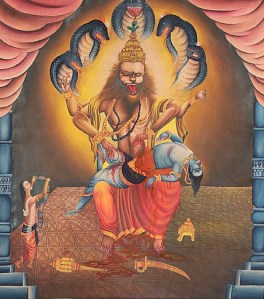
[Prahlada to Lord Vishnu:]
Whatever comes, let it come; whatever goes, let it go. Let notions of diverse experiences either arise or set in the body: I am neither in them nor they in me.
Even as steel cuts the steel-beam which has been heated, I have subdued the mind with its own purified state. I have cut asunder cravings, ignorance and foolishness by their opposites. Egolessly, my body functions with its inherent energy. The past tendencies, mental conditioning and limitations have been completely destroyed. I begin to wonder: how was it that for such a long time I was caught up in the trap of ego-sense! Freed from dependency, from habits of thought, from desire and cravings, from deluded belief in the existence of the ego, from the coloring of pleasure-seeking tendency and from revelry — my mind has reached a state of utter quiescence. With this all sorrow has come to an end and the light of supreme bliss has dawned! (V:35)
[Vishnu to Prahlada:]
Even though you are in the body, since you do not have the body, you are bodiless. You are the observer which is immaterial intelligence: just as, though air exists in space it is not attached to space, and hence it is free from spatial limitation.
Enlightened men, though they be constantly engaged in activity, do nothing: it is not by means of inaction that they reach the state of non-action! This very fact of non-action frees you from experiences: for there is no harvest where there is no sowing. When thus both notions of I do and I experience have ceased, there remains only peace; when that peace is firmly grounded, there is liberation.
Without self-inquiry and the consequent inner tranquillity, neither devotion to Lord Vishnu nor self-knowledge is possible. Hence resort to self-inquiry and the practice of the End to distraction and thus adore the Self: if you are successful in this, you have attained perfection.
Lord Vishnu (Supersoul) in fact dwells as the innermost being of all; they are surely the worst among men who, abandoning the indweller, seek Lord Vishnu outside. Consciousness free from the limitations of the mind is known as the inner intelligence: it is the essential nature of no-mind. That is the reality, that is supreme consciousness, that is the state known as the supreme self, that is omniscience.
One should enjoy the delight that flows from peace. The man whose mind is well-controlled is firmly established in peace. When the heart is thus established in peace, there arises the pure bliss of the Self. O mind, abandon this perception of diversity and realize the unreality of your own independence from the infinite consciousness: this is liberation.
Story about how Bhakta Prahlada became Videhamukta
Bhaktha Prahlada attained the true Self Knowledge through his intelligence. After his father Hiranyakasipu, the King of Danavas, expired, the sore-grieved son gave vent to the following words with a palpitating heart.
Countless were the numbers of Danavas born in my race, such as my father and others. They had bodies which cast into insignificance even Mahameru itself. They were able to do or undo even the lotus-born Brahma with his powers. But before Vishnu wearing the Tulsi garland, they fell easy victims to his fiery ire, like cotton before the wind.
There is none now who is not afraid of Vishnu. There is only one means of conquering the efful gent Vishnu, my enemy, wearing the discus. Think however we may, there is no higher goal than this. The real refuge can be sought only in Vishnu residing in the ocean of milk. Therefore let my mind from this moment seek an asylum in the seat of Narayana (Vishnu).
May I through devotional meditation, be “ He” and inseparable from Him. May the Maha Mantra *AUM NAMOH NARAYANAYA* which confers upon its devotees whatever they long for, be inextricably inter woven and commingled within me, like the Ether pervaded by the wind. Those who salute and worship Vishnu will be able to attain their desired results of emancipation, only when they contemplate upon Vishnu as themselves. Otherwise such results will not accrue. Following that path, I will worship and meditate upon Vishnu as myself.
This body is no other than the form (or manifestation) of Vishnu. He who is bound by this body in the form of Prana-Vayu is Vishnu, the supreme of the supreme. That which goes before Prana-Vayu abides externally as the second Vishnu. Therefore collecting mentally all articles of worship, I shall always worship Vishnu as above.
With this purpose in view, he created, through his mind articles of worship and then worshipped with them, Lord Vishnu with true love in his divine place.
From that time forward, be began to ever worship the feet of Vishnu, the one partless Brahman. Thereafter, all the bad people bearing axes began like Prahlada to be the slave of Hari (Vishnu), abandoning all their bad qualities. Are not thus the qualities (good or bad) of a king imbibed by his subjects ?
Indra and the other Gods marvelled with fear at this unprecedented event and were sceptical as to how these vicious personages were able to secure the love of Vishnu. Therefore they went to Vishnu, sleeping his long (Yoga) sleep in the sea of milk and having seen and eulogised him, addressed him thus : “
If all the Daityas of fiery nature after meditating upon you become merged in thee, then there cannot be but Maya everywhere. These words of the Gods were replied to by our Lord Vishnu thus, “ Oh Gods, do not be afraid. The victorious Prahlada has rendered himself no more liable to re-births. Freed from his murderous propensities, he has reached Moksha through his Tatwa Knowledge vision.
Therefore do not suppose that there is any deception practised by him. If good persons incline their minds towards vice, then manifold evils will ensue ; but if the vicious incline towards the virtuous path, then incalculable good will result. Therefore may all of you fare well.”
Through the steady application, Prahlada’s worshipped with supreme discrimination, bliss and indifference towards objects, etc.. With the development of the four means (of salvation), all his minds attractions towards sensual objects ceased. Therefore his mind became quiescent, without sinking into sensual objects.
The mind of Prahlada was oscillating like a cradle between the cognition of the all-full Reality and the enjoyment of sensual pleasures. Prahlada then prayed to Lord Vishnu thus“Oh you, the original seat of all rare things in the incomparable mansion of the three worlds ; Oh you, the ever-resplendent Brahman without the dawning and the setting of the sun in you ; Oh you who are the eye of mercy to all the votaries, salutation, salutations, a thousand salutations to thee.
Oh you who are the Tatwa (Reality , the prototype of all grace and the lord of all earths, salutations, salutations, a thousand salutations to thee. O : you, who are the sun to the full blown lotus of Gods walking in the path of the Vedas ; Oh you, who are the Lord of all souls, salu tations, salutations, a thousand salutations to thee.”
Lord Vishnu spoke to him thus * Oh Prahlada of true love, you are free to demand of me a boon which will not make you be subject to the trammels of re-births.”
To which Prahlada said thus * O you Supreme Principle who resides in the hearts of all, please vouchsafe to confer on me that bliss wherein there are no pains.”
Thereupon Vishnu blessed him by laying his lotus-like hand upon his head with these words : ** May the final Atmic enquiry arise in you in order that you may attain quiescence in the Brahmic bliss of the pure ParaBrahma, after your mind is freed from the delusions of the world.”
The incomparable Lord has deigned to bless me with the Atmic enquiry enabling one to overcome re-birth. Let me cogitate upon the questions, whom am I? What was I before? What is the nature of this “ I” which identifying itself with the parapher nalia of this world (and body) stays and runs, cries and laughs, exults and is afflicted ? I am not this diverse world. How can this inert world be called the “I, “as the former is external to the latter and is composed of hills, stones, preity things, earth, trees and others ?
Neither can the temporary body be called the “I,”. Nor is the inert property of form this “ I,” which dies in the “knower” who though acting in this perishable world and sight is yet no participator in it. Now have I cognised my Reality as shining both within and without, as the one pure Knowledge of pure Sat and without re-birth, being freed from all ideas of “I” and “mine,” from all Sankalpas and from all the delusions of the five organs, without the least despondency of heart. This is perfectly certain.
Ha, Ha, now have I known my true Self. Is this the Atmic Reality which shines, in the path of spiritual knowledge, in the intelligence of one divested of all diversities? In the one Tatvva Knowledge which is no other than the “ I” pervading everywhere without fluctuation, all the universes from the sun down to a pot shine.
Like sparks of fire which shine through the heat in the burn ing fire, so I find, in my present illuminated state, that all the organs performed diverse actions through me only. All Individuals from Brahma downwards will shine as my Reality alone in the one space at the end of a Kalpa when all the universe goes into Pralaya;
How then can exist the ideas of “I” or “ he” which pertain to the mind ? How can “ I” which now shines as the one full Knowledge throughout this infinite universe, possess the modifications of this reasoning mind, with a seat allotted to it in the body. Therefore my spiritual vision of quiescent Knowledge which is eternal, blissful and in comparable is in all the worlds.
All the manifested appearances are only the spiritual vision of the one subtle ideation. As all Individuals are no other than “ I”, the invisible Knowledge and Pratya- gfitma that has no other object than itself to lean upon, I offer salutations to them all on account of (their non-divisibility from) my own Self.
Out of the differenceless Knowledge which has no thoughts other than its Self, which is pure, equal in all, without differ ence, beyond and without the three divisions of time past, present and future arose the diverse transcendental (Sakthis) potencies.
The non-dual Knowledge without attractions to any is equal unto itself alone. As it is above all words, a principle equal unto Self Knowledge cannot be found in words. If the imperishable non-desires should become replete in one, which are invisible and pure and yet like the illusory worldly things, then there will remain equal vision overall, like a waveless ocean. But a mind whirling in actions associated with activity and passivity will be bound, like a bird caught in a net.
Therefore all persons who are afflicted with love and hatred and are thereby dizzy in mind, cling to this earth like poison.
O you illuminated dweller in the mind of all souls, I have been able to attain You only after a very long period. You are fit to be enquired into through the holy sentences of the Vedas and Gurus. You shinest as of the nature of Self Knowledge which is pure bliss.
Many salutations to You who are “That” into which all things merge. You are the Eternal Knowledge wherein “ I” am “ thou” and “Thou” are “I”. Prostrations to you my Lord, the ParaBrahma, the infinite consciousness.
Prostrations to myself which has attained its Reality, shining as itself in a blissful state and as the one Consciousness without any thoughts. Though seeming to be mobile or immobile or quiescent, it is yet without such actions. Though performing all actions, it is yet without desires therein.
It is He who is sought after by the bodies and organs. It is He who is- praised by the organ of speech. It is He who is meditated upon by the mind. It is He who causes birth and death to-be bridged over. It is He who can be easily attained to. It is He who can cognize all.
I have no love or hatred towards sensual enjoyments. Let me attain those things, I am destined to get; let me not long after those things, I am not destined to get. Originally I became oblivious of discrimination and other blissful things through my inimical Ignorance.
Now I am in possession of Self Knowledge, Having destroyed my mind sunk in Samsara with my discrimination that had labored hard in the Spiritual Inquiry, having freed myself from all the painful Ego, having annihilated all conceptions of duality by meditating upon non-duality, I am now the incomparable ParaBrahma (infinite consciousness) in an immovable state.
Victory to thee, imperishable God. Victory to thee, the seat of final quiescence. Victory to thee, beyond the reach of all Vedas.
Victory to Thee, the source of all Vedas. Victory to thee, the cause of creation. Victory to thee, the causeless cause. Victory to thee, the perishable cause. Victory to thee, the imperishable cause.”
Thus did the noble son of Hiranya meditate through his pure mind and enjoy bliss in the supreme differenceless Nirvikalpa Samadhi of great omniscience. As he seated him self statue-like in Nirvikalpa Samadhi for 5000 years and remained steadfast in one vision (or thought) only, there prevailed anarchy in his Kingdom.
The stainful Danavas who are the night-rovers bearing axes have ceased to exist, all the Gods are deprived of war in their absence and will became quiescent and attained Moksha.
With the quiescence of Gods, all the Yajnas done on earth in their honor as well as Tapas, will be barren of results, and therefore fade away from earth. With the cessation of the laborious performance of these Yajnas, and other actions, the universe will have to come to a stand still.
And then all created objects will cease to exist. Should all the created objects such as the sun, moon, etc, disappear, then we shall have to give up this form of ours and reach the non-differentiated state of * That* ParaBrahma. Were all the archaic universes to perish before their allotted time, then no real benefit (or law) will reign in this world.
The beneficent Vishnu caused his Panchajanya (conch) to be sounded in order to intimate to Prahlada his arrival. Through the terrible reverberating sound which pierced the earth, the skies and the quarters, Prahldda who was merged in the primal seat of “That”, slowly recovered consciousness on this plane.
The Chaitanya Sakti (or consciousness potency) issuing first out of Brahmarandhra pervaded, as before, the Nadis to all the parts of his body and when it got to the nine apertures of the body, Prahlada became conscious of this (physical) plane.
Then his Chaitanya (consciousness) began to perceive material objects, only alter it shone as the reflection in the glass of the internal Prana. Hence that intelligence of his which manifested itself in objects, may be compared to the reflected image in a mirror and thus assumed the attributes of Manas. As he recovered consciousness little by little like a lotus unfolding its petals gradually, his beautiful eyes opened. Then the beneficent Prana and Apna began to percolate all throughout his Nadis (nerves) and organs, thus producing a complete perception of the world. Like a lotus fanned by the mild zephyrs, Prahlada began to move in his position. In the twinkling of an eye, his mind became gross and his eyes, mind, Prana and body began to glow with life with their respective functions.
Thereupon Vishnu eyed, with great grace, Prahlada and blessed him thus “Oh immaculate Prahlada, go and look after your Kingdom which is praised and coveted by Indra, the lord of Devas. Also look after your body. Why do you think of abandoning this, your body at such a premature period as this ? So long as you are not haunted by the San- kalpa of attraction and repulsion towards objects, what mat ters it whether your body exists or not ?
Now get you up from Samaddhi. May you, O Prahlada, be in the Jivanmukti state. May you, until the end of this Kalpa, administer due justice in this world with this body of yours in the Jivan mukti state, but yet without groaning under the load of Samsara. Why do you now in vain die (or disappear from this world), when neither the fires nor the twelve suns burn the universe out of existence (and the Kalpa has not yet closed) ? The lives of those only are blissful, who, having mastered egoism and desires, do cast their eyes equally upon all, which vision confers infinite bliss.
The lives of those only are blissful who, devoid of love and hatred and having rendered their minds cool, are witness to all actions, though performing them. He who is attracted towards objects as well as the objects themselves are both bondage-giving ; the severance (of the mind) from objects constitutes quiescence. It is only when this quiescence is mastered that Moksha is attained. Now in as much as you have reached that state, you should seat yourself on your victorious throne (of the quiescent mind) and reign over your kingdom. May you reign till the end of this Kalpa.”
Aum Pratyahara Pranayama Purushottamaya ParaBrahmane Namaha
Aum Satsang Self-control Self-inquiry Contentment
Aum Desireless Egoless No-mind Unconditional-love
Aum Pray Purify Meditate Love

 Self Discovery
You must be logged in to post a comment.