Krishna & Gopis

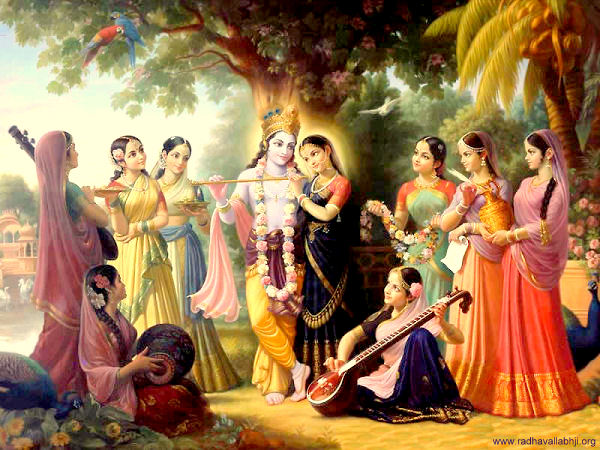
Krishna & GopisWhen Krsna suddenly disappeared from the company of the gopis,they began to search for Him in every place. After not finding Him anywhere, they became afraid and almost mad after Him. They were simply thinking of the pastimes of Krsna in great love and affection. Being absorbed in thought, they experienced loss of memory, and with dampened eyes they began to see the very pastimes of Krsna, His beautiful talks with them, His embracing, kissing and other activities. Being so attracted to Krsna, they began to imitate His dancing, His walking and smiling, as if they themselves were Krsna. Due to Krsna’s absence, they all became crazy; each one of them began to tell the others that she was Krsna Himself. Soon they all began to assemble together and chant Krsna’s name very loudly, and they moved from one part of the forest to another searching for Him. Actually, Krsna is all-pervasive; He is in the sky, and He is in the forest; He is within the heart, and He is always everywhere.

The gopis therefore began to question the trees and plants about Krsna. There were various types of big trees and small plants in the forest, and the gopis began to address them. “Dear banyan tree, have you seen the son of Maharaja Nanda passing this way, laughing and playing on His flute? He has stolen our hearts and has gone away. If you have seen Him, kindly inform us which way He has gone. Dearasoka tree, dear naga flower tree and campaka flower tree, have you seen the younger brother of Balarama pass this way? He has disappeared because of our pride.” The gopis were aware of the reason for Krsna’s sudden disappearance. They could understand that when they were enjoying Krsna, they thought themselves to be the most fortunate women within the universe, and since they were feeling proud, Krsna disappeared immediately just to curb their pride. Krsna does not like His devotees to be proud of their service to Him. He accepts everyone’s service, but He does not like one devotee to prouder than others. If sometimes there are such feelings, Krsna ends them by changing His attitude toward the devotee.

The gopis then began to address the tulasi plants: “Dear tulasi, you are much beloved by Lord Krsna because your leaves are always at His lotus feet. Dear malati flower, dear mallika flower, dear jasmine flower, all of you must have been touched by Krsna while He was passing this way after giving us transcendental enjoyment. Have you seen Madhava passing this way? O mango trees, O trees of jack fruit, O pear trees and asana trees! O blackberries and bael trees and trees of kadamba flower–you are all very pious trees to be living on the bank of Yamuna. Krsna must have passed through this way. Will you kindly let us know which way He has gone?”

The gopis then looked upon the ground they were traversing and began to address the earth, “Dear earthly planet, we do not know how many penances and austerities you have undergone to be now living with the footprints of Lord Krsna upon you. You are very jolly; the hairs on your body are these jubilant trees and plants. Lord Krsna must have been very much pleased with you, otherwise how could He have embraced you in the form of Varaha the boar? When you were submerged in water, He delivered you, taking the whole weight of your existence on His tusks.”

After addressing the innumerable trees and plants, they turned their faces toward the beautiful deer who were looking on them very pleasingly. “It appears,” they addressed the deer, “that Krsna, who is the Supreme Narayana Himself, must have passed through this way along with His companion, Laksmi, the goddess of fortune. Otherwise, how is it possible that the aroma of His garland, which is smeared with the red kunkuma from the breast of the goddess of fortune, can be perceived in the breeze blowing here? It appears that they must have passed through here and touched your bodies, and thus you are feeling so pleasant and are looking toward us with sympathy. Will you kindly, therefore, inform us which way Krsna has gone? Krsna is the well-wisher of Vrndavana. He is as kind to you as to us; therefore after leaving us, He must have been present in your company. O fortunate trees, we are thinking of Krsna, the younger brother of Balarama. While passing through here, with one hand resting on the shoulder of the goddess of fortune and the other hand whirling a lotus flower, He must have been very pleased to accept your obeisances, and He must have glanced at you with great pleasure.”

Some of the gopis then began to address their other gopi friends, “Dear friends, why don’t you question these creepers who are so jubilantly embracing the big trees as if the trees were their husbands? It appears that the flowers of the creepers must have been touched by the nails of Krsna. Otherwise, how could they feel so jubilant?”

After searching for Krsna here and there, when the gopis became fatigued, they began to talk like madwomen. They could only satisfy themselves by imitating the different pastimes of Krsna. One of them imitated the demon, Putana, and one of them imitated Krsna and sucked her breast. One gopi imitated a hand-driven cart, and anothergopi lay down beneath the cart and began to throw up her legs, touching the wheels of the cart, as Krsna did to kill the demon Sakatasura. They imitated child Krsna, lying down on the ground, and one gopi became the demon Trnavarta and carried the small child Krsna by force into the sky; and one of the gopis began to imitate Krsna while He was attempting to walk, ringing His ankle bells. Two gopis imitated Krsna and Balarama, and many others imitated Their cowherd boy friends. One gopi assumed the form of Bakasura, and another forced her to fall down as the demon Bakasura did when he was killed; similarly, another gopi defeated Vatsasura. Just as Krsna used to call His cows by their different names, so the gopis imitated Him, calling the cows by their respective names. One of the gopis began to play on a flute, and another praised her the way Krsna’s boy friends praised Him while He played on His flute. One of the gopis took another gopi on her shoulders, just as Krsna used to take His boy friends. Absorbed in thoughts of Krsna, the gopi who was carrying her friend began to boast that she was Krsna herself: “All of you just see my movement!” One of the gopis raised her hand with her covering garments and said, “Now don’t be afraid of torrents of rain and severe hurricanes. I’ll save you!” In this way she imitated the lifting of Govardhana Hill. One gopi forcibly put her feet on the head of another gopi and said, “You rascal Kaliya! I shall punish you severely. You must leave this place. I have descended on this earth to punish all kinds of miscreants!” Another gopi told her friends, “Just see! The flames of the forest fire are coming to devour us. Please close your eyes, and I shall immediately save you from this imminent danger.”

In this way all the gopis were madly feeling the absence of Krsna. They inquired for Him from the trees and plants. In some places they found the imprints of the marks on the sole of His feet–namely the flag, the lotus flower, the trident, the thunderbolt, etc. After seeing those footprints, they exclaimed, “O here is the impression of the marks on the sole of Krsna. All the marks, such as the flag, the lotus flower, the trident and the thunderbolt, are distinctly visible here.” They began to follow the footprints, and shortly they saw another set of footprints beside them, and immediately they became very sorry. “Dear friends, just see! Whose are these other footprints? They are beside the footprints of the son of Maharaja Nanda. It is certainly Krsna passing through, resting His hand on some other gopi, exactly as an elephant goes side by side with his beloved mate. We must, therefore, understand that this particular gopi served Krsna with greater affectionate love than ourselves. Because of this, although He has left us, He could not leave Her company. He has taken Her along with Him. Dear friends, just imagine how the dust of this place is transcendentally glorious. The dust of the lotus feet of Krsna is worshiped even by Lord Brahma and Lord Siva, and the goddess of fortune, Laksmi. But at the same time, we are very sorry that this particular gopi has gone along with Krsna, for She is sharing the nectar of Krsna’s kisses and leaving us aside to lament. O friends, just see! At this particular spot we do not see the footprints of thatgopi. It appears that because there were some pin-pricks from the dried grass, Krsna took Radharani on His shoulder. O, She is so dear to Him! Krsna must have picked some flowers in this spot to satisfy Radharani, because here, where He stood erect to get the flowers from the high branches of the tree, we find only half the impression of His feet. Dear friends, just see how Krsna must have sat down here with Radharani and tried to set flowers in Her hair. You can be certain that both of Them sat together here.” Krsna is self-sufficient; He has nothing to enjoy from any other source, yet just to satisfy His devotee He has treated Radharani exactly as a lusty boy treats his girlfriend. Krsna is so kind that He always tolerates the disturbances created by His girl friends.

In this way, all the gopis began to point out the faults of the particular gopi who had been taken alone by Krsna. They began to say that the chief gopi, Radharani, who was taken alone by Krsna, must be very proud of Her position, thinking Herself the greatest of the gopis. “Yet how could Krsna take Her away alone, leaving all of us aside, unless She be extraordinarily qualified and beautiful? She must have taken Krsna in the deep forest and told Him, ‘My dear Krsna, I am now very tired. I cannot go any further. Please carry Me wherever You like.’ When Krsna was spoken to in this way, He might have told Radharani, ‘All right, better get on My shoulder.’ But immediately Krsna must have disappeared, and now Radharani must be lamenting for Him, ‘My dear lover, My dearest, You are so fine and so powerful. Where have You gone? I am nothing but Your most obedient maidservant. I am very much aggrieved. Please come and be with Me again.’ Krsna, however, is not coming to Her. He must be watching Her from a distant place and enjoying Her sorrow.”

All the gopis then went further and further into the forest, searching out Krsna, but when they learned that actually Radharani was left alone by Krsna, they became very sorry. This is the test of Krsna consciousness. In the beginning they were a little envious that Krsna had taken Radharani alone, leaving aside all other gopis, but as soon as they knew that Krsna had also left Radharani and that She was alone lamenting for Him, they became more sympathetic to Her. Thegopis found Radharani and heard everything from Her, about how She misbehaved with Krsna and how She was proud and was insulted for Her pride. After hearing all this, they became actually very sympathetic. Then all the gopis, including Radharani, began to proceed further into the forest, until they could no longer see the moonlight.

When they saw that it was getting gradually darker, they stopped. Their mind and intelligence became absorbed in the thoughts of Krsna; they all imitated the activities of Krsna and His speeches. Due to their heart and soul being completely given to Krsna, they began to chant His glories, completely forgetting their family interests. In this way, all the gopis assembled together on the bank of Yamuna, and expecting that Krsna must return to them, they simply engaged in the chanting of the glories of Sri Krsna.

“Jai Shri Radhe”
Prakriti – Material Nature

Prakriti

“The material world is not a fit place for living entities because they are spiritually one with the Lord and in the material world the living entities become conditioned by the laws of the material world. The Lord wants all living entities, who are His parts and parcels, to live with Him in the transcendental world, and for enlightening conditioned souls in the material world, all the Vedas and the revealed scriptures are there–expressly to recall the conditioned souls back home, back to Godhead.”

Srimad-Bhagavatam 2:2:14 Purport


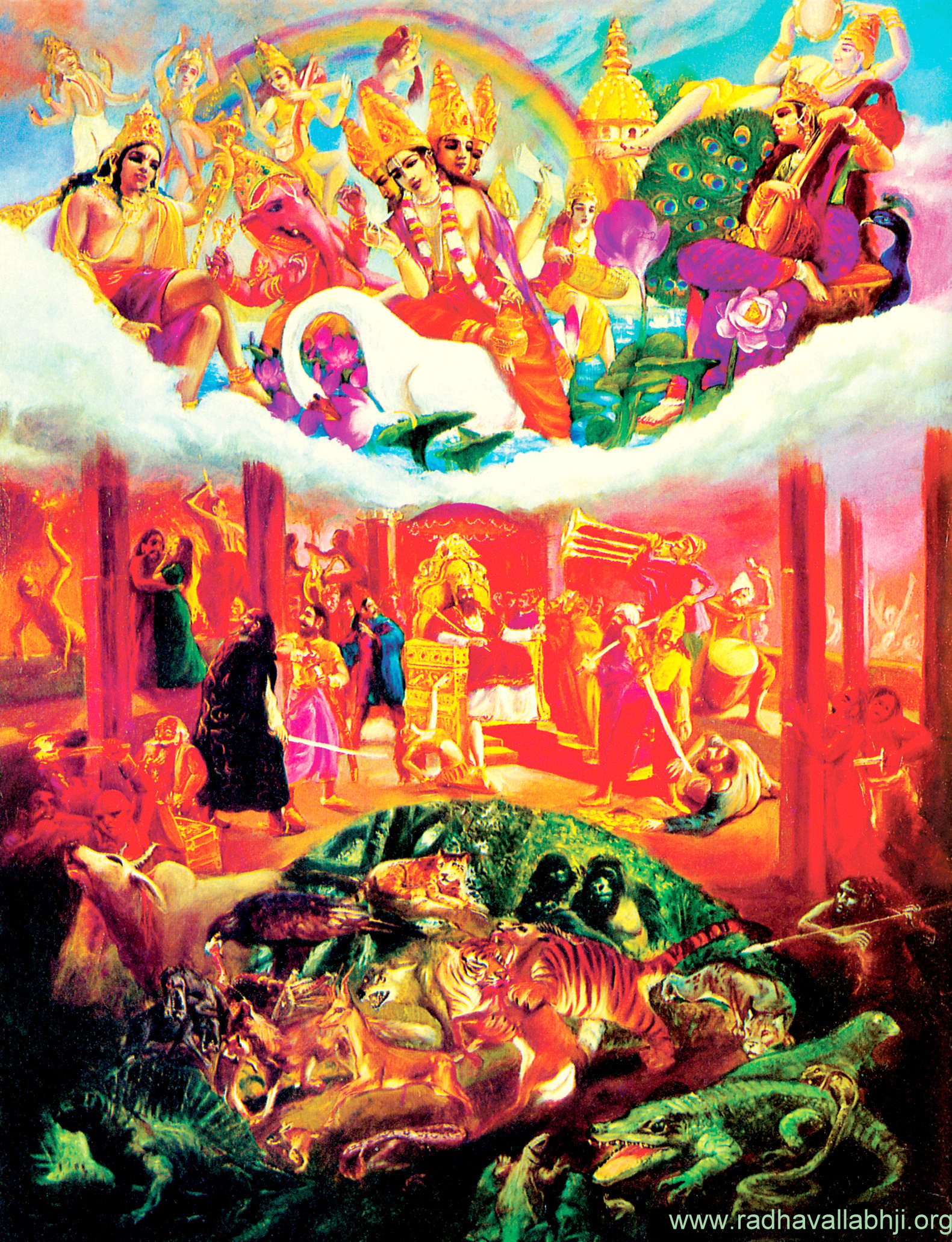
It is accepted in the Vedas and in Bhagavad-gita that the Supreme Lord creates by looking over the prakrti. The Lord glanced over the prakrti, or nature, and impregnated it with atomic individual souls (jivatmas). Because prakrti (material nature) is dull and inert, it can’t actually be the cause of the material world. Rather, the Lord mercifully infuses the dull, inert material nature with his energy. As a result, the prakrti becomes the secondary cause, just as iron becomes red-hot by the energy of fire. In this way, the material nature is always working under the direction of the Lord, producing all moving and unmoving beings. All varieties of living entities – the aquatics, plants, trees, insects, birds, animals, human beings and demigods – come from the original source. Prakrti is the mother, and the Supreme Personality of Godhead is the father. Material nature has no power to create without the power of the Lord (the purusa), just as a prakrti, or woman, cannot produce a child without the connection of a purusa, or man. The purusa impregnates, and the prakrti delivers.

“The purusa, after creating innumerable universes in the mahat-tattva, entered in each of them as the second purusa, Garbhodakasayi Visnu. When He saw that within the universe there was only darkness and space, without a resting place, He filled half of the universe with water from His own perspiration and laid Himself down on the same water. This water is called Garbhodaka. Then from His navel the stem of the lotus flower sprouted, and on the flower petals the birth of Brahma, or the master engineer of the universal plan, took place. Brahma became the engineer of the universe, and the Lord Himself took charge of the maintenance of the universe as Visnu. Brahma was generated from rajo-guna of prakrti, or the mode of passion in nature, and Visnu became the Lord of the mode of goodness. Visnu, being transcendental to all the modes, is always aloof from materialistic affection. This has already been explained. From Brahma there is Rudra (Siva), who is in charge of the mode of ignorance or darkness. He destroys the whole creation by the will of the Lord. Therefore all three, namely Brahma, Visnu and Siva, are incarnations of the Garbhodakasayi Visnu. From Brahma the other demigods like Daksa, Marici, Manu and many others become incarnated to generate living entities within the universe. This Garbhodakasayi Visnu is glorified in the Vedas in the hymns of Garbha-stuti, which begin with the description of the Lord as having thousands of heads, etc. The Garbhodakasayi Visnu is the Lord of the universe, and although He appears to be lying within the universe, He is always transcendental. This also has already been explained. The Visnu who is the plenary portion of the Garbhodakasayi Visnu is the Supersoul of the universal life, and He is known as the maintainer of the universe or Ksirodakasayi Visnu. So the three features of the original purusa are thus understood. And all the incarnations within the universe are emanations from this Ksirodakasayi Visnu.”

Srimad-Bhagavatam 1:3:5 Purport

“There is one Supreme Person who is the progenitor of this cosmic manifestation and whose energy acts as prakrti, or the material nature, dazzling like a reflection. By such illusory action of prakrti, even dead matter is caused to move by the cooperation of living energy of the Lord, and the material world appears like a dramatic performance to the ignorant eyes. The ignorant person, therefore, may even be a scientist or physiologist in the drama of prakrti, while the sane person knows prakrti as the illusory energy of the Lord. By such a conclusion, as confirmed by the Bhagavad-gita, it is clear that the living entities are also a display of the Lord’s superior energy (para prakrti), just as the material world is a display of the Lord’s inferior energy (apara prakrti). The superior energy of the Lord cannot be as good as the Lord, although there is very little difference between the energy and the possessor of the energy, or the fire and the heat. Fire is possessed of heat, but heat is not fire. This simple thing is not understood by the man with a poor fund of knowledge who falsely claims that the fire and heat are the same. This energy of the fire (namely heat) is explained here as a reflection, and not directly fire. Therefore the living energy represented by the living entities is the reflection of the Lord, and never the Lord Himself. Being the reflection of the Lord, the existence of the living entity is dependent on the Supreme Lord, who is the original light. This material energy may be compared to darkness, as actually it is darkness, and the activities of the living entities in the darkness are reflections of the original light. The Lord should be understood by the context of this verse. Nondependence of both the energies of the Lord is explained as maya, or illusion. No one can make a solution of the darkness of ignorance simply by the reflection of light. Similarly, no one can come out of material existence simply by the reflected light of the common man; one has to receive the light from the original light itself.”

Srimad-Bhagavatam 2:9:34 Purport


“Jai Shri RadheKrishna”

The Eight Topmost Varistha Gopis

varistha

Lalita-devi

Of the varistha gopis, Lalita is the most important, being the leader and controller. She and the other eight principal gopis, the other gopis and the manjari have forms that are for the most part like the transcendental form of Srimati Radharani, the queen of Vrndavana.

Lalita is famous as Srimati Radharani’s constant companion. Her complexion is like the yellow pigment gorocana and her garments are like peacock feathers. Her mother is Saradi-devi and her father is Visoka. Her husband is named Bhairava. He is a close friend of Govardhana-gopa. Her age is 14 years, 8 months and 27 days. Her home is in Yavata and her nature is vama-prakhara. In gaura-lila, she has assumed the form of Sri Svarupa Damodara Gosvami.

The beauty of all the other gopis appears to be conserved in the form of Lalita-devi. She is contrary and hot-tempered by nature. In an argument, her mouth becomes bent with ferocious anger and she expertly speaks the most outrageous and arrogant replies. When the arrogant gopis pick a quarrel with Krsna, she is at the forefront of the conflict. When Radha and Krsna meet, she audaciously remains standing a little away from them.

Lalita-devi is full of ecstatic love for the Divine Couple. She is expert at arranging both Their meetings and Their conjugal struggles. Sometimes, for Radha’s sake, she offends Lord Madhava. With the help of Purnamasi-devi and the other gopis Lalita arranges for the meetings of Radha and Krsna. She carries the parasol for the Divine Couple, she decorates Them with flowers, and she decorates the cottage where They rest at night and rise in the morning.

On the northern petal of Ananga-sukhada Kunja, there is a beautiful kunja covered with various kinds of flowers and trees. This place is known as Lalitanandada Kunja and it is the color of lightning. The lovely Lalita Sakhi always lives here. She has a beautiful bright yellow (gorocana) complexion and wears a dress the color of peacock feathers. She is adorned with celestial ornaments and personifies the type of bhava known as khandita. She and Sri Krsna are very, very dear to each other and her seva is to bring camphor and tambula to Him.

The chief sakhis in Lalita’s group are Ratnarekha (Ratnaprabha), Ratikala, Subhadra, Candrarekhika (Bhadrarekhika), Sumukhi, Dhanistha, Kalahamsi and Kalapini.


Visakha-devi

Visakha is the second most important of the eight varistha-gopis. Her attributes, activities and resolve are all much like those of her friend Lalita. Visakha was born at the exact same moment as her dear friend, Srimati Radharani, appeared in this world. Visakha’s garments are decorated with stars and her complexion is like lightning, being cream-colored with a tinge of red (gaurangi). She is 14 years, 2 months and 15 days in age. Her father is Pavana, the son of the sister of Mukhara-gopi, and her mother is Daksina-devi, the daughter of the sister of Jatila. Her husband is Bahuka (Vahika-gopa). Her residence is cloudlike in color. She appears in gaura-lila as Sri Ramananda Raya.

Visakha-devi is the intimate friend of the Divine Couple. Although she is more exalted than the younger gopis (the gopi messengers lead by Vrnda devi), she also takes up the work of carrying messages between Radha and Krsna and she is the most intelligent and expert of all the gopi messengers. Loquacious Visakha is expert at joking with Lord Govinda, and she is the perfect counsellor of the Divine Couple. Being expert at all aspects of amorous diplomacy, she knows all the arts of how to conciliate an angered lover, how to bribe him, and how to quarrel with him.

Visakha is very dear to Sri Krsna and has the bhava known as svadhina-bhartrka. Her seva is dressing and decorating. In Sri Visakha’s yutha the chief sakhis are Malati, Madhavi, Candrarekha, Subhanana, Kunjari, Harini, Surabhi and Capala.


Campakalata (Campakamallika)

Campakalata is the third of the varistha-gopis. Her complexion is the color of a blossoming yellow campaka flower and her garments are the color of a blue-jay’s. She is one day younger than Srimati Radharani, and her age is 14 years, 2 months and 13 1/2 days. Her father is Arama, her mother is Vatika-devi and her husband is Candaksa. Her qualities are much like those of Visakha. In gaura-lila she appears as Sri Sivananda.

Campakalata veils her activities in great secrecy. She is expert at the art of logical persuasion, and she is a skilled diplomat who knows how to thwart Srimati Radharani’s rivals.

Campakalata is expert at collecting fruits, flowers, and roots from the forest. Of all the gopis who are appointed as protectoresses of the trees, creepers, and bushes of Vrndavana, the leader is Campakalata-devi. She is an expert cook who knows all the literatures describing the six flavors of gourmet cooking. She is so expert at making various kinds of candy that she has become famous by the name Mistahasta (sweet hands). Using only the skill of her hands, she can artistically fashion things from clay.

On the southern petal of Madana-sukhada Kunja lies Kamalata Kunja, the home of Sri Krsna’s beloved Sri Campakalata. This extremely blissful kunja is the color of molten gold. Campakalata, who loves Krsna very much, personifies the stage of a nayika known as vasaka-sajja. Her nature is vama-madhya, and her seva is to offer jewelled necklaces and to fan with a camara. The chief gopis in Campakalata’s yutha are Kurangaksi, Suracita, Mandali, Manimandana, Candika, Candralatika, Kandukaksi and Sumandira.


Citra-devi

Citra is the fourth of the varistha gopis. Her beautiful saffron complexion resembles the color of kunkuma, and her garments are the color of crystal. She is 26 days younger than Srimati Radharani, being 14 years, 7 months and 14 days of age. Her father is Catura, the paternal uncle of Suryamitra. Her mother is Carcika-devi and her husband is Pithara. She is an adhika-mrdvinayika, and her home is in Yavata. In gaura-lila she appears as Sri Govindananda.

She and Sri Krsna are very affectionate toward each other, and she is very devoted to her seva of bringing cloves and garlands. She is especially expert in the lover’s quarrel between Radha and Krsna (the third of the six definitions of the word abhisarana). When Lord Madhava is full of bliss, she becomes satisfied.

Citra-devi can read between the lines of books and letters written in many different languages, perceiving the hidden intentions of the author. She is a skilled gourmet and can understand the tastes of various foods made with honey, milk, and other ingredients simply by glancing at them. She can nicely make various kinds of nectarean beverages. (There are also eight other gopi maidservants, headed by Rasalika-devi, who are expert at making various nectarean beverages.)

Citra-devi is expert in playing music on pots filled with varying degrees of water. She is learned in the literature describing astronomy and astrology, and she is well versed in the theoretical and practical activities of protecting domestic animals. She is especially expert at gardening. There are other gopis who mostly collect transcendental herbs and medicinal creepers from the forest and do not collect flowers or anything else. Citra-devi is the leader of these gopis. The chief gopis in Sri Citra’s yutha are Rasalika, Tilakini, Saurasen, Sugandhika, Vamani, Vamanayana, Nagari and Nagavallika.


Tungavidya

Tungavidya is the fifth of the varistha gopis. Her complexion is the color of kunkuma and the fragrance of her body is like sandalwood mixed with camphor. Her dress is pandu-mandana (pale yellow). She is fifteen days younger than Srimati Radharani, and her age is 14 years, 2 months and 22 days. She wears white garments. Her parents are Puskara and Medha-devi and her husband is Balisa. On the western petal of Madana-sukhada Kunja lies the extremely beautiful crimson-colored Tungavidyanandada Kunja, where Sri Tungavidya Sakhi always resides. In gaura-lila she appears as Sri Vakresvara Pandita.

She loves Sri Krsna very much and, filled with eagerness for that prema, she exhibits the bhava known as vipralabdhatva. She is very devoted to her seva of dancing and singing, and is a celebrated music teacher who is expert at playing the vina and singing in the style known as marga. She has full faith in Krsna. She is very expert at arranging the meetings of the Divine Couple. She is learned in rasa-sastra (transcendental mellows), is learned in the eighteen branches of knowledge, in niti-sastra (morality), dancing, drama, literature and all other arts and sciences.

Being hot-tempered and expert at dissimulation, Tungavidya is one of the leaders of the gopis. Some of the sakhis in Tungavidya’s yutha are Manjumedha, Sumadhura, Sumadhya, Madhureksana, Tanu madhya, Madhusyanda, Gunacuda and Varangada. These gopis are the best of dancers. They are musicians expert at playing the mrdanga and singing in recital halls. They are especially engaged in fetching water from the streams in Vrndavana. Eight gopi messengers headed by Manjumedha-devi are especially expect at arranging political alliances (sandhi) the first of diplomatic maneuvers in the art of politics between Radha and Krsna.


Indulekha

Indulekha is the sixth of the varistha gopis. She has a lemon-yellow (tan) complexion and wears garments the color of a pomegranate flower. She is three days younger than Srimati Radharani, being 14 years, 2 months and 10 1/2 days of age. Her parents are Sagara and Vela-devi and her husband is Durbala. On the southeastern petal of Madana-sukhada Kunja lies the golden-colored Purnendu Kunja, where Sri Indulekha lives. In gaura-lila she appears as Vasu Ramananda.

Indulekha-devi has a deep love for Sri Krsna and possesses the prosita-bhartrka-bhava. She often serves Krsna by bringing Him nectar-like delicious meals. She is vama-prakhara and her principal seva is fanning with a camara.

Indulekha is contrary and hot-tempered by nature. She is learned in the science and mantras of the Naga-sastra, which describes various methods of charming snakes. She is also learned in the Samudraka-sastra, which describes the science of palmistry. She is expert at stringing various kinds of wonderful necklaces, decorating the teeth with red substances, gemology and weaving various kinds of cloth.

In her hand she carries the auspicious messages of the Divine Couple. In this way she creates the good fortune of Radha and Krsna by creating Their mutual love and attraction. Indulekha-devi is fully aware of the confidential secrets of the Divine Couple. Some of her friends are engaged in providing ornaments for the Divine Couple, others provide exquisite garments, and others guard their treasury.

In Sri Indulekha’s yutha the chief gopis are Tungabhadra, Citralekha, Surangi, Rangavatika, Mangala, Suvicitrangi, Modini and Madana. The group of gopis headed by Tungabhadra-devi are the friends and neighours of Indulekha. Among these gopis is a group, headed by Palindhika-devi, which acts as messengers for the Divine Couple.
Rangadevi

Rangadevi is the seventh of the varistha gopis. Her complexion is the color of a lotus filament and her garments are red like a jaba flower. She is seven days younger than Srimati Radharani, and is 14 years, 2 months and 4 1/2 days of age. Her parents are Karuna-devi and Rangasara, and her husband is Vakreksana.

On the southwest petal of Madana-sukhada Kunja lies the dark blue, cloudlike Sukhada Kunja, where Sri Krsna’s beloved Sri Rangadevi always resides. She possesses the utkanthita-bhava, and in every way she is very attached to Sri Krsna. Her seva is offering candana, and her nature is vama-madhya. In Kali-yuga she appears in gaura-lila as Govindananda Ghosa.

Rangadevi’s personal qualities are much like those of Campakalata. She is always like a great ocean of coquettish words and gestures. She is very fond of joking with her friend Srimati Radharani in the presence of Lord Krishna.

Among the six activities of diplomacy she is especially expert in the fourth: patiently waiting for the enemy to make the next move. She is an expert logician and because of previous austerities she has attained a mantra by which she can attract Lord Krsna.

The chief gopis in Sri Rangadevi’s yutha are Kalakanthi, Sasikala, Kamala, Prema Manjari, Madhavi, Madhura, Kamalata and Kandarpa-sundari. Kalakanti-devi is the leader of the eight most important friends of Ranga-devi. These friends are all expert in the use of perfumes and cosmetics and burning aromatic incense, carrying coal during the winter and fanning the Divine Couple in the summer. Ranga-devi’s friends are able to control the lions, deer and other wild animals in the forest.
Sudevi

Sudevi is the eighth of the varistha gopis. She is sweet and charming by nature. She is the sister of Rangadevi. Her husband is Vakreksana, the younger brother of Bhairava. Her marriage with Vakreksana was arranged by his younger brother. Her form and other qualities are so similar to those of her sister Rangadevi that they are often mistaken for one another. Like Rangadevi, she has a complexion the color of a lotus stamen and wears a dress the color of a red jaba flower. Being slightly older than her sister, her age is 14 years, 2 months and 4 days. On the northwest petal of Madanananda Kunja lies the beautiful emerald-colored Vasanta-sukhada Kunja, the residence of Sri Sudevi. In gaura-lila she appeared as Sri Vasudeva Ghosa.

She is very loving toward Sri Hari, and possesses the bhava known as kalahantarita. Her seva is to bring water. Sudevi always remains at the side of her dear friend Srimati Radharani, and arranges Radharani’s hair, decorates Her eyes with mascara, and massages Her body.

She is expert in training male and female parrots and she is also expert in the pastimes of roosters. She is an expert sailor and she is fully aware of the auspicious and inauspicious omens described in the Sakuna-sastra. She is expert at massaging the body with scented oils, she knows how to start fires and keep them burning and she knows which flowers blossom with the rising of the moon.

The principal gopis in Sri Sudevi’s yutha are Kaveri, Carukavari, Sukesi, Manjukesika, Harahira, Harakanthi, Haravalli and Manohara. Kaveri-devi and the other friends of Sudevi are expert at constructing leaf-spitoons, playing music on bells and decorating couches in various ways. Sudevi’s friends are also entrusted with the decoration of the Divine Couple’s sitting place. Sudevi’s friends act as clever spies, disguising themselves in various ways and moving among Radharani’s rivals (Candravali and her friends) to discover their secrets. Sudevi’s friends are the deities of Vrndavana forest and they are charged with the protection of the forest birds and bees.