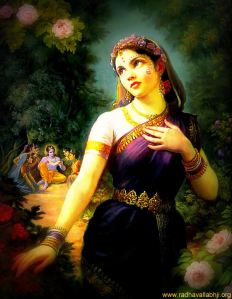
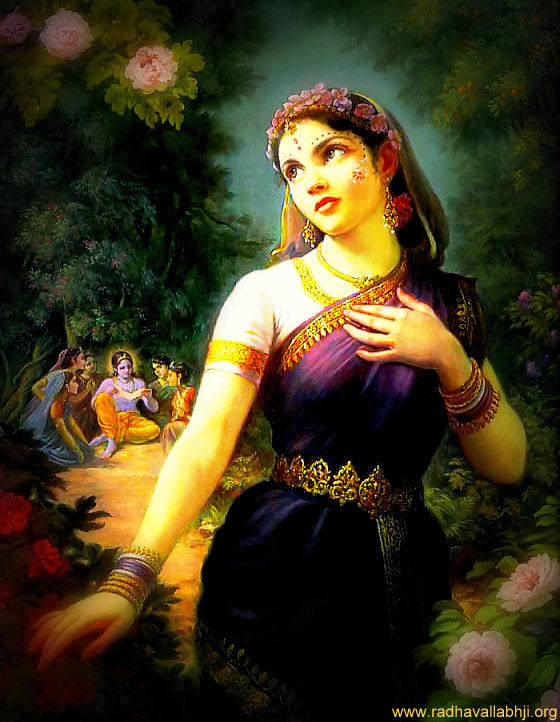
Among all the beautiful gopis Srimati Radharani is the best. Radharani is the queen of Vrndavana. She has many famous friends, headed by Lalita and Visakha.
Sri Krsna, the cowherd prince whose charming sweetness has no equal or superior, is very dear to Srimati Radharani. She considers Him millions and millions of times more dear than Her own life’s breath.
Now the beauty of Srimati Radharani’s trancendental form will be described. Srimati Radharani is expert in all the fine arts and Her transcendental form is like an ocean of nectar. Her splendid bodily luster is like the yellow pigment gorocana, molten gold, or stationary lightning. She wears wonderfully beautiful blue garments and She is decorated with various pearls and flowers.
She is very beautiful and She has long nicely braided hair. She is decorated with a garland of flowers and a beautiful pearl necklace. Her splendid forehead is decorated with the red pigment sindura and with beautiful locks of curling hair.
Decorated with blue bangles, Her arms have defeated Cupid’s staff with their beauty. Decorated with black mascara and reaching back almost to Her ears, Srimati Radharani’s lotus eyes are the most beautiful in all the three planetary systems. Her nose is as beautiful as a sesame flower and it is nicely decorated with a pearl. She is anointed with various perfumes. She is splendidly beautiful.
Her ears are decorated with wonderful earrings and Her nectarean lips defeat the red lotus flowers. Her teeth are like a row of pearls and Her tongue is very beautiful. Decorated with a nectarean smile of pure love for Krsna, Her beautiful face is a splendid as millions of moons.
The beauty of Her chin has defeated and bewildered the demigod Cupid. Decorated with a drop of musk, Her chin appears like a golden lotus flower with a bumblebee. Bearing all the marks of wonderful beauty, Her neck is decorated with a string of pearls. Her neck, back and sides are enchantingly beautiful.
Her beautiful breasts are like two splendid waterpots covered with a bodice and decorated with a necklace of pearls. Her beautiful enchanting arms are decorated with jeweled armlets. Her arms are also decorated with jeweled bracelets and other kinds of jeweled ornaments. Her hands are like two red lotus flowers illuminated by the series of moons that are Her fingernails
Srimati Radharani’s hands are decorated with many auspicious markings such as the signs of the bumblebee, lotus, crescent moon, earring, parasol, sacrificial post, conchshell, tree, flower, camara and svastika. These auspicious marks are manifest in various ways on Srimati Radharani’s lotus hands. Her splendidly beautiful fingers are also decorated with jeweled rings.
Charming, full of sweet nectar and decorated with a deep navel, Srimati Radharani’s beautiful waist enchants the three worlds. Her sloping hips lead to Her charmingly beautiful slender waist, which is bound by a creeper of three beautiful folds of skin and decorated with a sash of tinkling bells.
As beautiful as two exquisite plantain trees, Her thighs enchant the mind of Cupid. Her beautiful knees are like two reservoirs filled with the nectar of various transcendental pastimes. Her beautiful lotus feet are decorated with jeweled ankle-bells and Her toes with toe rings as beautiful as the treasure of Varuna. The auspicious markings on Srimati Radharani’s lotus feet include the signs of the conchshell, moon, elephant, barleycorn, rod for controlling elephants, chariot flag, small drum, svastika and fish.
Srimati Radharani is fifteen years old and full of the luster of youth.
Yasoda-devi, the queen of the cowherds, is more affectionate to Radharani than millions of mothers can be. Radharani’s father is King Vrsabhanu, who is as splendid as the sun.
Srimati Radharani’s mother is Kirtida-devi, who is also known in this world as Ratnagarbha-devi. Radharani’s paternal grandfather is Mahibhanu and Her maternal grandfather is Indu.
Her maternal grandmother is Mukhara-devi and Her paternal grandmother is Sukhada-devi. Her father’s brothers (Her uncles) are Ratnabhanu, Subhanu and Bhanu.
Bhadrakirti, Mahakirti and Kirticandra are Radharani’s materal uncles. Menaka-devi, Sasthi-devi, Gauri-devi, Dhatri-devi and Dhataki-devi are Radharani’s materal aunts.
Radharani’s mother’s sister is Kirtimati-devi, whose husband is Kasa. Radharani’s father’s sister is Bhanumudra-devi, whose husband is Kusa.
Radharani’s elder brother is Sridama and Her younger sister is Ananga-manjari. Radharani’s father-in-law isVrkagopa and Her brother-in-law is Durmada.
Jatila-devi is Radharani’s mother-in-law and Abhimanyu is Radharani’s so-called husband. Kutila-devi, who is always eager to find fault, is Radharani’s sister-in-law.
Lalita, Visakha, Sucitra, Campakalata, Ranga-devi, Sudevi, Tungavidya and Indulekha are the eight dearest friends of Srimati Radharani. These gopis are considered the leaders of all the others.
Kurangaksi, Mandali, Mankiundala, Matali, Candralalita, Madhavi, Madanalasa, Manjumedha, Sasikala, Sumadhya, Madhureksana, Kamala, Kamalatika, Gunacuda, Varangada, Madhuri, Candrika, Prema-manjari, Tanumadhyama, Kandarpa-sundari and Manjukesi are among the millions of dear friends (priya-sakhi) of Srimati Radharani.
Lasika, Kelikandali, Kadambari, Sasimukhi, Candrarekha, Priyamvada, Madonmada, Madhumati, Vasanti, Kalabhasini, Ratnavali, Manimati and Karpuralatika are among those friends (jivita-sakhi) for whom Srimati Radharani is as dear as life.
Kasturi, Manojna, Manimanjari, Sindura, Candanavati, Kaumudi and Madira are among Sriamti Radharani’s eternal friends (nitya-sakhi).
Ananga-manjari, Rupa-manjari, Rati-manjari, Lavanga-manjari, Raga-manjari, Rasa-manjari, Vilasa-manjari, Prema-manjari, Mani-manjari, Suvarna-manjari, Kama-manjari, Ratna-manjari, Kasturi-manjari, Gandha-manjari, Netra-manjari, Sripadma-manjari, Lila-manjari and Hema-manjari are among Srimati Radharani’s manjari friends. Prema-manjari and Rati-manjari are both also known by the name Bhanumati-devi.
Srimati Radharani’s worshipable deity is the sun-god, who enlivens the lotus flowers and acts as an eye for the entire world. Srimati Radharani’s maha-mantra is the name of Lord Krsna. Srimati Radharani’s benefactor, who brings Her all good fortune, is Bhagavati Paurnamasi.
In Radharani’s garden is a vine of golden jasmine flowers that She has named Tadidvalli (“the vine of lightning”). Her private lake bears Her own name (Radha-kunda) and on the shore of that lake is a kadamba tree that is the site of very confidential talks between Her and Lord Krsna.
Her favorite ragas are mallara and dhanasri and Her favorite dances are chalikya and rudravallaki.
Srimati Radharani’s glorious birth occured on the eighth day of the bright moon in the month of Bhadra. Although generally not full on that day, the moon appeared full to celebrate Radharani’s appearance in this world. (SSRKGD)
Sri Caitanya Mahaprabhu is Sri Krsna, the Supreme Personality of Godhead. It is therefore said, sri-krsna-caitanya, radha-krsna nahe anya: “Two personalities–Srimati Radharani and Sri Krsna–are combined in the incarnation of Sri Caitanya Mahaprabhu.” (CC Madhya 5.142-143p)
In Brhad-gautamiyatantra it is said: Sri Radha is known as Devi, Krsnamayi, Supreme Goddess in whom all Laksmis reside; Her beauty and charm defeat that of all others.
In a supplement to the Rg-veda it is said: Among all people, Radhika and Madhava together are the most beautiful. In the Matsya-purana: In Varanasi, She is known as Sri Visalaksi, and in Purusottama-ksetra, She is called Sri Vimala. In Dvaraka, She is Sri Rukmini, and as the queen of the Vrndavana forest, She is called Sri Radha.
In the Ujjvala-nilamani, a statement taken from the Padma-purana says: Just as Sri Radha is the most beloved of Sri Krsna, similarly Sri Radha-kunda is also very dear. Among all the gopis, Sri Radha is the dearest lover of Sri Krsna.
In the Radha-prakarana of Ujjvala-nilamani it is said: Sri Radhika’s body is composed of maha-bhava. The greatest of all saktis is the hladini-sakti. Therefore it is called maha-sakti. Of that, the essence is madana, which is the zenith of maha-bhava. Sri Radha is the embodiment of that highest maha-bhava. This conclusion is well established.
In the Gopalottara-tapani, She is glorified as Gandharva. This daughter of Vrsabhanu has a very beautiful form and wears 16 items of beautification (srngara) and 12 types of ornaments (abharana).
An example concerning Her beautiful form is given in Ujjvala-nîlamani, wherein Sri Krsna says, “O Radhe! The locks of Your hair curl beautifully, and You have a lotus-like face with elongated restless eyes. Your chest is adorned with lovely large and firm breasts. Your waist is attractively slender, Your head is bowed slightly in modesty, and Your fingernails are like rows of jewels. Your beautiful form is a festival of elegance and sweetness that crushes the vanity of the three worlds.”
Concerning Her sixteen items of beautification, Subala says to Sri Krsna, “After bathing, Sri Radhika decorates the tip of Her nose with an effulgent jewel. She dresses in blue clothing, with a sash (nivibandhana) around Her waist. Her hair is plaited and She wears ornaments on Her ears. Her limbs are smeared with camphor, musk and sandal paste. She wears flowers in Her hair and a garland around Her neck. In Her hand She playfully carries a lotus flower. In Her mouth She has tambula, and on Her chin a dot of musk. She wears kajjala around Her eyes and on Her cheeks are muskpaintings of dolphins, etc. The bottoms of Her lotus feet are painted red and She wears tilaka on Her forehead.”
Concerning Her twelve ornaments, Subala says, “Sri Radhika wears a diamond on Her head, golden earrings on Her ears, and tiny golden bells around Her hips. A golden locket hangs around Her neck. She wears a cakri-salaka (an elaborate ornament that encircles the entire ear and fastens at the top) over Her ears, bangles on Her hands, and a necklace around Her throat. There are rings on Her fingers and a group of star-like necklaces on Her bosom. She is adorned with jewelled armlets, jewelled ankle bells and radiant toe rings. She is very beautiful wearing these twelveornaments.”
Sri Radha’s age is in the middle of the kaisora period. Just as previously, Krsna’s age was increased by half again, so Radha’s age is increased to 14 years, 2 months and 15 days. She has a strong feeling that Krsna belongs to Her (madiyata-bhava), as well as madhu-sneha (a very sweet affectionate mood). Her love for Krsna is pure, powerful and lasting, and She has various kunjas for Her pastimes with Him. Her home is in Yavatagrama, Her mother’s name is Kirtida, and Her father’s Vrsabhanu. Her husband’s name is Abhimanyu, Durmukha is Her brother-in-law,Jatila is Her mother-inlaw, and Kutila is Her sister-in-law. Just as Sri Krsna always exists as the nayaka (heroiclover), Sri Radhika is forever the principal nayika (heroine).
Sri Radha’s sakhis are of five types: sakhi, nitya-sakhi, prana-sakhi, priya-sakhi, and parama-prestha-sakhi.Kusumika, Vindhya, Dhanistha and others are known as sakhis. Kasturika, Mani Manjari, etc., are known asnitya-sakhis. Sasimukhi, Vasanti, Lasika, etc., are known as prana-sakhis. These gopis usually have forms (or natures) similar to Sri Radha. Kurangaksi, Sumadhya, Madanalasa, Kamala, Madhuri, Manjukesi,Kandarpasundari, Madhavi, Malati, Kamalata and Sasikala, etc., are priya-sakhis. Lalita, Visakha, Citra,Campakalata, Tungavidya, Indulekha, Rangadevi and Sudevi are the parama-prestha-sakhis. These eightgopis are chief amongst them all. They are worthy of being yuthesvaris (group leaders) themselves, but because they love Radha so much, they would rather be Her sakhis.
Source: http://www.vrindavan.de/radha.htm
“Jai Shri RadheKrishna”

 Self Discovery
You must be logged in to post a comment.