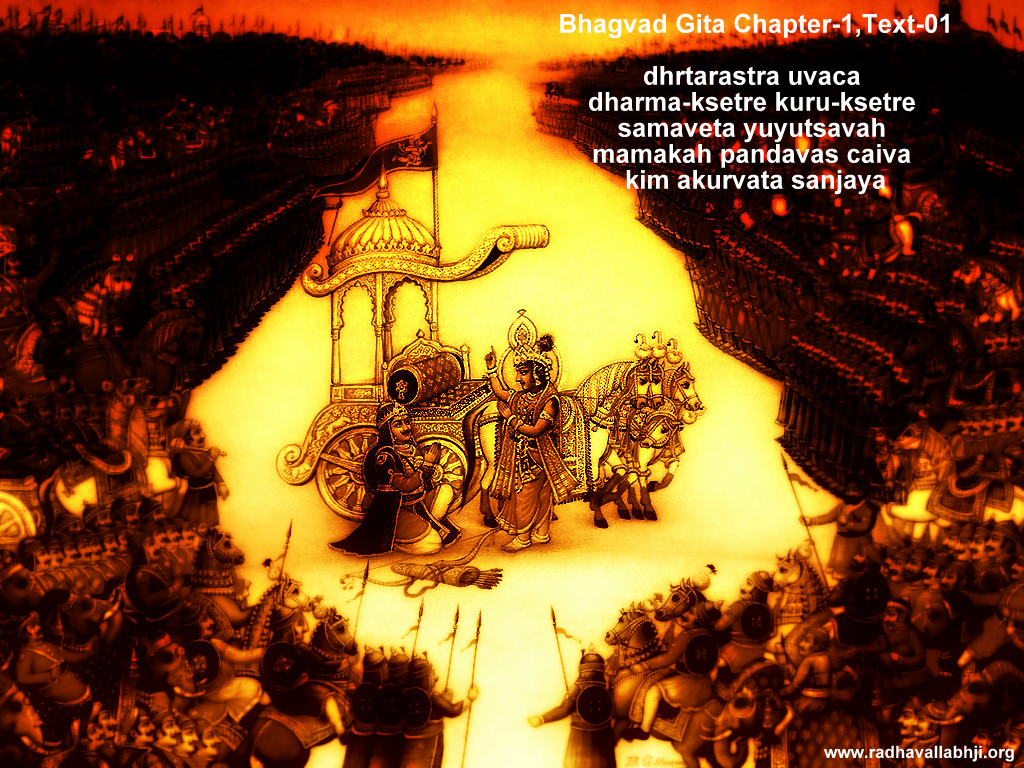
Bhagavad Gita : Ch-1, Verse-1: Lamenting the Consequence of War

Ch-1 Tx-1

Bhagavad-gita is the widely read theistic science summarized in theGita-mahatmya (Glorification of the Gita). There it says that one should read Bhagavad-gita very scrutinizingly with the help of a person who is a devotee of Sri Krsna and try to understand it without personally motivated interpretations. The example of clear understanding is there in the Bhagavad-gita itself, in the way the teaching is understood by Arjuna, who heard the Gita directly from the Lord. If someone is fortunate enough to understand Bhagavad-gita in that line of disciplic succession, without motivated interpretation, then he surpasses all studies of Vedic wisdom, and all scriptures of the world. One will find in the Bhagavad-gita all that is contained in other scriptures, but the reader will also find things which are not to be found elsewhere. That is the specific standard of the Gita. It is the perfect theistic science because it is directly spoken by the Supreme Personality of Godhead, Lord Sri Krsna.

The topics discussed by Dhrtarastra and Sanjaya, as described in theMahabharata, form the basic principle for this great philosophy. It is understood that this philosophy evolved on the Battlefield of Kuruksetra, which is a sacred place of pilgrimage from the immemorial time of the Vedic age. It was spoken by the Lord when He was present personally on this planet for the guidance of mankind.

The word dharma-ksetra (a place where religious rituals are performed) is significant because, on the Battlefield of Kuruksetra, the Supreme Personality of Godhead was present on the side of Arjuna. Dhrtarastra, the father of the Kurus, was highly doubtful about the possibility of his sons’ ultimate victory. In his doubt, he inquired from his secretary Sanjaya, “What did my sons and the sons of Pandu do?” He was confident that both his sons and the sons of his younger brother Pandu were assembled in that Field of Kuruksetra for a determined engagement of the war. Still, his inquiry is significant. He did not want a compromise between the cousins and brothers, and he wanted to be sure of the fate of his sons on the battlefield. Because the battle was arranged to be fought at Kuruksetra, which is mentioned elsewhere in the Vedas as a place of worship–even for the denizens of heaven–Dhrtarastra became very fearful about the influence of the holy place on the outcome of the battle. He knew very well that this would influence Arjuna and the sons of Pandu favorably, because by nature they were all virtuous. Sanjaya was a student of Vyasa, and therefore, by the mercy of Vyasa, Sanjaya was able to envision the Battlefield of Kuruksetra even while he was in the room of Dhrtarastra. And so, Dhrtarastra asked him about the situation on the battlefield.

Both the Pandavas and the sons of Dhrtarastra belong to the same family, but Dhrtarastra’s mind is disclosed herein. He deliberately claimed only his sons as Kurus, and he separated the sons of Pandu from the family heritage. One can thus understand the specific position of Dhrtarastra in his relationship with his nephews, the sons of Pandu. As in the paddy field the unnecessary plants are taken out, so it is expected from the very beginning of these topics that in the religious field of Kuruksetra where the father of religion, Sri Krsna, was present, the unwanted plants like Dhrtarastra’s son Duryodhana and others would be wiped out and the thoroughly religious persons, headed by Yudhisthira, would be established by the Lord. This is the significance of the words dharma-ksetre and kuru-ksetre, apart from their historical and Vedic importance.

“Jai Shri RadheKrishna”
Ananda Ekadashi in Krishna Paksha

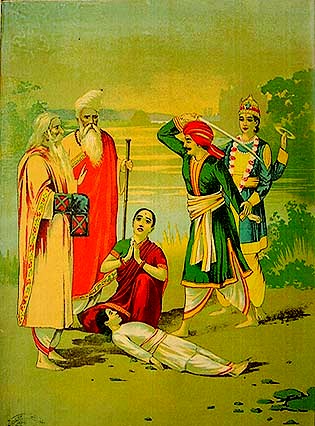
HarishchandraSri Yudhisthira Maharaja said, “Oh Janardana, protector of all living entities, please tell me the name of the Ekadashi that occurs during the dark fortnight of the month of Bhadrapada (August-September).”

The Supreme Lord, Sri Krishna, then replied, “Oh King, hear me attentively. The name of this sin-removing, sacred Ekadashi is Aja. Any person, who fasts completely on this day and worships Hrishikesha, the master of the senses, becomes free of all reactions to his sins. Even one who simply hears about this Ekadashi is freed from his past sins. Oh King, there is no better day than this in all the earthly and heavenly worlds.

There once lived a king named Harishchandra, who was a person of great truth and integrity. His wife’s name was Chandramati, and he had a son named Lohitashva. By the force of destiny, however, Harishchandra lost his great kingdom and sold his wife and son. The pious king himself became a menial servant of a dog-eater, who made him guard a crematorium. Yet even while doing such menial service, he did not forsake his truthfulness and good character.

Then one day he sadly thought, ‘What shall I do? Where shall I go? How can I be delivered from this plight?’ In this way he drowned in an ocean of anxiety and sorrow. One day a great sage happened by, and when the king saw him, he paid his respectful obeisances to the sage, whose name was Gautama Muni. With joined palms the king stood before Gautama Muni and narrated his pitiful story. Gautama Muni was astonished to hear the king’s tale of woe. He thought, ‘How has this mighty king been reduced to collecting clothes from the dead?’ Gautama Muni became very much compassionate toward Harishchandra and instructed him on the process of fasting for purification.

Gautama Muni said, ‘Oh king, during the dark fortnight of the month of Bhadrapada there occurs an especially meritorious Ekadashi named Aja (Annada), which removes all sins. Indeed, this Ekadashi is so auspicious that if you simply fast on that day and perform no other austerity, all your sins will be nullified. By your good fortune it is coming in just seven days. So I urge you to fast on this day and remain awake through the night. If you do so, all the reactions of your past sins will come to an end. Oh Harishchandra, I have come here because of your past pious deeds. Now, all good fortune to you in the future!’

King Harishchandra followed Gautama Muni’s instructions concerning fasting on the sacred day of Aja Ekadashi. Oh Maharaja Yudhisthira, because the king fasted on that day, the reactions to his previous sins were completely destroyed at once. Just see the influence of this Ekadashi fast! It immediately vanquishes whatever miseries one may be suffering as a result of past karmic sinful activities.

Thus all Harishchandra’s miseries were relieved. Just by the power of this wonderful Ekadashi, he was reunited with his wife and son, who had died but were now revived. By the blessings of the Ekadashi fast, he regained his kingdom without difficulty. Moreover, when King Harishchandra left the planet, his relatives and all his subjects too, went with him to the spiritual world.

Whoever fasts on Aja Ekadashi is surely freed from all his sins and ascends to the spiritual world. And whosoever hears and studies the glories of this Ekadashi achieves the merit gained by performing a horse sacrifice.”

Thus ends the narration of the glories of Bhadrapada-krishna Ekadashi, or Aja Ekadashi, from the Brahma-vaivarta Purana.

“Jai Shri RadheKrishna”

Radha , Krishna and Uddhava

Uddhava

Uddhava, the apprentice of Krishna, one day expressed his dissatisfaction to Krishna that in-spite of studying all Vedas ,Upnishadas and Sutras, he still was not recipient of the title “Maha-Rishi”, meaning the great sage. He indirectly suggested that Krishna should use his weight in the council of wise men to honor Uddhava  the title.

Krishna sensed the ego and pride of Uddhava. He smiled and asked Uddhava if he thought his study was complete. Uddhava answered a confident yes. Krishna did not say anything. He just told Uddhava to come and see him the next day.

The next day Krishna asked him a for a favor. He asked Uddhava to visit Vrindavan, where Krishna’s soul mate Radha resided, and to give her a message. Uddhava gladly agreed. After all, getting to do a special assignment for no one else but Krishna, the divine one, was an honor. When he was ready to leave, Krishna smiled and waved him goodbye. Uddhava asked about the message and Krishna said he had none.

Uddhava was surprised. He sat in chariot and started on his way, but he could not help wonder what would be Radha’s reaction. He was sure Radha would be very angry at this. He did not want to see a problem in Radha and Krishna’s relationship. So just before he entered Vrindavan, he got a parch-paper and wrote a hi-hello message to Radha and forged to look like it came from Krishna.

On reaching Vrindavan, he did not have problem finding Radha’s house. She gave him a warm welcome. After he settled, he handed over the message, hoping she would not examine the message in too much detail.

For a moment Radha stared at the parch-paper and then she started laughing hysterically. Uddhava was confused. He asked Radha what was the matter. She said the message Krishna wrote was funny. Uddhava pretended surprise and asked what was the message.

“The message says Uddhava’s study is still not complete.” replied Radha.

On listening this, Uddava was stunned.

‘How could she have known this?’ he wondered.

Radha calmed him down.

“I love Krishna and trust Krishna in ways beyond you can imagine.” She said “We are two bodies but same soul. There is nothing to be said in between us. We have walked the path of trust, love, devotion and sacrifices for so long that there are no boundaries in my being and his. He does not need to send me messages. He is my message. He is my love letter from the universe.”

“But Uddhava, you have not learned to trust Krishna. You have not learned to give up your self, your ego, and stop your manipulating mind. You ego stands between you and the truth. Between you and the supreme awakening.”

“Erasing the sense of duality and being one with the universe, being one with the one who beholds universe, is this not the jist of the sacred ancient texts, Uddhava?”

Uddhava was speechless. Within a minute, Radha had explained the the deepest mysteries of life. He just wanted to stand there and listen.

He spent the whole day at her house. She talked about life in layman’s terms of love and truth. But Uddhava found answers to his most profound questions in philosophies he learned all this life.

“How did you get so much knowledge staying in this village and living life doing chores?” He asked.

“Each moment makes you take sides. If you always take side of truth and love, you will gain insights. Each insight awakens you from the illusion and takes you a step closer to the supreme awakening.”

“How can you be in Love with Krishna and still remain free from bonds of life ?”

“There is distinction between the love that results from insecurity and the love that results from faith. The former results in bonds. The later results in freedom. The former gets lost, the later transcends. The former leads to fear of death and abandonment. The later leads to Nirvana, to enlightenment that is death of death, to realization that Radha and Krishna are just ripples and love is like the water, eternal and infinite.”

“How can you get awakened without leaving the society and becoming a monk?”

“Where a man reaches by renouncing the world, a woman reaches by embracing the world in its wholeness.” Said Radha.

“Is there no point in pursuit of knowledge? Then what is the meaning of life?”

“Your ability to give it any meaning, is the meaning of life. ” Ansewred Radha. “And about the pursuits, pursuit of currency is not the same as pursuit of wealth, pursuit of sensation is not pursuit of happiness, pursuit of titles is not pursuit of knowledge. These pursuits are in synergy for some time, and they are at conflict later. You must wake up, and open your eyes.”

Radha’s answers turned all of Uddhavas learning upside down and inside out and presented to him as a paradox, a paradox his doubting mind could never grasp. Uddhava’s ego surrendered. The constant chatter of thoughts at the back of his mind stopped and he saw a totally new world at the same place. An eternal, peaceful world where everything seemed OK.

On his way back to Dwaraka, Uddhava sensed a big change within him. He sang to himself. He offered lift to a sick man. He appreciated the sunset in the Western sky. He did not feel rush to get home and work on getting his title.

Next day he met Krishna. Krishna sensed the change too.

Krishna smiled and said “So let’s talk about your title Maha-rishi.”

“I am not that interested in the title anymore. ” replied Uddhava and bent to touch Krishna’s feet.

Krishna rose from his throne. He hold on to Uddhava’s shoulders and smiled at him.

” Your journey is complete. You have arrived. Uddhava, I bestow you the responsibility of writing down my teaching in simple language for all those who do not have luxury of spending their life trying to be Maha-rishi. You will share the gems of knowledge that do not belong to any title such as Maha-rishi. “

“And for this great contribution to humanity, hereafter you shall be known as Maha-rishi.”

“Jai Shri RadheKrishna”

Story Credit: Kedar Soman