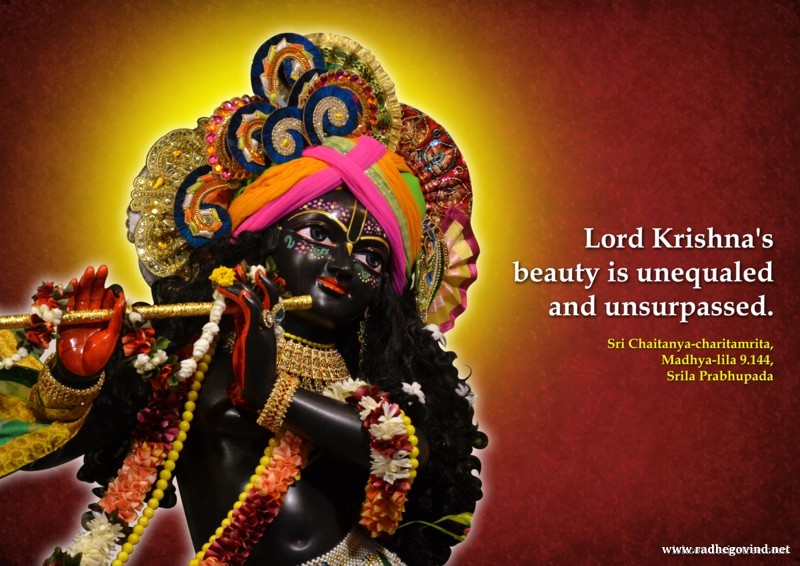
 Lord Krishna’s beauty is described in numerous prayers, poems, and portions of the Vedic literature. So we could provide many verses that describe this aspect of Krishna. An example of this is found when Lord Brahma relates Lord Krishna’s form in the many verses of his Brahma-samhita. He also explains the beauty of Lord Krishna in his prayers that he directly offered to the Lord in the Bhagavatam. He says that Lord Krishna’s body is dark blue like a new cloud. His garments are like brilliant lightning, and the beauty of Krishna’s face is enhanced by His earrings and the peacock feather He wears on His head. He stands beautifully while wearing garlands made from the forest flowers, carrying a herding stick, a buffalo horn, and a flute. (Bhag.10.14.1)
His personal form is so attractive that it is considered the reservoir of all beauty. In fact, all beautiful things emanate from Him. His form is so attractive that it directs one’s attention away from all other objects. Those same objects then seem devoid of attractiveness after seeing Lord Krishna. Thus, He attracts the minds of all people. His words also captivated the minds of all who remembered them. Even seeing His footsteps, people were attracted. Thus, Krishna spreads His glories which are sung everywhere throughout the universe in the most sublime and essential Vedic verses. Lord Krishna says that by hearing and chanting about His glorious pastimes, the conditioned souls within this world could cross the ocean of ignorance. (Bhag.11.1.7)
The attractive nature of God is further described in the Caitanya-caritamrita (Madhya-lila, 17.139-140): “The transcendental qualities of Sri Krishna are completely blissful and relishable. Consequently Lord Krishna’s qualities attract even the minds of self-realized persons from the bliss of self-realization. Those who are self-satisfied and unattracted by external material desires are also attracted to the loving service of Sri Krishna, whose qualities are transcendental and whose activities are wonderful. Hari, the Personality of Godhead, is called Krishna because He has such transcendentally attractive features.”
Many of the Gosvamis of Vrindavana who had personally realized the attractive features of the Supreme wrote many books about the transcendental personality of God. One of the greatest of these saints was Rupa Gosvami (1489-1564 A.D.) who wrote a list of Krishna’s characteristics in his book, Bhakti rasamrita-sindhu. This list describes 64 different qualities of God that are mentioned in the Vedic literature. This again confirms that the Lord is not merely an impersonal force, but a person who interacts in every way with the creation and the living entities that are within the creation that manifests from Him.
The list includes the following qualities: 1) beautiful features of the entire body; 2) marked with all auspicious characteristics; 3) extremely pleasing; 4) effulgent; 5) strong; 6) ever youthful; 7) wonderful linguist; 8) truthful; 9) talks pleasingly; 10) fluent; 11) highly learned; 12) highly intelligent; 13) a genius; 14) artistic; 15) extremely clever; 16) expert; 17) grateful; 18) firmly determined; 19) an expert judge of time and circumstances; 20) sees and speaks on the authority of the scriptures–the Veda; 21) pure; 22) self-controlled; 23) steadfast; 24) forbearing; 25) forgiving; 26) grave; 27) self-satisfied; 28) possessing equilibrium; 29) magnanimous; 30) religious; 31) heroic; 32) compassionate; 33) respectful; 34) gentle; 35) liberal; 36) shy; 37) protector of surrendered souls; 38) happy; 39) well-wisher of devotees; 40) controlled by love; 41) all-auspicious; 42) most powerful; 43) all-famous; 44) popular; 45) partial to devotees; 46) very attractive to all women; 47) all-worshipable; 48) all-opulent; 49) all-honorable; and 50) the Supreme controller.
These fifty qualities, however, may also be found in varying degrees in some of the jivas or common living entities in this universe. But they are found in Lord Krishna to an unlimited degree. But besides these 50 qualities, there are five more which may also be manifested at times in the forms of Lord Brahma and Shiva. These are: 51) changeless; 52) all-cognizant; 53) ever-fresh; 54) sat-cid-ananda-vigraha–possessing a transcendental form of eternity, full of knowledge and absolute bliss; and 55) possessing all mystic perfection.
Beyond the above mentioned qualities, which may be seen in other forms of Divinity such as the demigods, Lord Krishna has the following exceptional qualities which are also manifested in the form of Narayana or Vishnu, His form as the Lord of Vaikuntha. These are: 56) inconceivable potency; 57) uncountable universes are generated from His body; 58) the original source of all incarnations; 59) the giver of salvation to the enemies He kills; and 60) the attractor of liberated souls.
Besides the above-mentioned traits, Lord Krishna has four more qualities that are found only in Him, and not even in His forms of Vishnu, not to mention any of the demigods. These are: 61) the performer of wonderful pastimes (especially his childhood pastimes); 62) surrounded by devotees endowed with unsurpassed love of Godhead; 63) the attractor of all living entities in all universes through the expert playing of His flute; and 64) possessor of unexcelled beauty without rival. All of these qualities are those of someone who has a highly developed form and personality.
Even the Bible verifies that God has a most beautiful form and is not formless, as is shown in the next few verses that are very similar to the Vedic description of God’s form: “My beloved is white and ruddy, the chiefest among ten thousand. His head is as the most fine gold, his locks are bushy, and black as a raven. His eyes are as the eyes of doves by the rivers of waters, washed with milk, and fitly set. His cheeks are as a bed of spices, as sweet flowers; his lips like lilies, dropping sweet smelling myrrh. His hands are as gold rings set with the beryl; his belly is as bright ivory overlaid with sapphires. His legs are as pillars of marble, set upon sockets of fine gold; his countenance is as Lebanon, excellent as the cedars. His mouth is most sweet; yea, he is altogether lovely. This is my beloved, and this is my friend.” (Song of Solomon 5.10-16)
Obviously, there is no more elevated truth or higher bliss than the personal form of the Supreme. As Sri Krishna says: “O conqueror of wealth [Arjuna], there is no truth superior to Me.” (Bg.7.7) Many great transcendental scholars have accepted this fact, including Ramanujacharya, Madhvacharya, Vallabhacharya, Sri Chaitanya Mahaprabhu, Baladeva, as well as Lord Brahma, who, after performing many austerities for spiritual purification, became perfectly self-realized and, getting a glimpse of the Lord’s spiritual nature, composed the Brahma-samhita many thousands of years ago and described what were his confidential realizations. One such verse is the following: “Krishna, who is known as Govinda, is the Supreme Personality of Godhead. He has an eternal blissful spiritual body. He is the origin and He is the prime cause of all causes.” (Brahma-samhita 5.1)
by: Gaurangsundar Dasa
” Jai Jai Shri Radhe”


 Self Discovery
You must be logged in to post a comment.