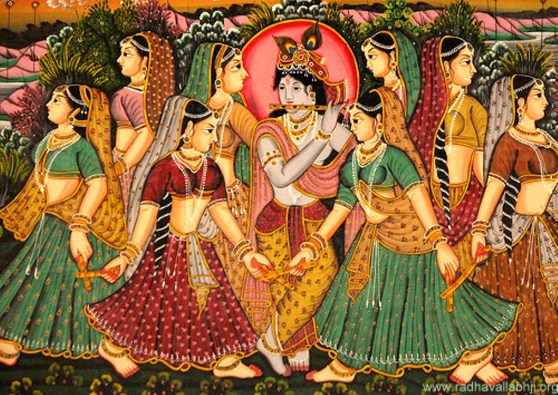
Krsna was very pleased with the atmosphere of the forest where flowers bloomed and bees and drones hummed very jubilantly. While the birds, trees and branches were all looking very happy, Krsna, tending the cows, accompanied by Sri Balarama and the cowherd boys, began to vibrate His transcendental flute. After hearing the vibration of the flute of Krsna, the gopis in Vrndavana remembered Him and began to talk amongst themselves about how nicely Krsna was playing His flute. When the gopis were describing the sweet vibration of Krsna’s flute, they also remembered their pastimes with Him; thus their minds became disturbed, and they were unable to describe completely the beautiful vibrations. While discussing the transcendental vibration, they remembered also how Krsna dressed, decorated with a peacock feather on His head, just like a dancing actor, and with blue flowers pushed over His ear. His garment glowed yellow-gold, and He was garlanded with a vaijayanti necklace. Dressed in such an attractive way, Krsna filled up the holes of His flute with the nectar emanating from His lips. So they remembered Him, entering the forest of Vrndavana, which is always glorified by the footprints of Krsna and His companions.
Krsna was very expert in playing the flute, and the gopis were captivated by the sound vibration, which was not only attractive to them, but to all living creatures who heard it. One of the gopis told her friends, “The highest perfection of the eyes is to see Krsna and Balarama entering the forest and playing Their flutes and tending the cows with Their friends.”
Persons who are constantly engaged in the transcendental meditation of seeing Krsna, internally and externally, by thinking of Him playing the flute and entering the Vrndavana forest, have really attained the perfection of samadhi. Samadhi (trance) means absorption of all the activities of the senses on a particular object, and the gopis indicate that the pastimes of Krsna are the perfection of all meditation and samadhi. It is also confirmed in the Bhagavad-gita that anyone who is always absorbed in the thought of Krsna is the topmost of all yogis.
Another gopi expressed her opinion that Krsna and Balarama, while tending the cows, appeared just like actors going to play on a dramatic stage. Krsna was dressed in glowing garments of yellow, Balarama in blue, and They held new twigs of mango tree, peacock feathers, and bunches of flowers in Their hands. Dressed with garlands of lotus flowers, They were sometimes singing very sweetly among Their friends. One gopi told her friend, “How is it Krsna and Balarama are looking so beautiful?” Another gopi said, “My dear friend, we cannot even think of His bamboo flute–what sort of pious activities did it execute so that it is now enjoying the nectar of the lips of Krsna?” Krsna sometimes kisses the gopis; therefore the transcendental nectar of His lips is available only to them, and His lips are considered their property. Therefore the gopis asked: “How is it possible that the flute, which is nothing but a bamboo rod, is always engaged in enjoying the nectar from Krsna’s lips? Because the flute is engaged in the service of the Supreme Lord, the mother and the father of the flute must be happy.”
The lakes and the rivers are considered to be the mothers of the trees because the trees live simply by drinking water. So the waters of the lakes and rivers of Vrndavana were full of happy lotus flowers because the waters were thinking, “How is it our son, the bamboo rod, is enjoying the nectar of Krsna’s lips?” The bamboo trees standing by the banks of the rivers and the lakes were also happy to see their descendant so engaged in the service of the Lord, just as persons who are advanced in knowledge take pleasure to see their descendants engage in the service of the Lord. The trees were overwhelmed with joy and were incessantly yielding honey, which flowed from the beehives hanging on the branches.
Sometimes the gopis spoke thus to their friends about Krsna: “Dear friends, our Vrndavana is proclaiming the glories of this entire earth because this planet is glorified by the lotus footprints of the son of Devaki. Besides that, when Govinda plays His flute, the peacocks immediately become mad. When all the animals and trees and plants, either on the top of Govardhana Hill or in the valley, see the dancing of the peacock, they all stand still and listen to the transcendental sound of the flute with great attention. We think that this boon is not possible or available on any other planet.” Although the gopis were village cowherd women and girls, they had knowledge of Krsna. Similarly, one can learn the highest truths simply by hearing the Vedas from authoritative sources.
Another gopi said, “My dear friends, just see the deer! Although they are dumb animals, they have approached the son of Maharaja Nanda, Krsna. Not only are they attracted by the dress of Krsna and Balarama, but as soon as they hear the playing of the flute, the deer, along with their husbands, offer respectful obeisances unto the Lord by looking at Him with great affection.” The gopis were envious of the deer because the deer were able to offer their service to Krsna along with their husbands. The gopis thought themselves not so fortunate because whenever they wanted to go to Krsna, their husbands were not very happy.
Another gopi said, “My dear friends, Krsna is so nicely dressed that He appears to be the impetus to various kinds of ceremonies held by the womenfolk. Even the wives of the denizens of heaven become attracted after hearing the transcendental sound of His flute. Although they are traveling in the air in their airplanes, enjoying the company of their husbands, on hearing the sound of Krsna’s flute, they immediately become perturbed. Their hair is loosened and their tight dresses are slackened.” This means that the transcendental sound of the flute of Krsna extended to all corners of the universe. Also, it is significant that the gopis knew about the different kinds of airplanes flying in the sky.
Another gopi said to her friends, “My dear friends, the cows are also charmed as soon as they hear the transcendental sound of the flute of Krsna. It sounds to them like the pouring of nectar, and they immediately spread their long ears just to catch the liquid nectar of the flute. As for the calves, they are seen with the nipples of their mothers pressed in their mouths, but they cannot suck the milk. They remain struck with devotion, and tears glide down their eyes, illustrating vividly how they are embracing Krsna heart to heart.” These phenomena indicate that even the cows and calves in Vrndavana knew how to cry for Krsna and embrace Him heart to heart. Actually, Krsna conscious affection can be culminated in shedding tears from the eyes.
A younger gopi told her mother, “My dear mother, the birds, who are all looking at Krsna playing on His flute, are sitting very attentively on the branches and twigs of different trees. From their features it appears that they have forgotten everything and are engaged only in hearing Krsna’s flute. This proves that they are not ordinary birds; they are great sages and devotees, and just to hear Krsna’s flute they have appeared in Vrndavana forest as birds.” Great sages and scholars are interested in Vedic knowledge, but the essence of Vedic knowledge is stated in the Bhagavad-gita: vedais ca sarvair aham eva vedyah. Through the knowledge of the Vedas, Krsna has to be understood. From the behavior of these birds, it appeared that they were great scholars in Vedic knowledge and that they took to Krsna’s transcendental vibration and rejected all branches of Vedic knowledge. Even the river Yamuna, being desirous to embrace the lotus feet of Krsna after hearing the transcendental vibration of His flute, broke her fierce waves to flow very nicely with lotus flowers in her hands, just to present flowers to Mukunda with deep feeling.
The scorching heat of the autumn sunshine was sometimes intolerable, and therefore the clouds in the sky appeared in sympathy above Krsna and Balarama and Their boy friends while They engaged in blowing Their flutes. The clouds served as a soothing umbrella over Their heads just to make friendship with Krsna. The wanton aborigine girls also became fully satisfied when they smeared their faces and breasts with the dust of Vrndavana, which was reddish from the touch of Krsna’s lotus feet. The aborigine girls had very full breasts, and they were also very lusty, but when their lovers felt their breasts, they were not very satisfied. When they came out into the midst of the forest, they saw that while Krsna was walking, some of the leaves and creepers of Vrndavana turned reddish from the kunkuma powder which fell from His lotus feet. His lotus feet were held by the gopis on their breasts, which were also smeared with kunkuma powder, but when Krsna travelled in the Vrndavana forest with Balarama and His boy friends, the reddish powder fell on the ground of the Vrndavana forest. So the lusty aborigine girls, while looking toward Krsna playing His flute, saw the reddish kunkuma on the ground and immediately took it and smeared it over their faces and breasts. In this way they became fully satisfied, although they were not satisfied when their lovers touched their breasts. All material lusty desires can be immediately satisfied if one comes in contact with Krsna consciousness.
Another gopi began to praise the unique position of Govardhana Hill in this way: “How fortunate is this Govardhana Hill, for it is enjoying the association of Lord Krsna and Balarama who are accustomed to walk on it. Thus Govardhana is always in touch with the lotus feet of the Lord. And because Govardhana Hill is so obliged to Lord Krsna and Balarama, it is supplying different kinds of fruits, roots and herbs, as well as very pleasing crystal water from its lakes, in presentation to the Lord.” The best presentation offered by Govardhana Hill, however, was newly grown grass for the cows and calves. Govardhana Hill knew how to please the Lord by pleasing His most beloved associates, the cows and the cowherd boys.”
Another gopi said that everything appeared wonderful when Krsna and Balarama travelled in the forest of Vrndavana playing Their flutes and making intimate friendship with all kinds of moving and nonmoving living creatures. When Krsna and Balarama played on Their transcendental flutes, the moving creatures become stunned and stopped their activities, and the nonmoving living creatures, like trees and plants, begin to shiver with ecstasy.
Krsna and Balarama carried binding ropes on Their shoulders and in Their hands, just like ordinary cowherd boys. While milking the cows, the boys bound the hind legs with a small rope. This rope almost always hung from the shoulders of the boys, and it was not absent on the shoulders of Krsna and Balarama. In spite of Their being the Supreme Personality of Godhead, They played exactly like cowherd boys, and therefore everything became wonderful and attractive.
While Krsna was engaged in tending the cows in the forest of Vrndavana or on Govardhana Hill, the gopis in the village were always absorbed in thinking of Him and discussing His different pastimes. This is the perfect example of Krsna consciousness: to somehow or other remain always engrossed in thoughts of Krsna. The vivid example is always present in the behavior of the gopis; therefore Lord Caitanya declared that no one can worship the Supreme Lord by any method which is better than the method of the gopis. The gopis were not born in very high brahmana or ksatriya families; they were born in the families of vaisyas, and not in big mercantile communities but in the families of cowherd men. They were not very well educated, although they heard all sorts of knowledge from the brahmanas, the authorities of Vedic knowledge. The gopis’ only purpose was to remain always absorbed in thoughts of Krsna.
“Jai Shri RadheKrishna”



 Self Discovery
You must be logged in to post a comment.