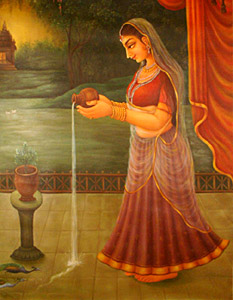
The Tulasi tree is a most important plant, and is often seen at numerous Hindu temples, especially those dedicated to Vishnu and Krishna. At such temples you are likely to find one or more in the courtyard wherein pilgrims circumambulate it, water it, or even offer prayers to it. Some temples will even have Tulasi groves, wherein you will see numerous Tulasi plants growing in a garden. Some temples will even have a special greenhouse just for taking care of Tulasi plants. At such temples, they may even prepare large garlands of Tulasi leaves and manjaris (the ends of the branches) for the deity of Lord Krishna to wear. It is said that Tulasi will not grow well where there is no devotion to the Lord. In fact, how well Tulasi grows is said to be like a barometer that indicates how high the devotional attitude is of the devotee community around the temple.
Vaishnava devotees also use the wood to make neck beads and wear two or three strands of them around their necks signifying their devotion to the Lord. They also make their japa mala or chanting beads from wood of the Tulasi tree as well. Tulasi is considered to be a pure devotee of the Lord who has taken the form of a tree. Therefore she is given the utmost respect. This is also why many devotees and Hindus in general also grow Tulasi in their homes. In this way, the Tulasi plant plays an important part in the spiritual life of many devotees. So what is the significance, history and legends behind this little tree?
To begin with, the Basil plant (Ocimum sanctum) is commonly called Tulasi (pronounced tulsi). In some accounts of the Puranic story of the Churning of the Ocean (samudramathana), the Tulasi is added to the list of articles which emerged from it, and is sacred to Krishna (according to Wilson’s VishnuPurana p, 67. n.8). It is also sacred to his Lord Vishnu’s consort Laksmi, and hence it is itself an object of worship.
The Tulasi plant also possesses curative properties and is said to be an antidote to snake-venom. It destroys mosquitoes and other pests and purifies the air. It even is said to ward off the messengers of Yama, the ruler of the dead, who will not enter a house containing a sprig of Tulasi. This is also one of the reasons why devotees wear the Tulasi as neck beads. When death occurs, the funeral pyre should be constructed of Tulasi, palasha, and sandal-wood.
There is further Puranic background for Tulasi attaining this spiritualistic importance. In fact it is Mahalaksmi, wife of Visnu, who had herself taken the form of Tulasi. There is a story about it in the Devi Bhagavata. The Puranic Encyclopedia summarizes these legends.
1) The curse of Sarasvati. Sarasvati, Ganga and Laksmi were all, in the beginning, wives of MahaVishnu. The Lord loved all the three equally. One day all the four were sitting together when Ganga sent lustful glances at Vishnu which was immediately noticed by both Sarasvati and Laksmi. Sarasvaii got angry and rising up caught hold of the hair of Ganga and dragged her to the ground. Laksmi then caught hold of Sarasvati to prevent farther assault but Sarasvati then poured all her rage on Laksmi and cursed her to be born as a plant on earth. Gangadevi could not bear this and she cursed Sarasvati to be born as a river on earth. Sarasvati retorted with a curse that Ganga also would be born as a river. When the whole tumult was over Vishnu called Laksmi to his side and said, “Oh Devi, do not worry. Things have happened as predestined. You go and be born as the daughter of Dharma-dhvaja and grow up there. From there by divine grace you will be transformed into a plant sacred enough to make all the three worlds pure. That plant will be named Tulasi. When you will be thus living as Tulasi, a demon named Sankhacuda with part of my virile strength will be born and he will marry you. Then you can come back to me. The holy river Padmavati will also be another form of your spirit.”
2) The story of Dharmadhvaja. Who was this Dharma-dhvaja to whom was born Mahalaksmi as a daughter? In times of old there was a Manu called Daksasavarni who was extremely virtuous and a part of Vishnu. Descending from Daksasavarni were Brahmasavarni-Dharmasavarni-Rudrasavarni-Devasavarni-Indrasavarni Vrsadhvaja. This last named was a great devotee of Shiva and because of his great affection for this devotee Shiva lived a whole period of a devayuga in the ashrama of Vrsadhvaja. King Vrsadhvaja by an edict prohibited the worship of any other deity than Shiva in his country. Even the worship of Mahalaksmi ordained by the Vedas during the month of Bhadra (September) became extinct. All Yagyas and worship of Vishnu came to a stop.Surya (Sun-god) got angry al this belittling of other gods than Shiva and cursed the King Vrsadhvaja that he would cease to be prosperous. Shiva did not like it and he went to punish Surya holding his trident in his hand. Surya was frightened and he approached his father Kasyapa. Kasyapa and Surya went to Brahma and acquainted him with all details. Brahma also was helpless in the matter and so all the three of them went to Mahavishnu. They prostrated before Vishnu and told him all. At that time Shiva also came there. Addressing all of them, Vishnu said “Oh. Devas, wilhinthis half an hour twenty-one yugas have passed by on the earth. He about whom you have come to speak to me is dead and gone. Even his son Rathadhvaja is dead. The latter has two sons named Dharmadhvaja and Kusadhvaja. They are dull and splendorless now because of the curse of Surya and are now worshipping Laksmi.” Saying thus Vishnu disappeared.
3) Birth of Tulasi. Dharmadhvaja and Kusadhvaja did penance to propitiate Mahalaksmi. Kusadhvaja had a wife named Malavati. She bore a daughter named Vedavati. Sita, wife of SriRama, was a rebirth of this Vedavati.
King Dharmadhvaja had a wife named Madhavi. Mahalaksmi entered her womb as an embryo and after a hundred years Madhavi gave birth to a daughter. Even at the time of birth the child looked like a matured girl and was extremely pretty. She was therefore, called Tulasi, meaning matchless. (Tula= match). This Tulasi, abandoning all worldly pleasures, went toBadarikashrama and started doing penance there with the prayer that MahaVishnu should become her husband. She did penance for twenty-four thousand years sitting amidst fire in the hot season and sitting in water in the cold season and taking only fruits and water as food. Then she did penance for another thirty thousand years eating leaves only, another forty thousand years taking air only as food and another ten thousand years without any food. At this stage Brahma appeared and asked her the object of her penance. She replied she wanted MahaVishnu to be her husband. Hearing this Brahma said thus: “Devi, you know the cowboy Sudama born of a part of Sri Krishna. That brilliant cowboy has now been born on earth, due to a curse of Radha, as a demon named Sankhachuda. He is matchlessly eminent and has once fallen in love with you seeing you at Goloka. You will become his wife and later you can become the wife of Narayana. At that time a part of your divine body will remain on earth as a plant named Tulasi. Tulasi will become the most sacred of all plants, dear to Vishnu, and all worship without using Tulasi leaves would be ineffective.”
4) Marriage of Tulasi. Due to a curse of Radha, Sudama, the cowboy, was born on earth as a demon named Sankhachuda. He did penance sitting at Badarikashrama and obtainedVishnukavaca. Another object of his was to marry Tulasi. He obtained a boon from Brahma that his death would occur only when the Vishnu Kavaca was removed from his body and the chastity of his wife was lost. At that time Sankhachuda and Tulasi met each other in the forests and were married. Sankhachuda, brilliant and majestic, went about with Tulasi in amorous sports creating jealousy even among the devas. His arrogance gave innumerable troubles to the devas and they along with Brahma and Shiva approached MahaVishnu for a remedy. Vishnu then sent Shiva with his spike to kill Sankhachuda and he himself started to molest the chastity of his wife Tulasi. Sankhachuda took leave of Tulasi to go and fight with Shiva. When Tulasi was thus left alone,MahaVisnu in the form of Sankhachuda approached Tulasi and after some preliminary talks entered into sexual acts. Tulasi found some difference in the usual affairs and suspecting foul play jumped up to curse the impostor. At once MahaVishnu appeared in his true form and said “You have been doing penance for a lone time to get me as your husband. Your husband Sankhachudawas the chief of my Parsadas, Sudarna. It is time for him to go back to [the spiritual abode of] Goloka getting himself released from the curse. By this time Shiva would have killed him and he would have gone to Goloka as Sudama. You can now abandon your body and come with me to Vaikuntha to enjoy life as my wife.
Your body will decay and become a holy river named Gandaki; your hair will become the Tulasi plant, the leaves of which will be held sacred in all the three worlds.”
Tulasi then changed herself into the form of Laksmi and went to Vaikuntha with MahaVishnu. (9th Skandha, Devi Bhagavata).
5) The greatness of Tulasi. Everything of the Tulasi plant, leaves, flowers, fruits, roots, twigs, skin and even the soil around is holy. The soul of a dead one whose dead body is cremated using Tulasi twigs for firewood would attain a permanent place in Vishnuloha [the spiritual abode]. Even great sinners would be absolved of their sins if their dead bodies are cremated with Tulasitwigs [or are wearing Tulasi beads]. If at the time of death one thinks of God and mutters His name and if his dead body is later cremated with Tulasi twigs, he would have no rebirths. Even he who has done a crore of sins would attain moksha [liberation] if at the time of cremating his dead body a piece of Tulasi twig is placed at the bottom of the funeral pyre. Just as all waters become pure by the union with Ganga water, all firewood is made pure by the addition of a small piece of Tulasi twig. If the dead body of one is cremated using Tulasi twigs alone, one’s sins for a crore of Kalpayears [1 kalpa is 4,800,000 years] would be washed away. Yamadutas [the soldiers of Lord Yama, the king of death] would keep away from one whose dead body is cremated with Tulasi twigs and servants of Vishnu would come near. If a light is burnt for Vishnu with a Tulasi stick it would be equal to burning several lakhs of lights for Vishnu. If one makes the Tulasi leaves into a paste and smears it on one’s body and then worships Vishnu for one day, one would be getting the benefit of a hundred ordinary worships and also the benefit of doing a hundred godanas (gifts of cows). (Chapter 24, Padma Purana)
It is also accepted that if ever a person leaves his or her body while wearing Tulasi beads, either around the neck or elsewhere, it creates the same affect as described above as having one’s cremation fire burnt using Tulasi.
“Shri Harivansh Shri RadhaVallabh”

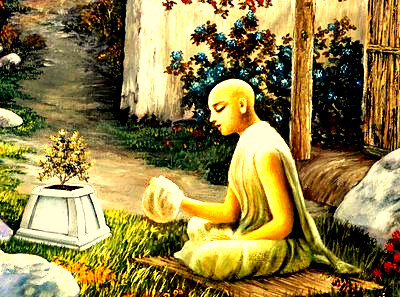 Bhakti yoga practice includes chanting the Hare Krishna mantra softly to oneself. This is called japa.
 Self Discovery
You must be logged in to post a comment.